Researchers are hoping the study of individual “fingerprints” of grid-forming inverters as they respond to faults in the network will provide enough clues on their ability to interact with network protection systems and open the path for a fully digital grid.
The Australian Renewable Energy Agency (ARENA) is putting $6.52 million into a $13 million project at the University of New South Wales (UNSW), and as the market operator prepares a real world trial at a scale never seen in grids of this scale.
Mark Twidell, former Tesla Australia director and now an industry professor at UNSW, says the 3.5 year university project will trace the waveforms and frequencies of each brand of inverter as they respond to fault currents.
It will then test those fingerprints individually, and later together, against the different protection systems built into the grid.
“The aim of the project is not to prove what grid forming inverters can do. The aim of the project is really to provide some objective evidence about how grid-forming inverters and protection systems interact,” he told Renew Economy.
“When you’re monitoring the grid and see a change in waveform… it may be that the protection system [will be able to] identify the shape of the fault current or the change in frequency… rather than the size.”
The issue – fault current – is a deeply technical problem of how to notice the unusually high spike in currents when a circuit fails. It’s a little-known part of making sure there is enough system strength in the grid to prevent, at worst, the kind of blackouts seen in South Australia in 2016 when wind blew over transmission lines, and Spain last year.
The old electricity system, built around a small number of very large coal power stations, recognises a fault by a sudden surge in current.
But grid-forming inverters automatically minimise that spike to protect equipment, which makes it harder for the old systems to detect a problem. Adding to the challenge is that each manufacturer has built their own bespoke software to manage the issue, so each response will look slightly different.
Phase one of the UNSW project will be to trace and record the different responses of each manufacturer’s inverter as it reacts to a fault.
Phase two will be to test them in combination, to see if the protective relays already in place in the grid can cope with detecting multiple different fingerprints.
Twidell says the results will tell them whether the system can cope and if so, what needs to be tweaked. The worst case scenario would be that grid protective systems would need to be completely redesigned – a decades-long proposition.
Some industry insiders are saying fault current could be the only thing standing in the way of a fully digital grid, and ending the need for spinning machines, and it’s a problem that has many eyes on it.
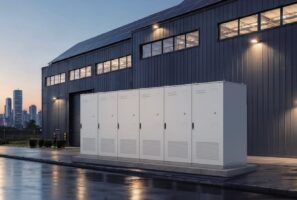
The Australian Energy Market Operator (AEMO) is running a similar real-world trial using a grid with a load of more than 100 megawatts to test manufacturer claims that grid-forming batteries can pass on high enough fault current signals to trigger the protection systems.
It’s already supporting grid-forming batteries in the grid, paying Sostoneo for the ability of its Koorangie battery in Victoria to maintain grid voltage and frequency.
Last year, for example, Tesla released a white paper saying its grid forming battery inverters – pioneered in Australia at its original Hornsdale battery – are a realistic alternative to traditional rotating machinery and provide “protection grade fault current”.
But part of AEMO’s task is to define what “protection grade fault current” is.
The market operator says that for its own trial, which was due to start in July, its definition covers magnitude, duration and waveform characteristics.
The ARENA-baked university study also wants to weigh in on what a definition might look like, and provide manufacturers with guidance on controller design and protection system adaptation that might work in the Australian market.
With the likes of Transgrid, the NSW transmission owner and operator, already swapping out synchronous condensers for grid-forming batteries as they become too expensive and too hard to get, working out how they will actually perform when it comes to the obscure-but-critical technical details cannot be done fast enough.
To join more than 29,000 others and get the latest clean energy news delivered straight to your inbox, for free, click here to subscribe to our free daily newsletter.