A landmark battery that is the second in Australia contracted to deliver grid-stabilising services to the grid is now fully operational, marking the start of a potentially radical change in the way the country’s grid could be managed.
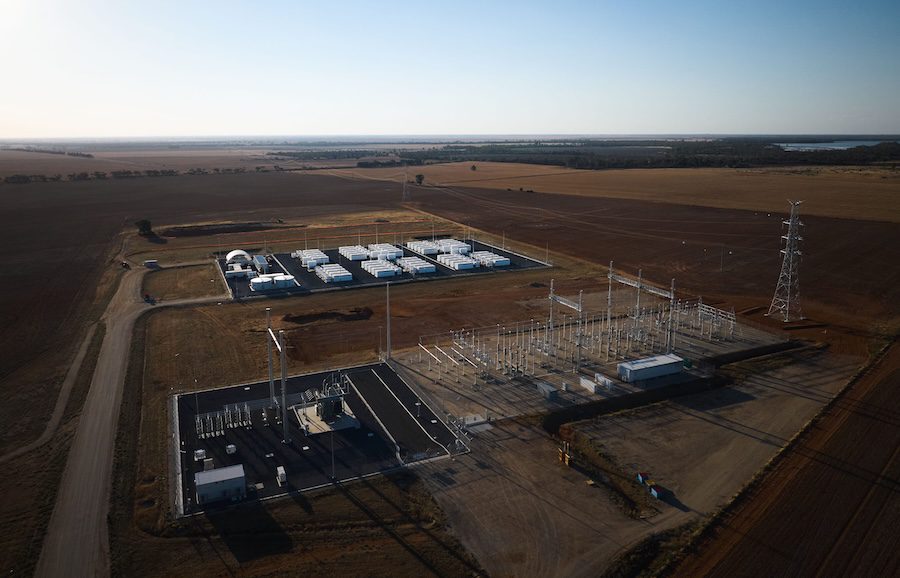
The 185 megawatt (MW) / 370MWh Koorangie battery energy storage system (BESS) with grid-forming inverters, has been developed and built by Edify Energy near the town of Kerang in north-west Victoria, and is now importing and exporting electricity into the grid after soft-launching in February.
But more importantly it is providing – and new owner Sostoneo is being paid for – its ability to maintain grid voltage and frequency.
This is thanks to a 20-year deal that Edify signed in 2022 with the Australian Energy Market Operator (AEMO) to put the grid-forming inverters that it was building into the system to work stabilising the shaky northern Victoria grid.
The value of the contract, AEMO’s second ever for a grid-forming BESS, is $119 million.
The first has been signed three months earlier for the 150MW / 300MWh Riverine BESS in New South Wales, another Edify development which also had offtake agreements with Shell Energy and also with EnergyAustralia.
“[The Koorangie BESS is] a powerful example of how advanced grid forming inverter and battery storage technologies can combine to solve some of the most complex challenges in Australia’s energy transition,” said Edify chair John Cole in a statement today.
“This system seamlessly delivers critical system strength services to AEMO while dispatching clean, green electrons to the grid.”
The deal to bring about the Koorangie BESS as a grid stabilising force is part of a $480 million program to do just that, said Victorian energy minister Lily D’Ambrosio today.
“We are proud of our role in this project, securing the system strength component of this advanced storage system, which will allow more renewables to connect to the grid in Victoria’s North West,” she said in a statement.
How it’ll work
The deal is the BESS will provide inertia support services to AEMO, and – because of the flexibility of the technology – it won’t affect the ability of the battery to deliver a separate 15-year off-take deal with with Shell.
The way it can fulfil both contracts is by engaging what’s called virtual machine mode (VMM).
VMM is a grid forming component of the inverter controller. It imitates the super-quick response time of a synchronous generator by using an algorithm to mimic the voltage behaviour the spinning machine would ordinarily deliver, an Edify spokesperson told Renew Economy.
It means that ripples in voltage and frequency caused by intermittent renewable energy or other sources can be smoothed out.
Importantly, the VMM function operates in parallel to the charging and discharging operations of the battery which means it can fulfil the contract with Shell and participate in FCAS markets.
Solving a very painful problem
The West Murray region had long been a point of despair, for both renewable energy developers who’d bought in only to see their projects heavily curtailed, and for AEMO.
The diamond-shaped region was dubbed the “rhombus of regret” because of the massive congestion problems and delays that affected many new wind and solar projects.
Edify says the Koorangie BESS will open up capacity for another 300 MW of electricity to be sent into the grid.
The concept of using batteries to shore up weaker sections of the grid is now a core part of AEMO’s latest engineering roadmap, nominated as it has been as one of the 29 priority actions for the coming year.
But in 2022, the BESS-plus-inverter technology was competing against offers from another traditional tech, “synchronous condensers”, which mimic the system strength services provided by the spinning machines of coal and gas generators, but without burning any fuel.
The pitch that BESS developers are making is that while syncons can only stabilise, batteries can also perform energy arbitrage, frequency control and inertia services at the same time.
But AEMO is still working out the kinks of how to fit lots of grid-forming batteries into the grid.
Last year the grid operator finished a study that said more investigation is needed into whether the synthetic inertia of grid forming BESSs can be easily swapped in or out for synchronous inertia.
And a new study in the coming 12 months, named in the most recent Engineering Roadmap, will look at how to use this technology to provide minimum levels of system strength.
In the roadmap, AEMO said one issue with BESSs is the fact the grid-forming software is not standardised, but must be configured depending on location and technology.
Edify, on the other hand, sees this as a feature not a bug.
“The fast and flexible VMM controls are highly configurable allowing them to be tuned to particular needs of the network in any location and they can also evolve over time with the changing network,” the Edify spokesperson told Renew Economy.
The Koorangie BESS uses 100 Tesla Megapacks and has a 15-year offtake agreement with Shell, and is next to Edify Energy’s existing 50 MW Gannawarra solar farm and the neighbouring 25MW / 50MWh battery.
The Koorangie battery is now owned by Italian energy infrastructure investor Sostoneo – its first big Australian investment.
The Koorrangie BESS is Edify’s 12 utility-scale project.
- * This article has been updated to show the Riverina BESS was the first to secure a system security agreement with AEMO — three months before the Koorangie deal was signed.