The government-owned Snowy Hydro has admitted that costs for its huge and controversial pumped hydro project are expected to bow out to up to $25 billion, and faces yet more delays that will push back its full commissioning another year to the end of 2029.
The long-awaited cost reassessment for Snowy 2.0, more than a year in the making, was conducted by principal contractors, Future Generation Joint Venture (FGJV).
It lifts the $12 billion estimate announced at the 2023 “reset” to a “target cost” of $22.2 billion, with “an allowance for a cost scenario of $25 billion”, Snowy Hydro said in a statement released late on Thursday night.
“Obviously, [the cost increase is] very disappointing,” Snowy’s chief executive, Dennis Barnes, told Renew Economy in an interview.
“But since the 2023 reset, where the project was still suffering from design immaturity, we have now got our hands around the number of people over what period we need to build this job,” Barnes said. “We’ve come out with the new target, and the slightly delayed schedule today.”
Snowy will provide more details about the project’s estimated net benefit when it releases its annual report on Friday. “From a Snowy Hydro perspective, it’s an asset that has value and [there’s] no need for a write-down
Barnes said.
The $22.2 billion figure is considered “cash”, he said, rather than a future discounted number.
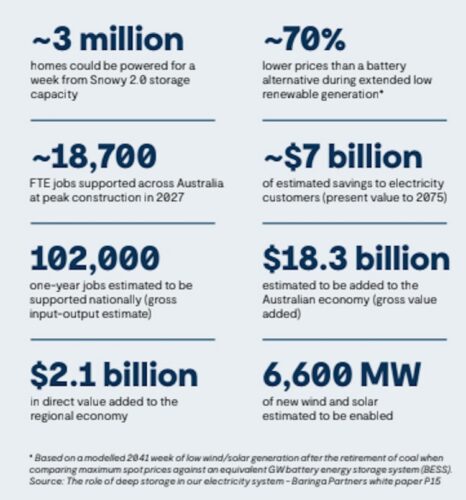
Snowy also included analysis by consultant’s GHD that showed “substantial economic benefit”, including $18 billion in gross value added to the Australian economy. Wages and salaries come in at $9 billion. In addition, savings to electricity customers were estimated at about $7 billion in present-value terms, out to 2075.
“One modelled scenario is a winter week with little wind and solar, after coal has left the NSW market,” the analysis by GUD stated.”In that week, Snowy 2.0 is estimated to deliver peak wholesale prices almost 70% lower than an equivalent battery solution.”
The latest blowout in costs and another delay will be scrutinised closely by critics, including from present Coalition leader Angus Taylor, who signed off on the project when he was energy minister in 2019.
When first floated, by Prime Minister Malcolm Turnbull in March 2017, a “back of the envelope” calculation put the bill at just $2 billion, with the 2.2 gigawatts of generation capacity with 350GW-hours of storage supposed to be operational by 2021.
The first formal contract put the cost at around $6 billion. And the latest revised costs exclude borrowing costs, the share of extra transmission needed to connect Snowy 2.0 to the grid, and the environmental damage done by the construction sites within NSW’s largest national park, Kosciuszko.
GUD also placed caveats on its estimates, stating “[t]he findings in this report should not be read as a formal economic appraisal, cost-benefit analysis or investment evaluation of Snowy 2.0”.
The economic impact figures were “gross input-output estimates” that did not account for displacement of activity from other projects or the opportunity cost of the investment, it said.
The figures, themselves, depended on “assumptions about project completion, commissioning (expected late 2029), transmission augmentation, market conditions and government policy, all of which may change. Actual outcomes may differ materially from those estimated”, GUD said.
One area where policy might change could come after next month’s Victorian state elections.
The Liberals-led Opposition has vowed to scrap the VNI-West transmission line which is the main conduit for Snowy 2.0 power supplies south, a policy change that would “guarantee a massive increase” in Victorians’ power bills, former Labor energy minister Lily D’Ambrosio told Renew Economy last month.
Snowy’s Barnes agreed that VNI-West’s “cancelation is not good for consumers”.
“Clearly, we expect to be able to access Victoria with Snowy 2.0 through VNI-West, but you know NSW is a big state,” Barnes said.
The scrapping would probably have a “detrimental impact on Snowy 2.0’s economics, but we think the market will adjust such that Snowy 2.0 still gets to market”, he said, adding, “preferably VNI West is not cancelled”.
Another unresolved matter is how the additional expense will be funded.
When the cost rose to $12 billion, about a third of the funds, or $4b, came from a Commonwealth investment that Snowy Hydro didn’t need to repay. The rest came from government and bank loans that as a profit-making business, Snowy will repay with interest.
“They’ve received our advice recently, so they’ll spend the coming months dealing with that,” Barnes said. “I imagine they will think about it [in] the same way”, he said, adding Snowy will also be required to borrow money on commercial terms and repay it.
It’s understand the revised cost – and further federal injection of funds – are yet to go through the full cabinet approval process.
In a joint statement, climate change and energy minister Chris Bowen and finance minister Katy Gallagher said, “the government remains transparent about the pressures facing this project and securing the best possible outcome for taxpayers, energy consumers and the grid.
“The former Coalition government left behind a project facing major delays, rising costs and serious delivery risks,” the two ministers said. “The former minister for energy, Angus Taylor, was aware of Snowy 2.0 cost blowouts before the 2022 election, but chose not to disclose the situation to the Australian people.”
Renew Economy will seek comment from the Opposition once the embargo has lifted.
“This revised cost and delivery schedule has been driven by cost pressures in the construction sector and the significant geological challenges of the project, exacerbated by design immaturity when it was first announced by the former government,” the ministers said.
Despite the latest cost blowout, the government remained committed to the project. “Once completed, Snowy 2.0 will be an incredible national asset, supporting Australia’s energy security, price stability and the transition to renewable energy,” the ministers said.
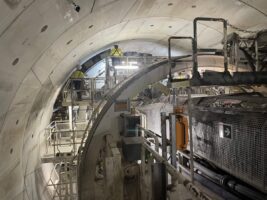
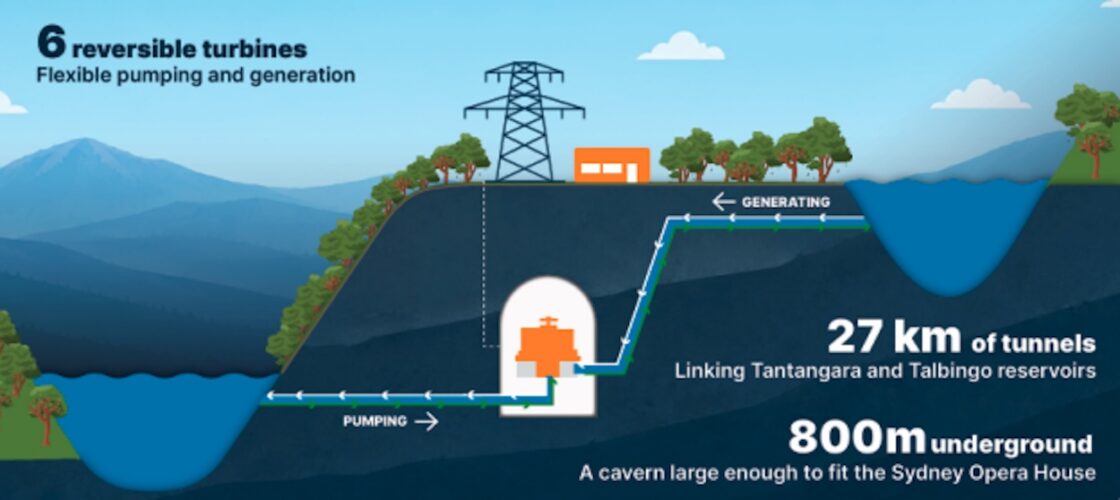
Barnes confirmed that one aspect of the “design immaturity” was the limited initial survey work, as highlighted by Renew Economy on Wednesday. The surveyors drilled Just 22 test cores in the mapping for the 16-km head race tunnel, the longest among the total of 33kms of tunnels in the complex.
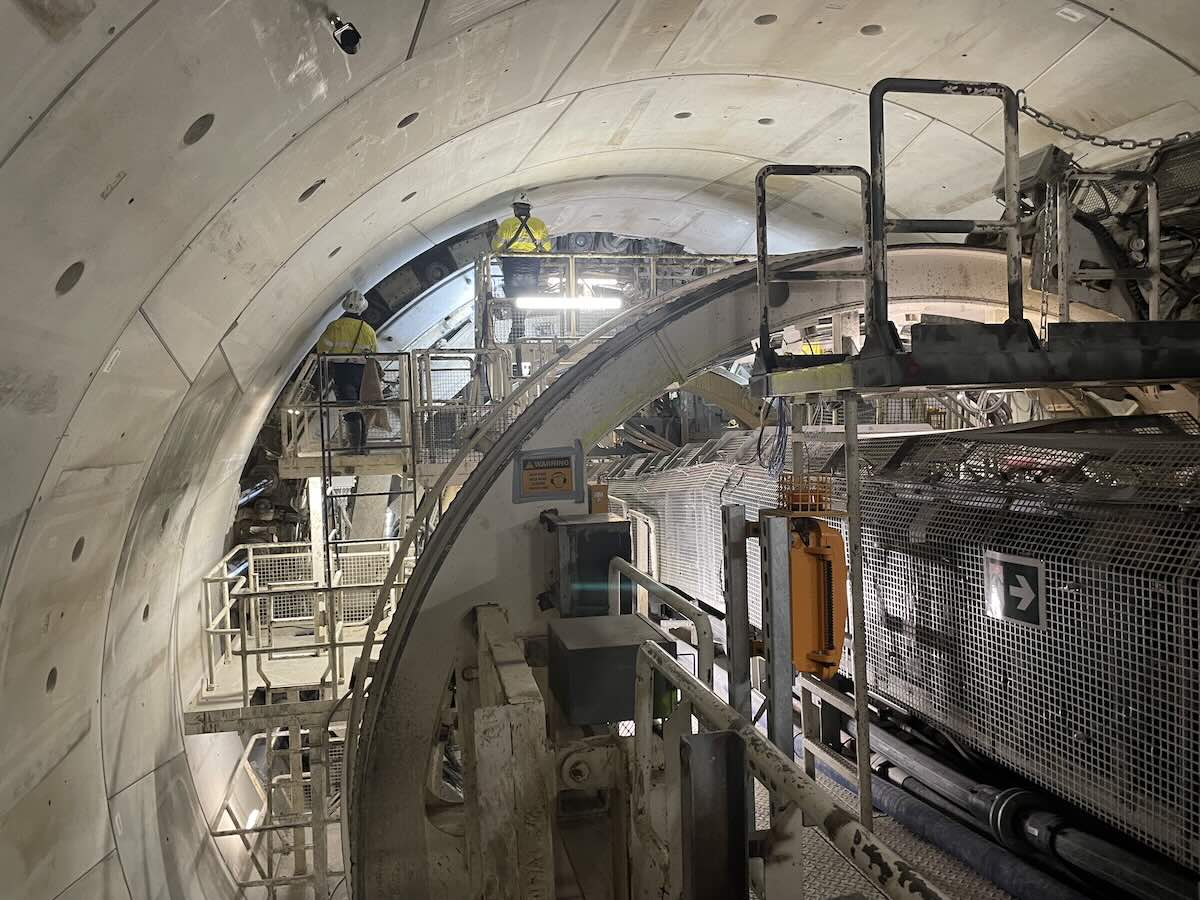
“That was the reason for [tunnel boring machine] four, [dubbed] Monica,” Barnes said. “The initial design was for [TBM] Florence to go through this long plain fault zone.”
By 2024, though, it became clear that Florence would be able get through the underground fault that runs between NSW and Victoria, and included about 1.3km of main tunnel.
“You know, they’re not cheap, and we’ve launched Monica now, and we have a high degree of confidence that she’ll get through the long plain fault zone,” he said.
The issue underscored why Snowy Hydro had to renegotiate its original “fixed-price contracts”. The new “cost-plus” arrangement allowed Monica to be brought on.
“I can guarantee you, Florence would have got to that bit of geology, got stuck, and we would’ve had a massive claim and years of delays,” Barnes said. “So there’s no doubt that the extent of geological surveying has an impact.”
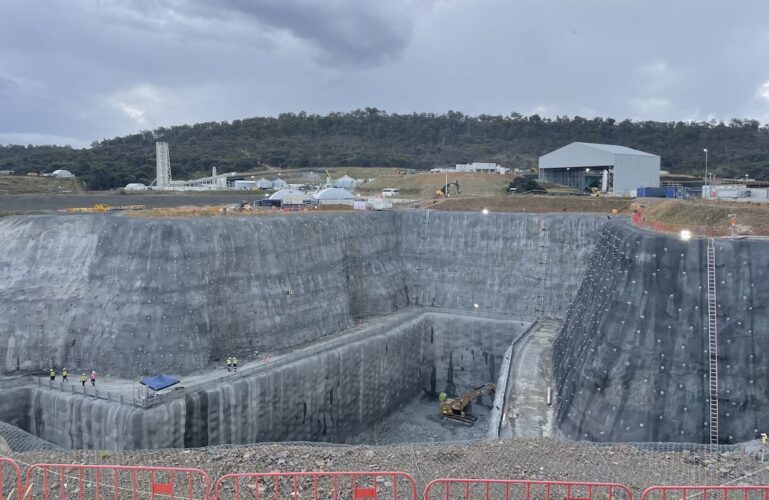
Florence, as it happens, resumed work just on Tuesday this week. It had been scheduled for 90 days of maintenance, which ended up taking 97 days, he said.
“We’re now much further through the project than at the 2023 reset, meaning we’ve learned more and more risk is behind us,” Barnes said, in a separate statement.
“At the reset, only 44% of the construction design had been completed, now it’s 96%.”
Florence was half though its 15-km tunnelling journey, 65% of the overall tunnelling work was down, and 95% of the drill and blast tunnelling had been completed, Snowy said.
Snowy, though, slated some of the blame for the delays and overspend home to its main contractor, FGJV, owned by Italian conglomerate, Webuild.
“Construction complexities contributing to principal contractor FGJV not meeting productivity targets,” and “cost and planning underperformance by FGJV leading to previous underestimating of the delivery scope”, were among the “primary reasons for the increased project cost”, Snowy said.
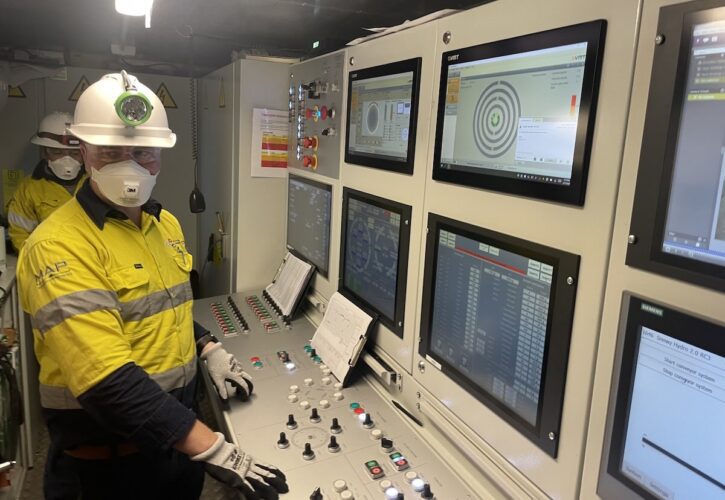
Remedial steps Snowy had already taken to improve the project’s delivery and cost performance included directing FGJV to establish a project control office with enhanced data and analytics to lift productivity and identify emerging risks early that is already operational.
It was also embedding independent infrastructure delivery and cost experts and was establishing a new board oversight committee “including external mega-project advisors to monitor and take action on progress and risk”. Snowy said.
It is understood the federal government will set additional requirements in part to act on the recommendations of an audit office investigation into the project.
Barnes, who took over as CEO in February 2023, said “sometimes it feels like dog years” that he had been in role.
The 660-megawatt gas-fired Kurri Kurri project, also under his supervision, would be available to supply power to the grid this summer.
“But you know, we’re doing something incredibly important by enabling this transition,” he said, referring to Snowy’s utility in boosting grid reliability but also enabling some 6.6 GW of new wind and solar farms to come online.
Asked if he’d last until Snowy 2.0’s formal commissioning, Barnes, 59, replied, “yeah, I’m pretty committed”, adding there’s a lot of hard work” still to come.
To join more than 29,000 others and get the latest clean energy news delivered straight to your inbox, for free, click here to subscribe to our free daily newsletter.