
The loss of bipartisan support for big transmission projects, particularly in Victoria, creates a “massive” issue for clean energy investors akin to the unexpected extension of coal-fired power stations, said Nick Carter, head of Akaysha Energy, the developer of Australia’s most powerful battery.
Carter told the AFR’s energy and climate summit in Sydney on Tuesday that scrapping projects such as VNI-West and the Western Renewables Link in Victoria would have a massive impact.
“It’s going to have a bigger impact than closing Yallourn, for example,” he said, referring to Energy Australia’s 1.48 gigawatt coal-fired power station in the Latrobe Valley that is slated to close in June 2028.
“It actually impacts NSW, and it’ll impact Snowy [Hydro’s 2.0 pumped hydro project] because you can’t export as much as you want to, when you need to,” Carter said. “I’m pretty sure [for] a lot of other other market participants, not having certainty on transmission delivery is a real problem.”
Many transmission projects have drawn political fire, particularly from the Liberal-National opposition coalition in Victoria, NSW, and federally, and from the insurgent One Nation party.
In Victoria’s case, the opposition has vowed to cancel VNI and review the WRL, while the Carroll Labor government has pledged a cost review of WRL if re-elected at next month’s poll.
“I personally think that transmission build-out is so important that it needs to be bipartisan,” Carter said. Instead, it’s “become a political football now in Victoria”.
The knock-on effects could be serious, he said.
“I’m expecting that if you’re trying to build wind or solar in Western Victoria, you’re not going to be building it anymore, he said. “So it’s a big problem.”
The issue of crumbling bipartisan support for transmission was raised earlier in the day at the summit, with NSW energy minister Penny Sharpe bemoaning the Liberal-Nationals U-turn on supporting the New England Renewable Energy Zone – the nation’s largest REZ – and its key transmission line.
Sharpe said she was “extremely disappointed” that the Opposition in her state had ditched support for their own energy roadmap that they had introduced while in power.
The New England REZ could “transform our energy system [with] at least $70 billion worth of investment in our regions and it is well underway”, she said. In scale, the zone would essentially replace the Vales Point and Bayswater coal-fired power stations that are scheduled to close by or before the end of 2033.
“This is not a nice to have,” Sharpe said. “This is a must-do.”
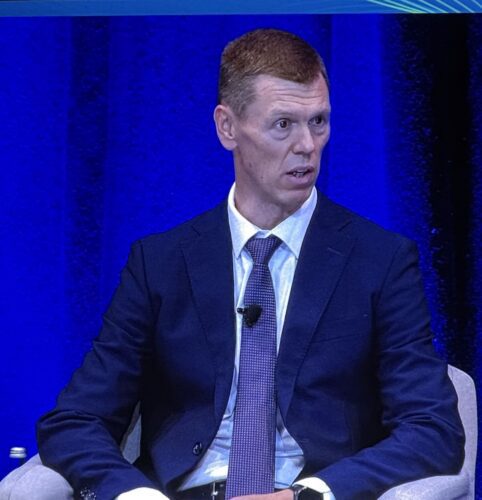
Mark Collette, managing director of EnergyAustralia, told the conference that his company had announced in 2021 the closure date of its Yallourn power station in June 2028 and “we haven’t changed” that timing.
However, Collette said that given the present pace of new generation being built, “there is no hope of shutting any other coal” after Yallourn and NSW’s Eraring plant close.
“At the moment, without the investment signals, some of these [renewable] projects are taking six, seven years to build,” he said. “You hit ‘go’ on a project now [and] come 2033, that’s when the coal’s meant to close.”
Collette, meanwhile, said he supported an announcement earlier today by NSW that it it would issue a 1.5 gigawatts firming tender that would favour gas peaker plants.
Energy Australia is looking to build a 1.4 GW gas plant at Marulan in the NSW Southern Highlands.
“[W]e’ve always thought that gas had a role to play as the backstop of the system, particularly when coal closed,” Collette said. “And as one of my team said to me coming in, it looks like gas is now moving from being Voldemort to being a bit of Harry Potter.”
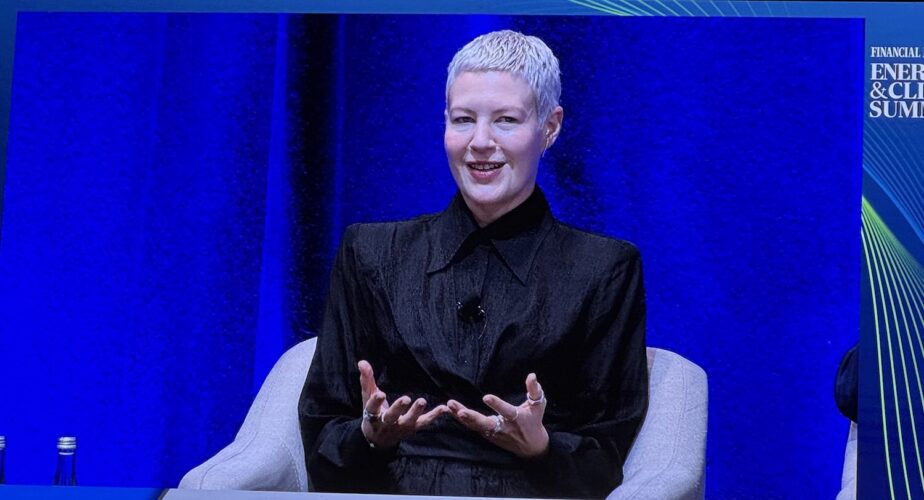
Separately, Maia Schweizer, Snowy Hydro’s chief operating officer, stood by the economics of her corporation’s giant 2.0 pumped hydro project that has continued to struggle to meet its cost and delivery schedule.
Snowy 2.0 offered 160 hours of backup for the grid, a contribution that would take 40 GW of batteries to match, and would “last about a seventh as long as our 150-year asset”, Schweizer said.
“So it is unique [and] it’s irreplaceable, and it’s hard to see [in a] 10- or 20- or 30-year time frame how that changes”, which is why we’re building it for 150 years.”
Schweizer, though, would not be drawn on when Snowy Hydro would release its long-awaited cost review that recently past its one-year anniversary since being announced.
“We’ve been working on it for a while, and it is imminent,” she said, adding that Snowy was “working very closely with our shareholder”, referring to the Commonwealth government.
“It is coming to the tail end of it,” Schweizer said.