A town council in regional New South Wales has told planning authorities that it is worried about losing their lucrative grey nomad trade if the caravaners believe their route is blocked or slowed by oversized loads delivering giant wind turbines to nearby projects.
The concerns arose in hearings held by the Independent Planning Commission into the Baldon wind project, a potentially 1.45 gigawatt wind farm that could be one of the first to have battery units paired with many of its turbines.
The main issue surrounding this project in the heart of the South-West Renewable Energy Zone is not about whether wind farms are good or bad – all of the councils in the region told the IPC at hearings this month that they supported the Baldon wind project, and others nearby such as the Pottinger and Bullawah projects.
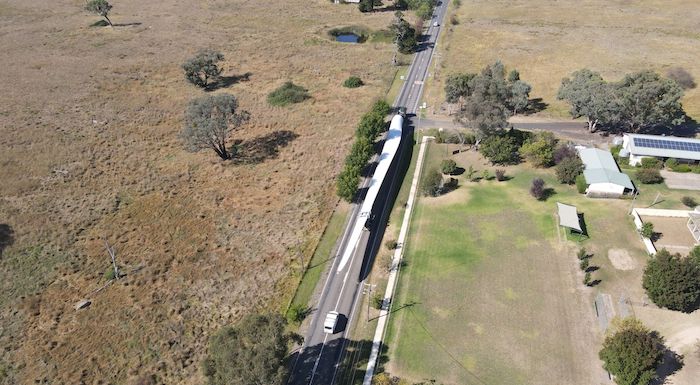
Their main concern – as it is for many other councils – is how to manage the increased traffic, and in this case the potentially thousands of heavy vehicles movements involving oversized loads, including 90 metre blades, but particularly the 6-metre wide wind turbine tower sections.
The Balranald council says it is particularly worried because of the town’s “fragile economy”, which is supported by the enormous number of caravaners and grey nomads that travel through the area.
“Our biggest challenge isn’t with the blades, it is with the towers,” Balranald Shire Council CEO Terry Dodds told the IPC at a hearing earlier this month, referring to the 6.5 metre wide wind turbine tower parts that are nearly double the 3..5 metre width of the highway lanes leading into town.
“To get through the centre of Balranald, there’s two 3.5-metre lanes with traffic islands in the middle which when the trucks are traversing, they’ve got to go down the centre of the road, which means our pedestrian-friendly traffic islands designed for people to walk across the road in two goes, will have to be taken out.
“That’s going to leave the centre of Balranald looking pretty ordinary for up to two years with the loads that are going through to another wind farm further east of Hay.
“So, if the same thing happens with this wind farm, and there’s 1,664 loads for the towers expected to go through Balranald for another wind farm, and that’s going to take two years and there could be five trucks to six trucks a day every day for two yars. That is going to create a fair bit of disruption if it’s not staged.”
Chief among its concerns is the potential impact on the flow of grey nomads, who support the local economy by filling up the caravan parks and camping grounds, and buying meals and provisions in town.
“What we’re concerned about is if the over-width/over-height loads go through at the wrong time and the caravaning traffic finds out about it and starts complaining on Facebook and places like that, that the caravaners will circumvent Hay and Balranald and Euston altogether,” Dodds said.
“What appears at face value as something that can be easily manipulated and managed, it’s not only the physical management of it, it’s the Chinese whispers and the grey nomads communication that needs to be managed.
“And if the OSOM loads mean that the grey nomads – and they’re mainly grey nomads, I’m not being facetious – the grey nomads find out that the Sturt is avoidable, Hay and Balranald will lose a lot of throughput.”
To address that situation, the council is calling on Transport NSW and the developers, Goldwind Australia, to ensure that the trucks go through at times that won’t affect the caravaners – and preferably at night.
Dodds told the IPC that Transport NSW is already working to build a series of lay-bys – 26 in total – along the Sturt Highway to ensure that the oversized loads can pull over and let traffic through.
Unlike renewable energy zones further north, in the central west and New England, which have to negotiate hills and winding roads, the issue with long blades is less acute in the south-west region because the roads are largely straight and flat.
“We’re quite happy with the over-length load designs,” Dodds said in reference to the transport of turbine blades, which are up to 90 metres long. “There’s only one intersection that is adversely affected at Balranald, and Transport for NSW listened intently to our criticism over their initial design.
“They’ve since redesigned it and instead of taking all the trees out but one, they’re leaving all the trees in but one. So, it was basically a 180- degree about face. It took some doing.”
Dodds said Transport NSW is already planning to raise well over a hundred lights and powerlines to get the tower loads underneath them, because as well as being 6.5 metres wide, they’re almost 7 metres high when stacked on the truck.
Goldwind’s Medard Boutry told the IPC that the company had been asked by Transport NSW to ensure none of the oversized load movements would cause “more than 10 minutes’ delay to any vehicles travelling anywhere.”
The Baldon wind project envisages up to 175 turbines, but the lack of grid capacity, and its failure to gain grid access rights in the new REZ, means that Goldwind will have to plug into the local network, allowing a maximum 46 turbines and 200 megawatts and 400 megawatts of battery storage in stage one of the project.
“For Stage 2, there is currently no existing pathway to progress,” Boutry told the IPC.
“However, this is a renewable energy zone and the government is continually looking for new ways, additional means of bringing in more generation into the network.
“This region, as you’ll see and as you’re probably aware, there are clearly a lot of projects in the pipeline, it’s a great region to develop renewables.
“Urbanisation is quite sparse, there are good transmission networks in the region, and there’s a – we expect that there is a likelihood that there may be further augmentations in the future to the network for which we want to be ready to apply as necessary to connect to.”
The IPC hearing was called by the state planning minister, although a hearing was inevitable under the now-changed planning rules that required projects to be reviewed by the IPC if there are 50 or more objections.
In the case of Baldon, as with many other projects, almost all the objections came from long distance and repeat objectors. The IPC heard from some of them at the hearings, mostly representing groups that oppose all renewable energy projects for various reasons often unrelated to local issues.
To join more than 29,000 others and get the latest clean energy news delivered straight to your inbox, for free, click here to subscribe to our free daily newsletter.