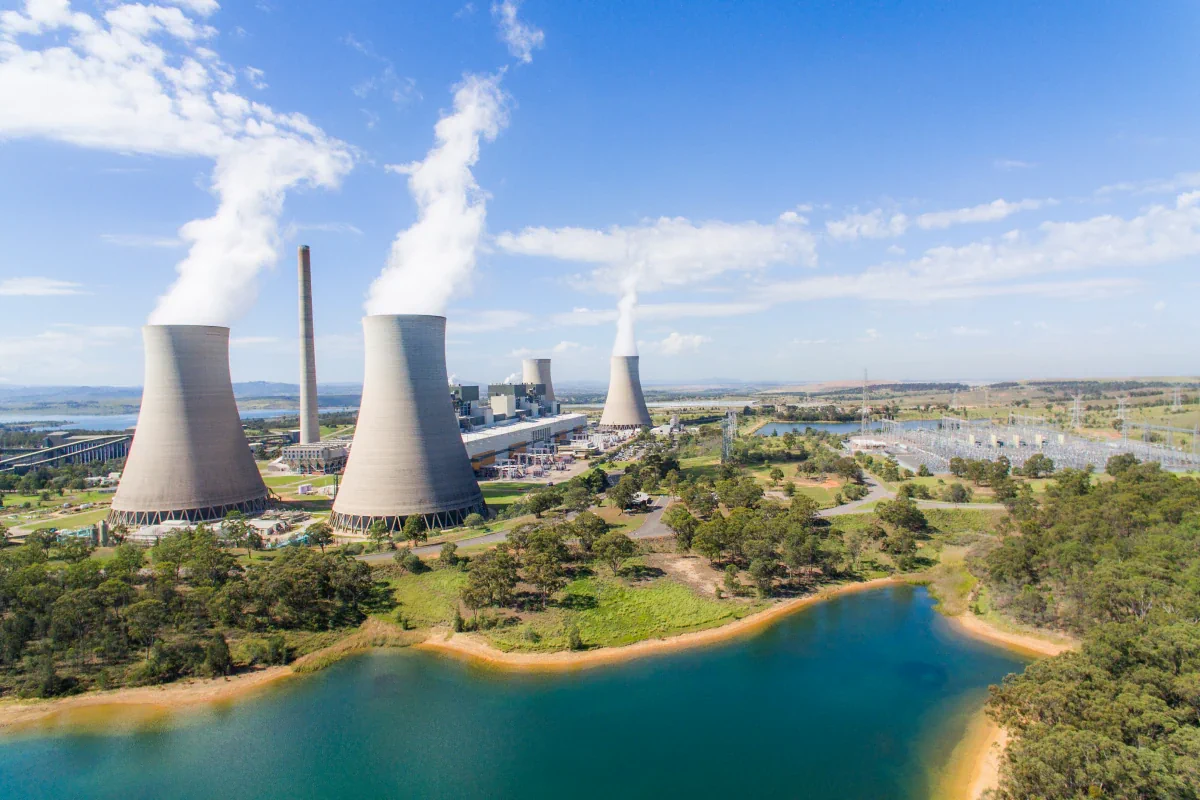
Australia’s largest electricity generator AGL Energy has no interest to build new coal-fired stations because there is no market support for such a move, according to Damien Nicks, the company’s chief executive.
Nicks told the AFR’s energy and climate summit in Sydney on Tuesday that adding new coal plants “doesn’t make sense”, and his company’s focus was on clean energy and storage.
“Would we sit here and build another coal-fired power station? I just don’t think the economics make sense,” he told the gathering.
“The market doesn’t support it right now. So right now, we’re investing in renewables, batteries and solar,” Nicks said, echoing comments he has made consistently since the closure of the ageing Liddell coal generator in NSW several years ago.
Among the major political parties, only One Nation explicitly support new coal-fired power stations being added to Australia main grids, although Nationals leader Matt Canavan has expressed support for new coal generators often enough.
“One Nation will advocate for the construction of three new black coal ultra-supercritical (USC) power plants at locations where coal-fired power generation once took place but has since been removed,” the party said on its website.
Those three sites are listed as Collinsville in Queensland’s Whitsunday region, Port Augusta in South Australia’s Upper Spencer Gulf region, “and where it is desperately needed” in the Hunter Valley, it said.
The party cited the appeal of USC plants as they “have higher thermal efficiencies and, as a result, lower emissions than any plant in operation in Australia today”.
Generally, though, One Nation has not placed any emphasis on curbing carbon emissions as a goal. Leader Pauline Hanson dubbed the view that the world is “doomed unless human beings stop emitting carbon dioxide altogether” as the “ultimate scam”.
Nicks’ comments follow those of executives at AGL’s annual general meeting earlier this month, where the company instead talked up the opportunity of repurposing the sites of exiting coal and gas plants to host new data centres
AGL’s chairman Miles George told the AGM the company had three energy hub sites with the combination of attributes data centres were looking for.
“I’m talking about Bayswater, Loy Yang and Torrens Island,” George said, according to an AAP report. Those sites are in NSW, Victoria and South Australia, respectively.
In a separate session at the AFR summit, Daniel Westerman, the chief executive of the Australian Energy Market Operator, said Australia’s energy systems and markets had “proven pretty resilient” over the past few years.
While gas supply and storage levels had “remained healthy throughout the winter, and over the last financial year,”, the standout achievements included a record 9.1 gigawatts of new generation and storage coming on line in the National Electricity Market, he said. West Australia’s main grid also added 850 megawatts of new renewables and storage.
“In fact, the pipeline of new projects seeking connection into the NEM has grown to 40 gigawatts,” Westerman said. “That’s equal to more than half of the total capacity of the NEM today.”
“Battery capacity on the transmission network has doubled in the past 12 months, and today there’s more than 9 GW of grid-scale storage connected to the NEM, he said. In Western Australia, battery capacity was now up to 1.5 GW “from a standing start four years ago”.,
“In a remarkably short time, batteries have become one of the most versatile assets on the grid, dispatching power and critical system services, and able to respond in milliseconds,” Westerman said.
“On average, during the September quarter, grid-scale batteries in the NEM absorbed more than 13 gigawatt hours of energy during daytime hours,” he said. “That is nearly triple the amount absorbed in the same period last year, and that alone is allowing for a high utilisation of solar generation.”
Batteries were dispatching about 11 gigawatt-hours of electricity between 4 pm and 9 pm, or aboutr 8% of total consumption during the evening peak – or a larger contribution to meeting peak demand than gas-fired generation.
“Increasingly, grid-scale batteries are also determining the wholesale price of electricity, both when they charge and when they discharge,” Westerman said.