Residents near camps that are housing construction workers for the New England Renewable Energy Zone in northern NSW have been told to brace for an upsurge in crime, with imported workers poised to descend on the region, en masse.
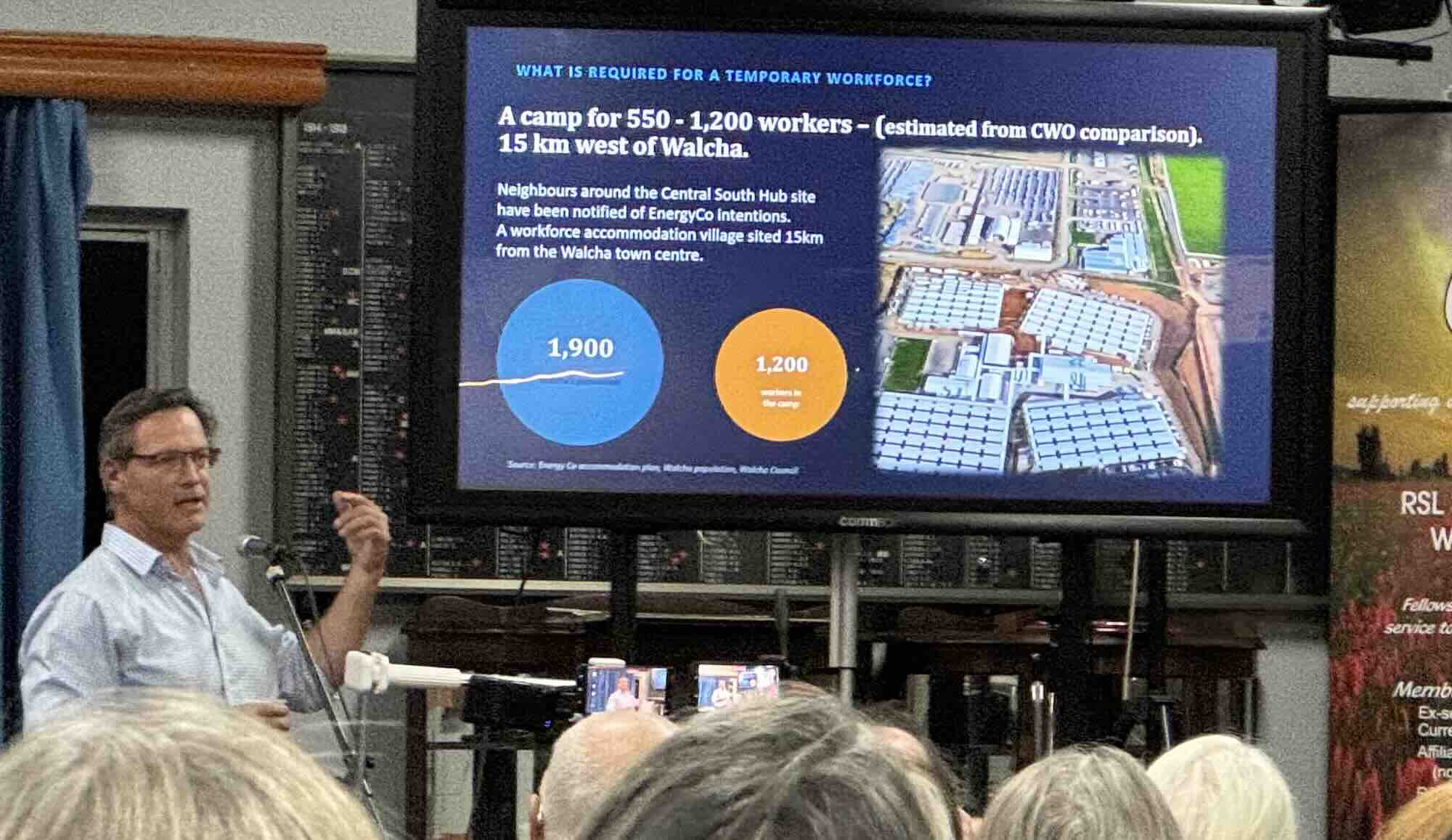
The claims were aired at a “community forum” in the Walcha Bowling Club last Thursday, in an event headlined: “What will the WORKERS CAMP and REZ mean for YOU,” and organised by the Voice for Walcha and the Walcha High Country Guardians.
About 200 people attended the gathering a town that describes itself as a “pasture wonderland,” and which has lately become a centre for opposition to the REZ after the zone’s developer, state-owned EnergyCo, released mapping for the main transmission that brought the line closer to Walcha.
Anna Young, a local grazier and one of the event’s speakers, told the meeting that “most of those workers at the moment constructing, they all have to be from the same nationality because, for safety reasons, they all have to be able to communicate.”

“[R]ight now, most of those groups are from the Philippines, they’re bringing in people from Bolivia in the Central West [Orana REZ] as well. So the idea that it’s local employment is an absolute farce.”
Renew Economy, which attended the event, approached the organisers, EnergyCo and NSW energy minister Penny Sharpe for comment. The claims could not be verified.
The workers camps, which include one housing as many as 1200 people, were among a litany of claims and concerns raised by the formal speakers and audience members.

Other topics included water, waste, roads and the experience of one self-described “chief agitator,” farmer Emma Bowman from the CWO REZ region.
“I would be terrified having 1,200 predominantly men from God knows where living two [kilometres] from my house,” Bowman told the meeting. “They are not locked in.
“We originally were told that there would be security and they would not be leaving, other than to go to work, because everything is there,” she said.
A spokesperson for Voice for Walcha said the comment about the nationality of the work crews “was reflective of many comments” made during a visit 30-odd Walcha residents made to the Central-West Orana REZ earlier in the year.
“We heard from a number of neighbours of the Merrotherie Rd Workers Camp,” the spokesperson said in a statement.
“It was an observation that was validated when 42 councillors and staff from the New England REZ visited the area more recently, and walked through the camps,” the statement said.
“The reasons for the homogonous nationality makeup of the work groups was communicated from [developers] ACEREZ during community meetings to these neighbours, and others,” it said.
During the question and answer session, one of the attendees claimed his experience in the Wellington region of NSW had been sobering.
“The rate of crime in the town has increased because most of the workers are coming from overseas,” the person said.
“[T]hese fellows are out working all day, and the crews come down from various places.
“I won’t name them, and they just stake the houses out until they’ve got a system, and then they hit,” he added. “They’ll come with a couple of trucks, and they’ll empty house upon house.”
Walcha Councillor Gary Olrich, a prominent opponent of the REZ, railed against the profits from the project heading overseas.
ACEREZ, the developers of the Central-West Orana REZ, he noted, were made up of European groups, Acciona and Cobra, with Endeavour Energy.
“So Endeavour is 50.4% owned by the NSW State Government, 49.6% owned by other equity partners,” Olrich said.
“The only one of them that’s Australian is Macquarie Infrastructure.”

Other owners included the Qatar Investment Authority and the British Columbia Management Corporation, he noted.
“So all the ones that get all the money to build the transmission corridor in the Central-West Orana [REZ] don’t pay too much tax here in Australia,” Olrich said.
Olrich said he had originally put his hand-up for a wind farm project on his land that “was going to be my ticket to passive income for the next X number of years.”
He said he was “no longer a part of that project,” before adding, “I’m still a supporter of renewable energy to some degree, but it’s not for baseload power in Australia.
“It may play a small role, [but] this REZ is just unbuildable in its current conglomeration.”
The Voice for Walcha statement also noted: “We need to appreciate the context that the New England REZ is nearly twice the size of the CWO REZ, and the Walcha Council employs a single planner, compared to Mid-West Councils eight.”
To see other stories in our series on New England, please read:
To join more than 28,000 others and get the latest clean energy news delivered straight to your inbox, for free, click here to subscribe to our free daily newsletter.