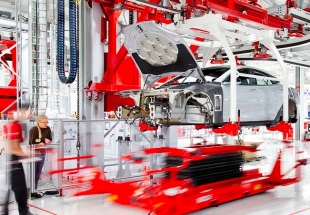
 Tesla Motors is finally ready to confirm that it’s building its $5 billion Giga factory in Nevada, putting to rest a five-state competition for what’s slated to be the world’s biggest lithium-ion battery plant. But the scope of Tesla’s plans extend far beyond the state’s borders.
On Thursday afternoon, Nevada Gov. Brian Sandoval will join Tesla representatives in the state’s capital, Carson City, to make a “major economic development announcement.” Multiple news sources indicate that Tesla will be admitting that a major ground-clearing project outside Reno isn’t just a red herring, but rather is the site of its promised 10-million-square-foot factory that will double the world’s lithium-ion battery capacity by decade’s end.
Tesla wants to have the Giga factory running in 2017, and capable of supplying 35 gigawatt-hours of batteries for the estimated 500,000 electric vehicles Tesla expects to build in 2020. California, Texas, Arizona and New Mexico were also vying for the Giga factory, and California lawmakers were ready to relax regulatory and environmental rules to entice the Fremont, Calif.-based company to stay within the state’s borders.
The local benefits are obvious, including construction jobs and economic impacts, and the 6,500 employees that Tesla CEO Elon Musk expects will be needed to run the massive facility. Even so, both left- and right-leaning critics within Nevada have launched a preemptive strike on any proposals from Gov. Sandoval or state lawmakers to support the Giga factory with taxpayer dollars. Tesla and Nevada officials haven’t yet released any details on how they’re planning to work together.
There’s also the logistics support required to feed the new factory with its raw materials, like the battery cells it will buy from partner Panasonic, which is expected to contribute about one-third of the estimated $4 billion in construction costs. Tesla will contribute about 45 percent, and plans to offer $800 million of convertible senior notes due in 2019 and another $800 million due in 2021 to support it.

Beyond that, a Giga factory could serve as the focal point of state economic development efforts around energy storage, from plug-in cars to grid-scale batteries. California and New York have both launched energy storage collaborations aimed at building up in-state technologies and companies. But Tesla’s factory is expected to dwarf the output of the rest of the U.S. lithium-ion battery manufacturing base, making it the natural epicenter of real-world energy storage work.
The Giga factory will dedicate about 35 gigawatt-hours of production to feeding its internal EV needs, but it’s also targeting 15 gigawatt-hours per year for stationary energy storage. The factory could have an even bigger impact on grid storage if Tesla doesn’t end up building as many EVs as it hopes to, according to a Thursday blog post from Lux Research. Halving Tesla’s 2020 production to 240,000 vehicles, for instance, could free up 20 gigawatt-hours of excess capacity to feed grid-scale and stationary storage markets, the research firm noted.
Indeed, Tesla’s plans are already influencing expectations in the grid storage world. AES Energy Storage President Chris Shelton told me that the Giga factory has played an important role in the company’s decision to concentrate on lithium-ion as the battery chemistry of choice for the next seven to ten years.
But the most potentially disruptive application for Giga factory production could be on the distributed solar-battery front. Tesla and SolarCity are already combining solar PV and behind-the-meter batteries for residential and commercial customers in California and a few other U.S. markets. Batteries are still too expensive to make sense for most solar-equipped customers, but falling solar and battery costs are set to make them a cost-effective combination for many markets in the coming years.

Tesla and SolarCity are laying the groundwork to supply all their technology needs, as SolarCity’s acquisition of Silevo proves. With 1 gigawatt of solar PV module capacity, and more to come in the years ahead, Silevo will make SolarCity “the most vertically integrated solar company in the world,” according to CTO Peter Rive. The Giga factory will provide a similar vertical integration on the battery side — although it’s much harder to predict how much of a market there will be for this product, compared to solar PV’s seemingly unstoppable growth.
As for how to maximize the economic value of those distributed energy storage assets, Tesla CTO JB Straubel has described how the company is “experimenting with aggregating the systems at a number of different houses that can dispatch batteries to market signals” for “behind-the-meter aggregation.” California, New York, Hawaii and Germany are among the solar-rich markets that are starting to take on the regulatory overhaul to allow this kind of distributed energy asset to play a role at grid scale. Perhaps Nevada will host its own utility pilot projects on this front.
Source: Greentech Media. Reproduced with permission.