
Origin Energy, one of Australia’s biggest energy generators and retailers, remains “focussed” on plans to close its Eraring coal-fired power station in 2029, with the plant already reporting lower output, Frank Calabria, the company’s chief executive, said.
Speaking after Origin’s annual general meeting in Sydney on Wednesday, Calabria said “all our plans are focussed” on the April 2029 exit of the 2.88 gigawatt plant, which is Australia’s largest coal fired generator.
“We don’t have any change to that. We have to think a bit about our own objectives over time, the market, and all those other things,” Calabria said, in answer to Renew Economy’s question.
“Whatever governments might decide, it is entirely for them to consider about their market,” he said, adding that the role of Eraring was already changing.
The plant in the lower Hunter Valley region of NSW was “running at much lower capacity factors than it’s been before”, he said. “And so, I can’t predict every market scenario, but everything we look at today has us closing in April 2029.”
The Minns Labor government in NSW has previously intervened to support the extension of Eraring, which can supply about one-fifth of the state’s power.
The government goes to the polls next March, and a promise to extend the plant further, or least some units, perhaps out to 2033, would not surprise some analysts who have spoken to Renew Economy.
“Look, I don’t know what is in the consideration of others,” Calabria said. “We don’t have an alternative outlook.”
The plant’s recent operations has been interrupted, with two of its four units offline. “We had some tube leaks” requiring maintenance, Calabria said, adding he would provide details of the timing of their restart.
Calabria also said it was “not a surprise, directionally” that the NSW government designed a firming tender to favour gas peaker plants. Energy minister Penny Sharpe on Tuesday announced plans for the 1.5-gigawatt tender, which set “characteristics” that effectively ruled out ineligible batteries and pumped hydro.
“The key role that gas serves, clearly, is this longer-duration storage that’s going to be needed for seasonal swings,” Calabria said. “As you think about the retirement of coal, those services currently aren’t able to be provided by both storage or variable renewable energy.”
“So, that being an ingredient into the energy mix as coal comes out, we’re certainly not surprised that they have now started to turn their minds” to supporting gas peakers, he said.
“I should highlight that it’s unlikely we would see those gas plants operating at very high capacity factors all year round, but they will need gas at the time when they’re needed to operate,” Calabria said.
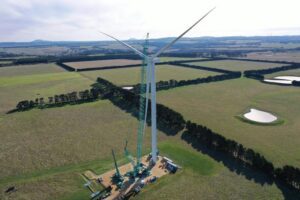
During his AGM speech, Calabria said this company’s 1.5 GW Yanco Delta Wind Farm had “made progress towards a final investment decision.
“However, economics remain challenging, even with support from the [federal] capacity investment scheme.”
He said,”Australia’s energy transition advanced this year, although not evenly”.
“An acceleration in the uptake of home batteries and electric vehicles, complementing Australia’s high penetration rates of rooftop solar, was evidence of the continued momentum in the energy transition for residential consumers,” Calabria said.
“Significant new grid-scale battery capacity helped to ease wholesale electricity prices, putting downward pressure on bills for homes and businesses,” he said, echoing comments made yesterday by Daniel Westerman, chief executive of the Australian Energy Market Operator, that batteries were “fundamentally” changing the grid.
On the downside, “the build-out of infrastructure the transition depends on – new renewables, firming and transmission – is proving difficult,” he said in his speech.
“Projects are taking longer, costs have risen materially, connection and approval processes remain complex, and the medium-term regulatory picture is uncertain.”
With the surge of artificial intelligence and rising energy demand from data centres, “the challenge of the energy build-out is about to become more acute”, he said.
One bright spot was that households with rooftop solar, batteries and electric vehicles were saving money on their energy bills.
“Origin’s data shows our customers who have electrified with solar, a battery and an EV are saving around $1000 per annum on their total household energy costs – a significant saving,” he said.
“These customers may not yet represent the masses,” Calabria said. “However, they do
reinforce that the benefits the transition promises for customers are real. The path we’re on is the right one.”
One roadblock or even diversion on that path may come from a breakdown in bipartisan support between Labor and the Liberal-National coalition at both the state and federal level, a point also raised elsewhere this week by Akaysha Energy and Energy Australia.
“What these [energy] reforms need most is durability,” Calabria said in his speech.
“Energy and climate policy has too often shifted with the political cycle, and that uncertainty has a price: investment gets deferred, projects stall, and the cost of that delay ultimately lands on customers and on the broader economy,” he said.
“Bipartisan, lasting agreement on the fundamentals across all levels of government is the outcome Origin will keep advocating for,” Calabria said.
Big transmission lines in Victoria, such as VNI-West and the Western Renewables Link, and the New England Renewable Energy Zone in NSW, are all at risk if the Coalition and/or One Nation win, respectively, next month’s state elections in Victoria and the NSW poll next March.