Spare a thought or three for Chris Bowen, Australia’s climate change and energy minister, who can’t take a trick.
Some things Bowen gets blamed for are not entirely his doing. Curiously, there is also one very promising target that Australia has been reluctant to claim credit for.
First, let’s take a little tour, marking some of Bowen’s travails and torments.
A year ago, Bowen was considered the front-runner to be president of a COP31 climate summit that looked likely to be hosted in Adelaide.
Turkiye ended up snagging the global jamboree with only the backing of itself and despite the majority of the “Western Europe and Others Group” backing Australia. The result disappointed many, including the would-be host city, and presumably Bowen himself.
As one consolation medal, Bowen got to be the COP31 President of Negotiations, a tough gig in itself – without accounting for his day job of overseeing Australia’s complex energy transition.
The other consolation trophy was to help bankroll a Pacific Pre-COP in Fiji and Tuvalu that wrapped up this week, with Prime Minister Albanese joining Bowen for the event.
Perhaps unkindly, critics dubbed the gathering a “Pre-COP flop,” since the only leaders from outside the Pacific to attend hailed from Mauritius and Timor Leste.
Senior ministers from a bunch of other nations, though, did show up.
Most notably was Nepal’s foreign minister, Shishir Khanal, who attended just five weeks after massive floods triggered in part by climate change devastated a swathe of his country and that of neighbouring China.
Khanal, rightly, “used the forum to highlight the shared climate risks facing mountain and small island developing states,” a hometown newspaper reported on Friday.
Bowen was forced to defend the cost of the Pre-COP for Australia, with a $20 million price tag “in keeping with the estimates at this point” – a hint that the final figure might be larger.
That sum, he told ABC’s 7.30 report, was part of a broader $147 million effort earmarked “for lifting the climate issues in the Pacific.”
(Australia’s Department of Foreign Affairs and Trade has a budget for this year of $10 billion. It includes $20.4 million for a new rugby league team in Papua New Guinea, annual support that is budgeted to roughly quadruple in two years’ time.)
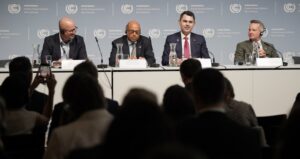
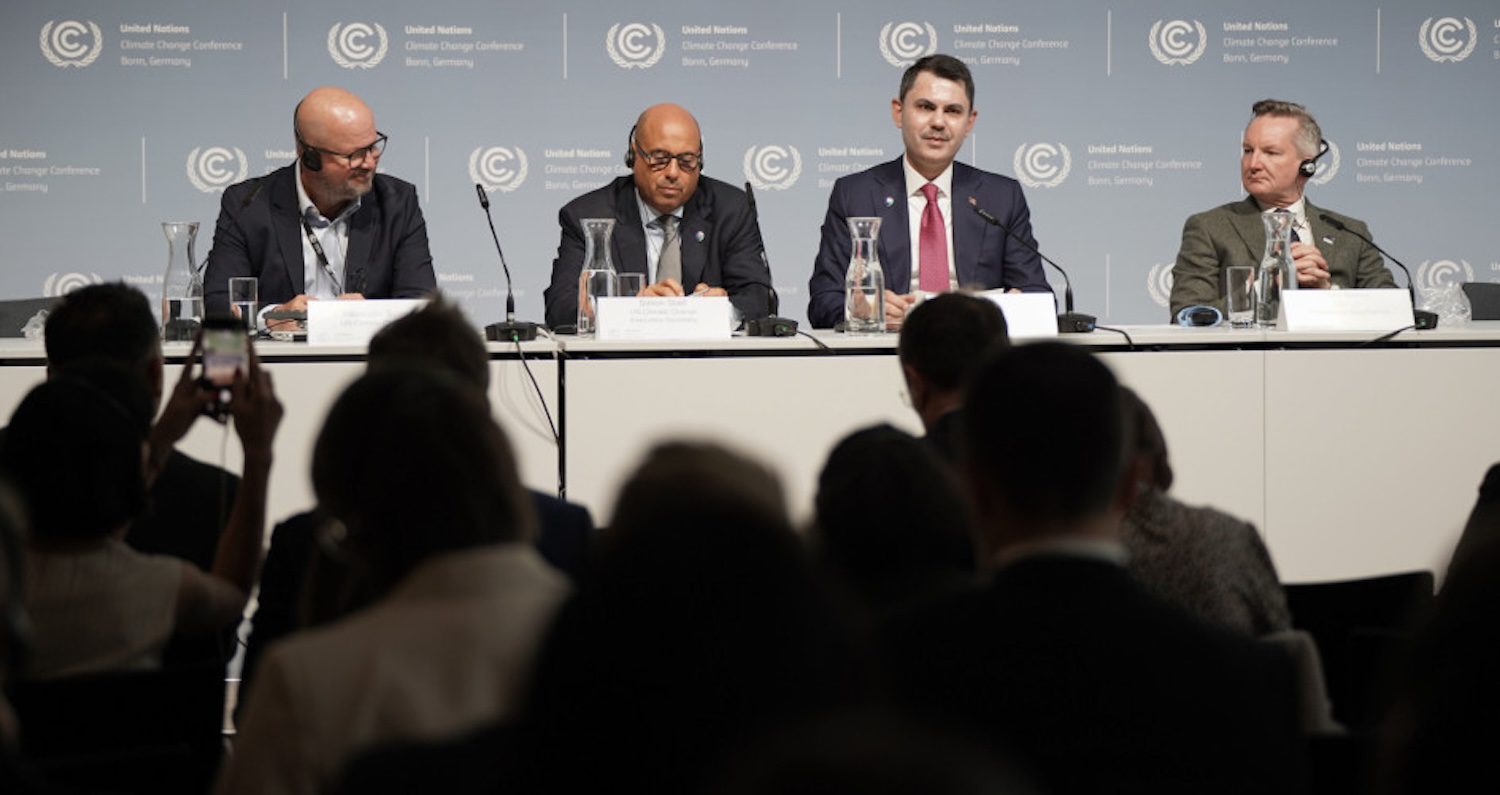
The final Pre-COP press conference anticipated some uncharitable media attention for Bowen, not least because Australian journalists were jostling for a response to this week’s remarkable High Court of Australia decision to uphold a challenge to (yet another) giant coal mine expansion.
Turkiye’s COP31 President-Designate, Murat Kurum, speaking before Bowen, requested the Australian and Pacific press keep in mind the big picture of climate change.
“[W]e have been told that they are quite rigid and have sharp edges,” Kurum said. “[E]veryone should take responsibility … We are all fighting to make sure that we may correct this bad course.”
(The “very short time for questions” and long speeches at the press conference meant Bowen ended up receiving just three queries.)
Kurum’s support for Bowen pointed to their close cooperation – and a nifty Australian idea about global electrification is one of the threads that bind them.
Public support for setting a goal of raising the share of final energy supplied by electricity has been gaining momentum in United Nations meeting for some months.
Back in June this year, the UN announced raising the share of final energy demand to 35% – from “around 20% today” – by 2035 would be the centrepiece of November’s COP31 to be held in Antalya, Turkiye.
Three months later, on September 21, the COP31 Presidency duly declared its “35-by-35 Global Electrification Pledge” during New York Climate Week.
A day after that, the International Energy Agency launched its special Electrification report, developed “at the request of Turkiye and Australia”. (Renew Economy has asked the Department of Climate Change, Energy, the Environment and Water (DCCEEW) about Australia’s contribution to any costs.)
The “35-by-35” flagship policy was not just nimble marketing.
Such a goal was “consistent with the most ambitious climate pathways” in terms of limiting global warming, an Australian-government supported report argued this week.
Electrification, after all, can be a much more efficient use of energy than direct combustion of fossil fuels. The key – in terms of reducing greenhouse gas emissions – is the deployment at speed and scale of renewable energy.
And this past week’s Pre-COP event in the Pacific reinforced the theme, stating electrification had emerged “as a COP31 priority”.
“Delegates identified electrification as a key pathway to cut emissions, strengthen energy security, lower energy costs and unlock economic opportunity,” the closing statement said.
“Australia announced its support for Türkiye’s goal to lift electricity to 35% of global final energy consumption by 2035.”
Actually, it would have been a surprise had Australia not supported the goal. After all, DCCEEW was the source of this concise and coherent goal, Renew Economy can reveal.
Without “35-by-35”, COP31 would have had little to rally nations to take serious action, beyond the bland intention to implement what had been promised at the previous 30 such confabs.
Turkiye, itself, had promoted reducing urban waste and methane as among the COP31 goals. That call, though, was hardly going to galvanise international action at a time when so many pressures are yanking peoples apart.
Some of DCCEEW’s analysis was based on publicly available modelling by CSIRO that underpinned the Climate Change Authority’s advice for Australia’s 2035 emissions reduction range. The Albanese government accepted the suggested 62-70% cut on 2005 pollution levels, just over a year ago.
As a disclosure, your correspondent worked at the CCA for 18 months until August 2026. A detailed knowledge of CSIRO’s additional modelling, though, has come since he left the authority.
That CSIRO modelling took in various estimates of when Australia would reach net zero emissions and the limit of assumed global warming.
By 2035, the electricity could provide 32%-36% of Australia’s final energy use, up from 23% now, Renew Economy understands.
Hence, the Aussie origin of a 35% share of final energy use coming from electricity by 2035.
By 2050, electricity may account for 53%-61% of Australia’s final energy use. Transport and industry were sectors considered to bear the highest uncertainty, with the uptake of new technologies including hard-to-electrify processes difficult to pin down, Renew Economy understands.
Renew Economy sought comments from Bowen’s office and DCCEEW why Australia hasn’t taken more credit for the crisp and clean idea of promoting “35-by-35”.
After all, the promise includes lower costs of living for consumers and a reduced need to import dirty fossil fuels from unstable parts of the planet.
Or as Bowen himself stated succinctly in his foreword to the IEA report: “Electrification offers many benefits at once: it strengthens energy security, supports economic development, improves affordability and lowers emissions.”
To join more than 29,000 others and get the latest clean energy news delivered straight to your inbox, for free, please click here to subscribe to our free daily newsletter.