Plans for a potentially massive new wind farm in Tasmania have started the process of federal environmental assessment, seeking approval to install up to 280 turbines in the island state’s North West renewable energy zone.
According to documents referred for assessment under the EPBC Act on Friday, the Whaleback Ridge wind farm is being proposed by local developer Westcoast Renewable Energy as a phased project of up to 2,800 megawatt (MW), or 2.8 gigawatt (GW).
The project documentsbut starting with a 288 – 432 MW first phase.
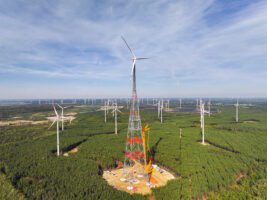
The referral says the project will have up to 280 turbines, each with a generating capacity of up to 10 MW, with a hub height of up to 180 metres and a maximum tip height of up to 250 metres.
These would be the most powerful in Australia, beating the 8 MW turbines currently being installed at the Nullagine and Narrogin wind projects in Western Australia.
The project documents suggest the first phase of the project would be between 288 and 432 MW. Given the size of the Tasmania grid, it would need either greater export capacity, or major industry, to justify the full 2.8 GW.
“As the largest renewable energy project in Tasmania, the project will produce enough energy to achieve the TRET [Tasmania Renewable Energy Target] of 200% renewable energy by 2040,” the documents say.
Nevertheless, the plans appear to be pared back from those reported by Renew Economy roughly a year ago, which had proposed to install 500 turbines across a mix of public reserve land and private land.
Back then, the huge project had already attracted close scrutiny from conservation groups like the Bob Brown Foundation, concerned about its proposed location, which takes in the southern extent of an area nominated for the Tarkine National Heritage Listing.
The wilderness region is celebrated for its biodiversity, and it includes a known habitat for the EPBC-listed blue-winged parrot, as Bob Brown Foundation Takayna campaigner Scott Jordan told Renew Economy in July last year.
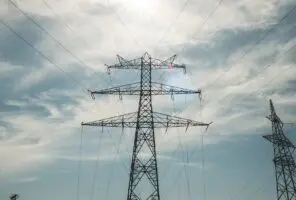
As well as the up to 280 turbines, the project newly referred to the EPBC will include up to nine electrical collector substations and four switching substations and switchyard/s, and underground and overhead cables to connect to the existing 220 kV transmission line that runs east-west through the northern part of the project.
A network of access tracks would also be developed to connect to each of the turbines and allow access to oversized construction materials and for maintenance during operations.
Westcoast Renewable Energy (WRE) says the project footprint would take in multiple land tenures within the West Coast Council municipal area, regional reserves and other types of Crown land, including permanent timber production zone land and future potential production forest land.
WRE says the area has a high-capacity factor for wind, that has been demonstrated by the existing Granville Harbour Wind Farm, located to the west of the proposed Whaleback Ridge project, and by data from four meteorological monitoring masts.
Referral documents say that consultation with TasNetworks has indicated there is sufficient capacity on the existing transmission line to accommodate the first 288 – 432 MW phase of the project. And it says the specific location of the first and any subsequent phases are still subject to design and refinement.
On its potential impacts, the documents say the project has sought to minimise potential environmental impacts and claims surveys so far have recorded a low abundance of bird species using the area, including “the lowest density of wedge-tailed eagles and whitebellied sea eagles of all wind farm sites currently proposed in Tasmania.”
That said, the documents note that the project area provides habitat for a large number of native fauna species, with a wide variety of landforms and associated vegetation communities, that are structurally connected, including by treed habitat corridors along gullies, creeks and rivers.
The referral also notes that the Project area sits within the southern extent of the area nominated for the Tarkine National Heritage Listing, which has been found by the Australian Heritage Council to contain rainforests of value and important for their flora, and with “links to the ancient continent of Gondwana.”
“The coastline was also recognised by the Australian Heritage Council for the numerous hut depressions found in Aboriginal shell middens. The huts and middens are the remnants of an unusual and specialised Aboriginal way of life based on the hunting of seals and land mammals, and the gathering of shellfish,” the documents say.
“The resulting National Heritage listing of the Western Tasmanian Aboriginal Cultural Landscape to protect these values is situated outside the Project area, approximately 4.5 km to the north-west and will not be directly impacted by the Project.”
To join more than 29,000 others and get the latest clean energy news delivered straight to your inbox, for free, click here to subscribe to our free daily newsletter.