Roughly 10 years ago – I wrote a series of articles on the South Australian Blackout event. How quickly time passes! A decade to a 10-year-old is an entire lifetime, but unfortunately the percentage is getting to be significantly less for me. Still, I am happy to keep the percentage reducing, particularly when you consider the alternative.
At the time I used the Swiss cheese model to describe what went wrong that caused SA to go system black. This where the various causes of a failure are stacked like a series of slices of Swiss cheese. If one of the holes line up across all slices – we have our failure. If a slice has a hole out of position that prevents line of sight – failure is averted (see diagram below).
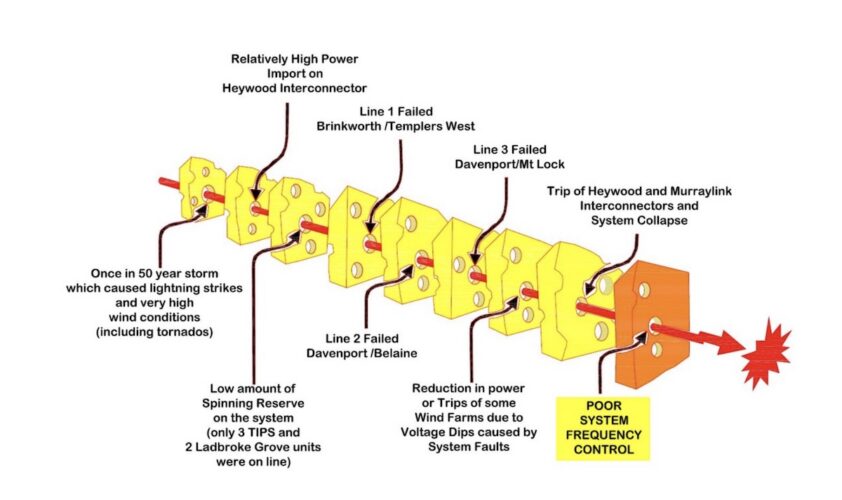
Figure 1 Copied from the Authors prior LinkedIn article published several years (2017) ago linked here
What would happen today if the conditions that occurred 10 years ago were to be repeated? Let’s look at this slice by slice.
Storm Event
The storm that occurred 10 years ago was estimated to be a once in 50 year event. Obviously, this sort of thing could reoccur again, and with climate change the probability of occurrence may need to be revised to be more frequent. This slice will not be a barrier for the pathway to system failure, in fact now the hole in the cheese is probably larger.
High Power Import
The high import of power across the Heywood interconnector (which occurred prior to the faults) is a common operating condition – but we now also have an AC interconnector backup in the form of Project Energy Connect (PEC).
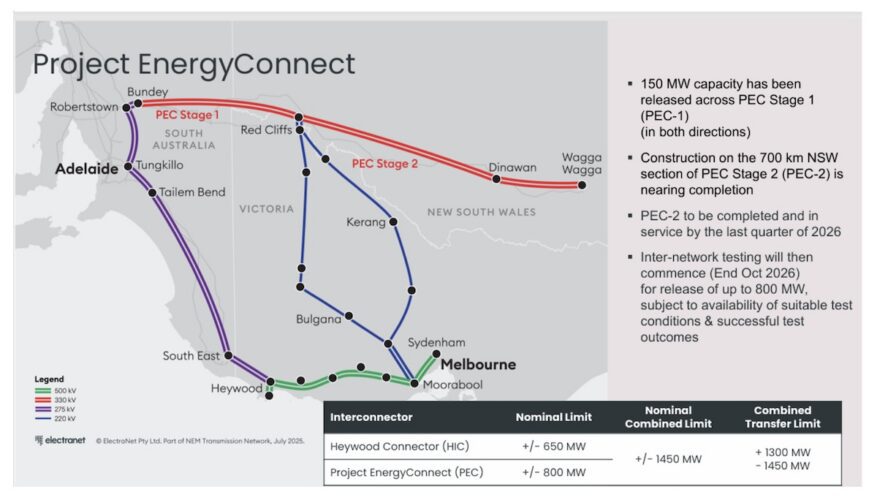
Figure 2 Copied from a published PEC PowerPoint presentation which is located at PEC webpage resources
This provides a level of redundancy that wasn’t present ten years ago (although we did have the HVDC interconnector Murray Link which I will discuss further below).
Does this mean the hole in that slice of cheese is filled in?
Unfortunately, this is not black and white. At the time of writing PEC stage 2 is not yet completed – and even if it was, we still need to consider the flows in Victoria from Red Cliffs down to Melbourne.
The stated combined transfer limits of +1300 MW/-1450 MW come with lots of caveats – the actual transfer limits are a complicated combination of various generation and load dispatch which are necessary to ensure other lines in the network are not overloaded.
High imports across both AC interconnectors will no doubt occur as a normal operating condition.
Accordingly, the hole in this slice of cheese is now significantly smaller, but it is still there.
Low amount of spinning reserve
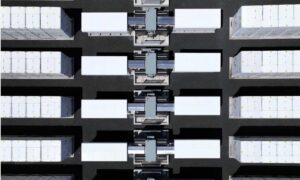
It is still very common for South Australia to operate with low levels of spinning reserve, but there are now also many battery systems installed which were not present ten years ago.
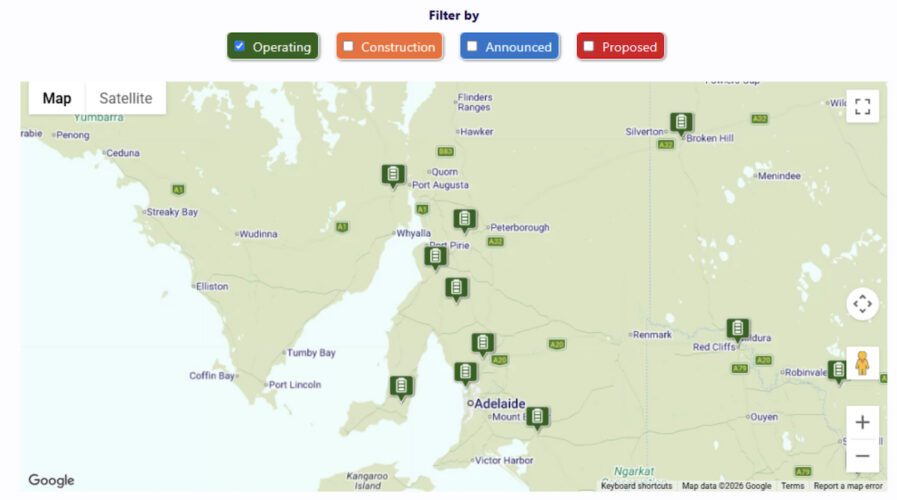
Figure 3 Filtered Map of operating BESS in SA courtesy of Renew Economy
Accordingly, there is likely to be lots of “non-spinning” reserve in the form of battery capacity which is ready to jump into action if the interconnectors are in danger of overloading. This has already been tested several times in power system events over the last ten years, and so far, the verdicts have been that it works well.
The hole in this slice of cheese can now be considered to be very small – but it would be overly optimistic of me to state that this path to failure is now fully closed off.
All engineering devices are imperfect and failure of a battery to respond or respond incorrectly cannot be ruled out. Nevertheless, we now have lots of redundancies in the form of multiple BESS installations which should be more than sufficient to respond to the power system needs.
HV Line failures caused by lightning and toppled towers
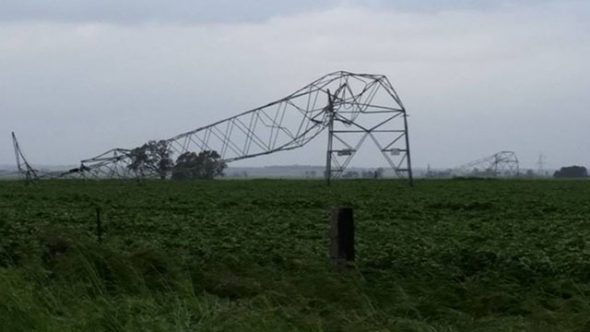
The next three slices of cheese relate to the 275kV line failures that occurred. These were caused by lightning strikes and toppled towers because of the storm event.
Could this happen again?
Unfortunately, yes.
There is not much to report that would mitigate this issue in the intervening ten years except that the towers that failed ten years ago have been replaced by likely stronger designs.
The cost to upgrade entire lines with new towers is prohibitive (effectively replacing entire lines) and as far as I know has not been attempted. It would also likely be of very limited benefit – who’s to say a stronger storm would not occur that would not topple a stronger tower? With climate change affecting storm incidence and magnitude it is hard to determine what wind loading should be applied to new towers.
These slices of cheese remain with effectively the same hole size.
Wind farm trips due to voltage dips
Several wind farms tripped due to the multiple faults that occurred on the 275kV system which were caused by lightning strikes, towers toppling due to high wind and auto-reclose operations of circuit breakers. Some wind turbines had counters in their protection systems which limited the number of under voltage events they could ride through which helped to protect their systems from damage due to temperature or mechanical impulses.
In fairness to the turbine manufacturers – this was compliant with the National Electricity rules of the time, but the rules have since been changed to require the turbines to ride through several system faults (15 for automatic access) to prevent this issue from reoccurring.
The settings on new and existing wind farm turbines now allow for a greater number of fault ride through events to occur.
This slice of cheese now has a much smaller hole.
Coincident Tripping of Heywood and Murray Link Interconnectors (and PEC )
Ten years ago, both interconnectors tripped basically because the load in SA exceeded the combined generation and the power import ratings of the interconnectors.
With the commissioning of Project Energy Interconnect – the total import capacity has increased, and we now have three interconnectors. However, there is still a total limit that must be kept within bounds. If that limit were exceeded – then all three interconnectors would trip just as the two interconnectors tripped ten years ago.
This slice of cheese now has a smaller hole.
Power system frequency regulation
The state of the regulation of the power system frequency in 2016 was deteriorating as shown in the figure below.
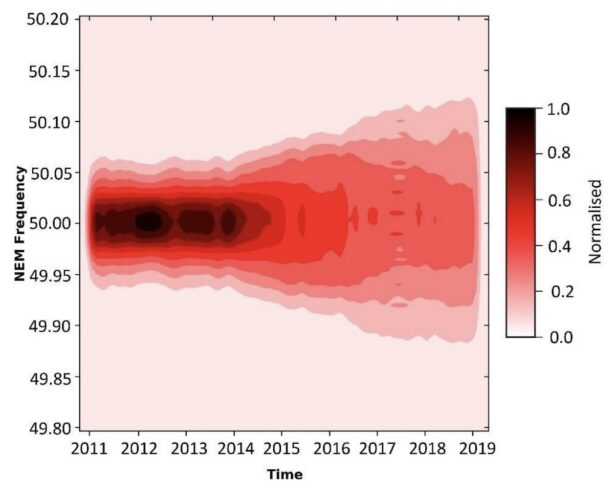
The tightness of the frequency control The tightness of the frequency control has an effect on how fast generator ( and in 2026 also BESS) governor control systems will respond if the frequency goes out of bounds.
A useful analogy is to think how difficult it would be to steer a car if the steering wheel was loose. Tighter control is generally better in frequency control and when steering a car.
We now have tight bounds on power system frequency which is roughly equivalent to where we were in 2013 ( although now we have two peaks instead of one) which is better than where we were in 2016.
This slice of cheese also now has a smaller hole.
Summary
A qualitative summary of the above discussion is given below.
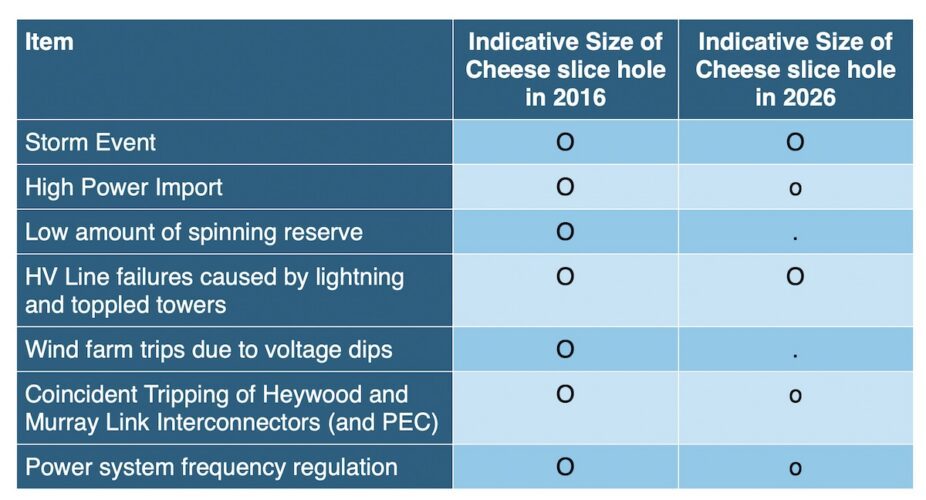
Most of the hole sizes have been reduced – some very significantly – so we can be reasonably confident that the likelihood of another blackout of South Australia is significantly reduced.
Reduced, but unfortunately not eliminated.
Nobody has yet designed and built a perfectly reliable power system. In common with all artefacts – power systems are fallible.
However, statistically speaking they are pretty good – particularly when compared to more unreliable systems like roads, rail or my home Wi-Fi.
South Australia and Queensland are more vulnerable than the other regions (NSW and Victoria) because they are located at the ends of the NEM. Losing connection with the middle means a significant loss of the ability to import or export power.
This is an accident of geography which also afflicts other systems. The blackout on the Iberian Peninsula (Spain and Portugal) was more likely than say a blackout in France or Germany because of similar geography.