A recently released statistical scorecard tracking progress of the renewable energy sector against government targets reveals a crisis of confidence amongst investors in wind and solar farms.
The inaugural Renewable Energy Scorecard reveals that Australia has an extremely large bank of renewable energy projects in development, many of which have the necessary government development and environmental approvals.
These projects are of a scale that could easily deliver on the Federal Government’s 82% renewable energy target. Unfortunately, only a trickle of these projects have managed to reach construction commitment over the past few years.
The scorecard is a product of research by Green Energy Markets and the Institute of Energy Economics and Financial Analysis and builds upon Green Energy Markets’ two decades of experience analysing the market in renewable energy and tracking the renewable energy project pipeline.
For Australia’s main grids in the National Electricity Market and the Western Australian South-West Interconnected System to deliver on the ISP and the Federal Government’s target we need close to 38,000 megawatts (MW)* of additional utility-scale wind and solar farms to become operational by 2030.
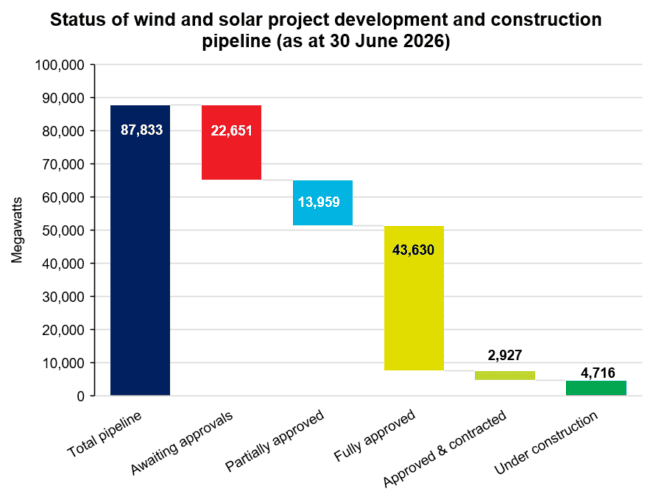
However, based on the status of projects at 30 June this year, there were just 4,716 MW under construction. Given construction of renewable energy projects tends to take between two to four years to complete, the amount in construction is clearly inadequate given we only have four years until 2030.
Yet the bank of wind and solar projects in development at almost 88,000 MW, shows large scope for expansion in renewable energy.
The Renewable Energy Scorecard reveals that a pivotal choke point in progressing renewable energy projects lies in difficulty with projects obtaining long-term power purchase contracts with large power customers like electricity retailers and large corporates.
The total bank of projects with environmental and planning approvals in place at June 30 was over 46,000 MW. Yet only 2,927 MW of these projects have contracts with end customers in place for a meaningful amount of their output. These contracts are important to investors because they provide them with a significant level of confidence about project revenues.
Given we are due to close several large coal power stations over the coming years (Yallourn in 2028, Eraring in 2029 and Bayswater in 2032), the lacklustre levels of customer contracting are puzzling.
They are especially puzzling given a significant proportion of large corporations operating in Australia have announced commitments to achieve net zero emissions and often also commitments to be fully renewably powered.
According to the Business Council of Australia, businesses representing 70 per cent of the ASX 200’s collective market capitalisation have adopted net zero emission commitments.
Few projects receiving government underwriting have progressed to construction
Both the NSW and Federal Governments have attempted to reduce the degree of revenue risk facing renewable energy projects through offering contracts that provide insurance against very low electricity market prices.
However, the Renewable Energy Scorecard reveals that projects supported under these underwriting tender schemes have had difficulty progressing to construction commitment on timeframes in line with the scale of targets the NSW and federal governments have for 2030.
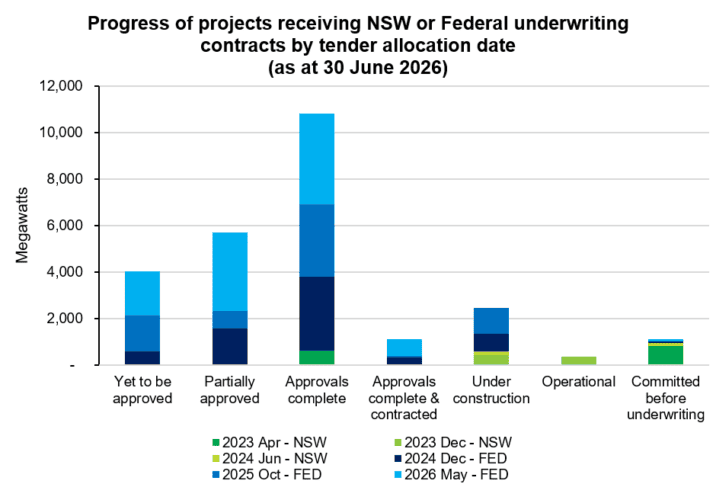
In evaluating the effectiveness of these underwriting tender programs in helping progress projects to construction, we need to put aside 1,099 MW of projects that were committed to construction prior to receiving underwriting contracts.
Also, almost 10,000 MW of projects were only just awarded contracts in May this year, so have had little time to achieve progress. This leaves us with around 14,500 MW of projects that have been awarded underwriting contracts since October 2025 or earlier.
As at 30 June only around 2,800 MW or 19% had managed to be committed to construction (of which 350 MW is now operational) and just a further 395 MW had obtained all their approvals and a power purchase agreement.
Concerningly, two projects under the NSW underwriting program, representing 39% of all capacity underwritten via that state’s program (which were not already under construction prior to receiving an underwriting contract), were still yet to be committed to construction and without a PPA, even though they were awarded underwriting contracts more than three years ago.
In the period after June 30 there has, thankfully, been some further progress, with another four projects from these underwriting rounds, equal to 980 MW, being committed to construction.
But we need to see far faster progress. One also has to question why such a large proportion of underwritten projects have been awarded contracts that do not have all their government approvals in place.
Scorecard illustrates need to focus on not just supply but also demand factors inhibiting renewable energy investment
Australia’s main grids have 46,000 MW of projects with both development and environmental approvals in place. Yet the rate at which these are managing to progress to construction is far too slow. An important inhibitor is inadequate levels of transmission capacity, but it is far from the entire story.
As has been highlighted in prior research by the Institute of Energy Economics and Financial Analysis, (such as the report – There’s a better way to manage coal closures than paying to delay them), uncertainty around the precise timing of when coal power plants will close, including the risk of government policy interventions to forestall those closures, will lead large energy consumers to be hesitant to contract for power from new projects.
This then results in low levels of investment in new projects which can then increase the pressure on governments to intervene to delay coal closure. The end result is a vicious cycle of uncertainty undermining investment.
Governments need to consider adjustments to policy settings that will overcome the uncertainty inhibiting investment in new renewable energy projects. These could include changes to underwriting schemes to address issues outlined in Green Energy Markets’ April 2024 paper, Five ways to save the Capacity Investment Scheme from attack by zombies. There is also a need to provide greater confidence to the market that coal power plants will close at the dates currently scheduled.
At the same time, it remains crucial that governments address supply-side constraints. While the Renewable Energy Scorecard shows there is a large amount of capacity with approvals in place, the larger the bank of approved projects, the greater the level of competition between developers and lower prices consumers should be able to obtain.
We ultimately need a bank of approved projects that is far larger than what is needed in order to facilitate competition and make up for the fact that some projects will encounter unforeseen challenges that make progression to construction difficult.
Also many of the projects that have their approvals in place will also need new transmission infrastructure. We are thankfully finally making progress with NSW’s Central-West Orana and South West Renewable Energy Zones. But the very slow progress and uncertainty surrounding new transmission infrastructure in Victoria is highly concerning.
The Australian Renewable Energy Scorecard will give a quarterly update on how the energy transition is progressing
This is the first instalment of what will be quarterly updates tracking how each Australian state is performing in progressing renewable energy projects and attracting the investment and jobs that could come from these projects.
You can access the Renewable Energy Scorecard from the Institute of Energy Economics and Financial Analysis website here: https://ieefa.org/australian-renewable-energy-scorecard.
*An earlier version of this article said Australia needs “close to 41,000 megawatts (MW) of additional utility-scale wind and solar farms to become operational by 2030” to meet ISP and federal targets. This was a typo. The correct number is 38,000 MW.
If you would like to learn more about the scorecard you can attend a webinar that will be held on Wednesday 30 September at 2pm. You can register for the webinar here.
Tristan Edis is the CEO of Green Energy Markets. Green Energy Markets provides analysis and advice to assist clients make better informed investment, trading and policy decisions in energy and carbon abatement markets.