Victoria’s new energy minister says the imminent closure of the state’s remaining coal plants is “indisputable,” and making “ideology-driven” policy decisions to scrap major transmission projects and pause others is putting investment and energy security at risk.
Jaclyn Symes was handed the energy portfolio for the Carroll Labor government less than four months out from the state election, after her predecessor Lily D’Ambrosio abruptly ended her run as Australia’s longest-serving energy minister – and nearly 12 years leading the state’s transition to renewables.
In the lead-up to the election, the opposition Coalition government has promised to wind back or scrap a number of Labor energy policies, including one of state’s major transmission projects, the contested VNI West line that will link Victoria to New South Wales and open up the state’s north-west to additional renewable energy capacity.
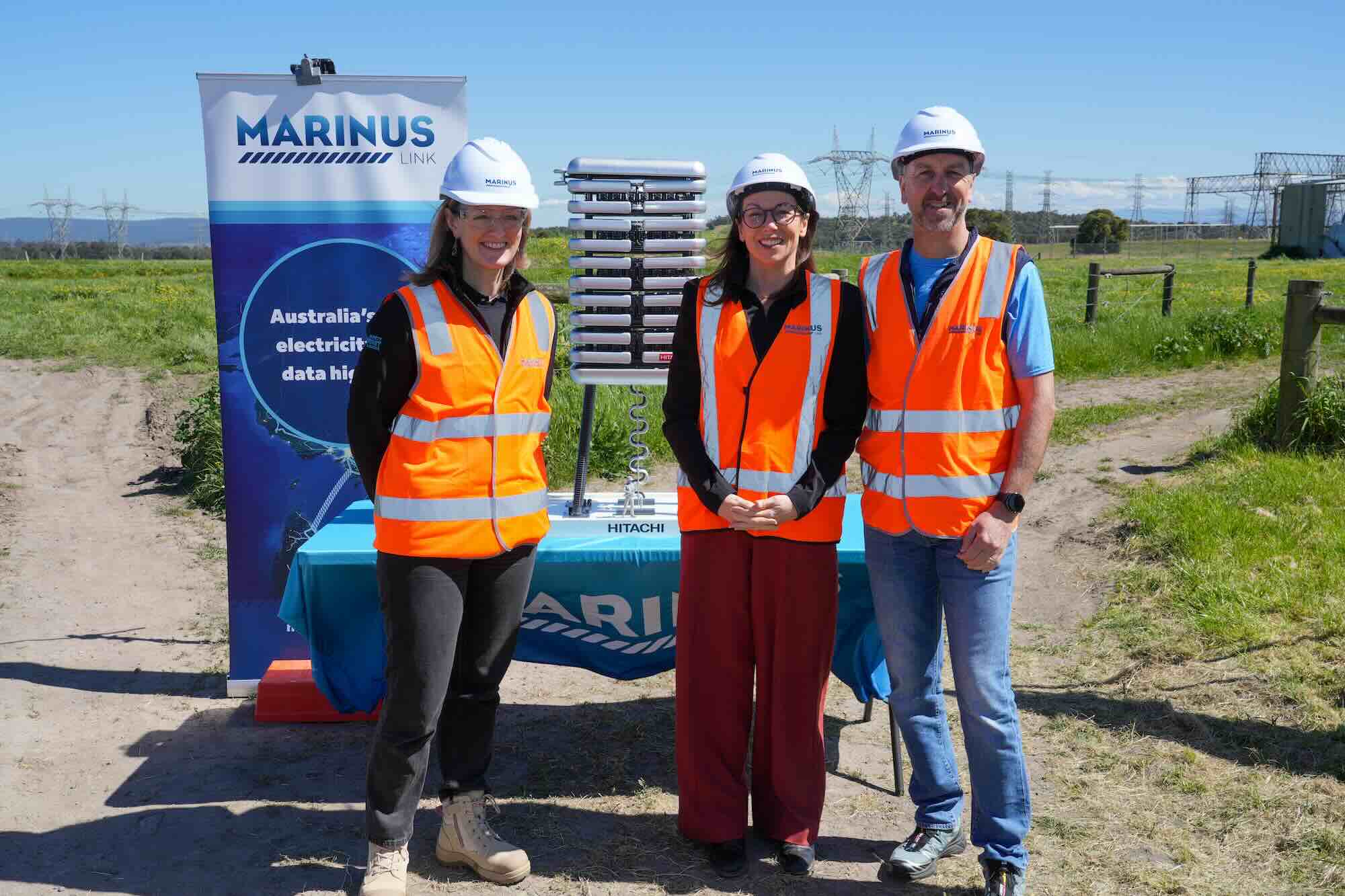
Speaking from a paddock in the Latrobe Valley that will soon host a huge HVDC to HVAC converter station – the end point of the 90 km line that will connect Victoria’s grid to the Marinus Link undersea cable – Symes said the state was now at a point in its energy transition where it was critical to stay the course.
“One of the questions I keep getting asked in this portfolio is, you know, you’re doing the same as the former minister. Of course I am! This is a policy area that is too important to make drastic changes that are not realistic,” Symes told reporters.
“Trying to tell people that there’s gas supplies that don’t exist. Trying to tell people that you can bring in nuclear quickly and cheaply. Like this is just a fantasy, and it is playing with communities … in a really unfair way.”
Symes was at the former dairy farm, which sits next to the Hazelwood Terminal Station in the thick of Victoria’s electricity generation and transmission heartland, to mark the launch of construction of the Marinus Link converter station – one of two that will use cutting edge grid forming technology supplied by Hitachi.
It’s a significant milestone for a significant project. And one that has courted controversy along the way – not least for its cost, which has gone from $1.3 billion for two 750 megawatt (MW) cables to more than $3.5 billion for one, first-stage 750 MW cable.
But as works at either end of the cable start to gather momentum, attention is turning to the details of the project, such as the hundreds of jobs it is creating in both Victoria and Tasmania, and the huge pieces of cutting edge electrical kit it will bring to Australian shores.
“The Hazelwood North Converter Station is one of two, with the other being constructed at Heybridge, in North West Tasmania,” Marinus Link project director Andrew Train told the small gathering at the site of the project on Friday morning.
“Each station will house four enormous transformers weighing 330 tonnes when installed, alongside 24 advanced valve structures standing 11 metres tall – equivalent to a three-storey building.”
The advanced high-voltage direct current (HVDC) valve technology that will be installed at the Hazelwood North Converter Station will enable electricity to flow efficiently between Tasmania and Victoria and will be the first deployment of grid-forming technology at both ends of an Australian interconnector.
Train says that this sort of configuration of technology is also a global rarity, with only about five projects around the world doing something similar – and none of those projects have been completed.
“With a gas or coal-based power system, the the whole thing acts as a big flywheel. It’s got momentum, and that gets you grid stability,” he told Renew Economy.
“What Marinus Link does is what’s called grid forming, and it does it at each end of the connection. So when power is coming from Tasmania to Victoria and vice versa from Victoria to Tasmania, it has the ability to gridform each each end. That’s unique.”
A scale model of Hitachi’s valve technology that was on display at the event gave some idea of the size of the machines that will be housed within what will wind up looking like a pretty regular, if very large shed. But the model rather understated the significance of the moment; a sort of changing of the guard of energy technologies in Victoria’s coal heartland.
“It’s really important for me to be down here today promoting an important project like this because it is all about ensuring that the lights stay on and power bills stay affordable,” said Symes.
“This is a change. It’s a new direction. Powering the state, powering the nation into the future relies on new renewable projects.
“We know that Latrobe Valley has powered the nation for many, many years, and this is a project that continues on that tradition.
“Victorians and indeed many people in Australia want affordable, reliable power, and that’s what these projects are all about delivering – it’s what is certainly at risk when you have ideology-driven decisions such as threats to [Western Renewables Link], VNI West.”
To join more than 29,000 others and get the latest clean energy news delivered straight to your inbox, for free, click here to subscribe to our free daily newsletter.