
Only about three in 10 home battery owners surveyed have signed up to join virtual power plants, with concerns about loss of control and a lack of trust discouraging a higher take-up, a new report by Rewiring Australia has found.
Of those opting to trade access to their storage, almost two-thirds joined Amber’s wholesale VPP, a provider that typically pays customers $25 per month as a reward for exposing them to fluctuating wholesale power prices. Despite that higher risk, about 75% of the wholesale customers reported being satisfied with the experience.
Rewiring Australia’s survey was “self-selecting”, eliciting responses from 407 battery owners via email and social media during May and June. Its objective was to glean people’s experience of purchasing and living with a battery, and their attitude towards VPPs.
The survey’s results offer some insights in how Australia’s army of new storage owners might use the 540,000-plus batteries they have installed under the Cheaper Home Battery scheme since its start in July 2025.
The Australian Energy Market Operator, in its 2026 Integrated System Plan, forecast that by 2050, just over half of home batteries would be coordinated as part of a VPP – or more than double the present proportion.
Losing control over their battery was the single largest reason for not signing up for a VPP, according to the Rewiring Australia survey.

Somewhat paradoxically, the most popular option for battery owners to sign up to a VPP presently involves ceding more control than what Rewiring Australia dubbed more conventional VPPs.
Amber’s wholesale offering accounted for 60% of VPP participants among survey respondents, with the remaining 40% choosing what those conventional options. The report cited Origin as one example of the latter, with its plan paying participants $1 per kilowatt-hour discharged to support the grid, up to a maximum draw of 200 kWh a year.
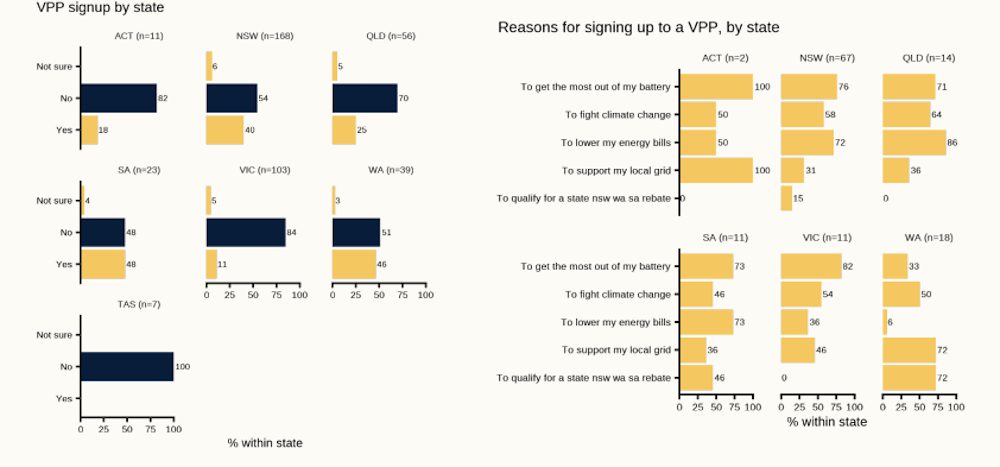
Among the states, support for signing on to a VPP was relatively high in South Australia, NSW and Western Australia, where state incentives seem “a likely cause”. Fighting climate change was other spur, along with lowering power bills and supporting the grid.
Rewiring Australia said VPP operators would need to offer more options to battery owners to get much of them to sign up.
“Sophisticated time-of-use plans which vary throughout the day will encourage those with batteries to shift loads away from the evening and into the middle of the day,” it said. “Simpler battery plans, like a daily evening export tariff or a reward for reducing grid energy use could allow other consumers to opt into a lower degree of flexibility alongside their main tariff and retain control of their battery.”
As energy analysts such Gabrielle Kuiper have long advocated, VPP comparison websites could cut through complexity. The report cited Energy Made Easy and the Victorian Energy Compare websites as examples now offering consumers tariff comparisons.
“They should estimate savings based on metered electricity data and incorporate some simple preferences (to allow for behaviour change based on a new tariff), providing qualitative descriptions about how each works,” the report said.
“Overall, these tools should help consumers to understand both the costs and rewards, as well as how they may have to adapt to make the most of a given offer.”
Transparency over how the benefits of VPPs are split would also help boost confidence in contracts. “In conventional VPPs, it remains unclear how the value from dispatching batteries in events is shared between operators and consumers,” the report said. “This lack of transparency may contribute to the low trust among consumers.”
A companion report on the survey also noted that about half of respondents reported being more careful of how they used electrical appliances once they had installed a battery.

In addition, about half of battery owners had switched electricity tariffs after installing storage. Those who did change plans mostly opted for a more dynamic tariff, such as a wholesale plan or a time-of-use tariff, the report said.
Rewiring Australia also noted the spread of storage offered other opportunities to offer dynamic pricing, such as the use of local network prices that could send signals based on a street or substation’s needs.
“Most of the VPP and battery reward tariffs at the moment are based on responding to the needs of the national grid, not the local network,” it said.
“Local pricing from networks could be used more dynamically and effectively to stimulate behaviour, such as to charge or discharge a battery, locally within our communities,” Rewiring Australia said.
To join more than 29,000 others and get the latest clean energy news delivered straight to your inbox, for free, click here to subscribe to our free daily newsletter.