The federal government will not grant exemptions for Queensland and the Northern Territory when it comes to setting national standards on how new data centres will be powered, unless they can show the energy supply is cheaper than renewable sources, climate change and energy minister, Chris Bowen, said.
Seeking to clarify “understandable” interpretations after this week’s meeting of national cabinet in Sydney – that had Queensland and the NT declaring “wins” over the use of coal and gas for new data centre projects – Bowen told Renew Economy on Friday that claims of exemptions for those two jurisdictions were wrong.
“We will, as we indicated, legislate binding national standards for data centres across the country without exception, which will require 100% renewables backed by firming, which can be gas,” Bowen said.
“The only concession made is that if a state-owned body feels that they have a case that they can have a mix which is cheaper than renewables, they are welcome to make that case to the Commonwealth. Commonwealth will consider it through the Australian Energy Regulator.”
The clarification follows speculation about what Prime Minister Anthony Albanese had agreed with the states and territories at Wednesday’s meeting. At a media conference at the conclusion of the gathering, Albanese said a common position had been reached that would allow “flexible” energy supplies.
Queensland’s treasurer and energy minister David Janetzki said the morning after on ABC’s RN Breakfast that Albanese had shown a “good streak of pragmatism” at the meeting.
“We’re very supportive of a renewable sector and we do believe there’ll be an opportunity for the renewables to feed into data centres, and we won’t be ruling out one energy form over another,” Janetzki said.
Bowen, however, on Friday, said it would be up to the Australian Energy Regulator to consider any claims for exemptions on a “case-by-case basis”.
“The regulator will have to be convinced that it would put downward pressure on bills and be cheaper than renewables,” he said. “That’s a high bar, appropriately.”
“Queensland or the Northern Territory can make that case if they wish, but it’ll be one which the Commonwealth will determine whether it meets our test, not the jurisdiction,” Bowen added.
“Importantly, the Commonwealth will decide through the AER whether to provide that exemption, not the state in question. So it is not a carveout, not an exemption, not an ability to use fossil fuels without the express permission of the Commonwealth.”
The minister also reiterated comments he had made in the weeks following the PM’s landmark speech on artificial intelligence, particularly that “no state can lead a race to the bottom” when it came to sourcing non-renewables to power the booming data sector.
The industry itself wanted clean energy sources, Bowen said. “They are the cheapest. Even Queensland has agreed with us.”
While solar and wind farms were being built in months and years, those seeking a gas turbine for generation would have a five-year wait, he said.
Separately, the government also released national data of greenhouse gas emissions on Friday. Emissions has been an aspect of the data centres expansion, as we noted here this week.
The latest figures show Australia’s emissions in the year to March 31 were estimated to be 455.6 million tonnes of carbon dioxide equivalent (Mt CO2-e), down 1.6%, or 7.5 Mt CO2-e, versus a year earlier.
The electricity sector continued to drive emissions lower in a sector that still accounts for about a third of the national total. Record levels of renewable energy supplies and storage has been pushing out dirty, expensive coal and gas generation from the grid.
As a result, sector emissions were down 3.7%, or 5.6 Mt CO2-e from the year earlier.
Reductions in fossil gas venting, a drop in underground coal mining, and more carbon capture and storage activities also helped drive down fugitive emissions. These dropped about 3.3%, or 1.5 Mt CO2-e.
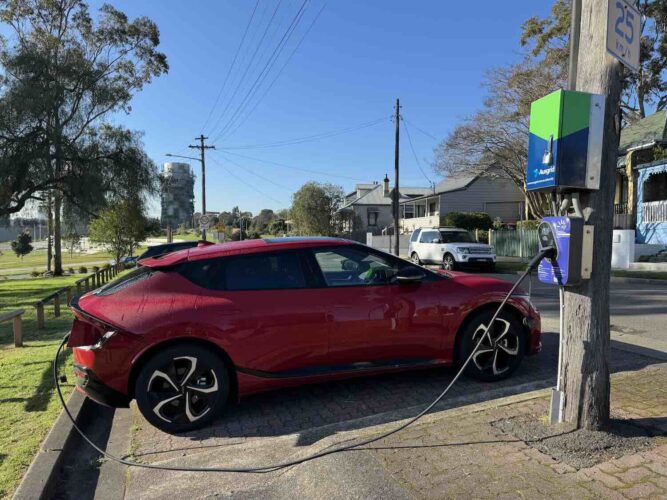
- A rise in diesel consumption – despite the outbreak of the Iran War in late February – lifted emissions from transport, as did an increase in domestic aviation. The increase was about 200,000 tonnes of CO2-e, or 0.2%.
Bowen said he was “particularly pleased with the ongoing progress on electricity”, with emissions 4.3% lower for the quarter alone and “battery discharge up 300% in a year.”
“The fact that transport emissions are slightly up, 0.2%, underlines the need to keep going,” he said. “[I]t takes a long time for things like the big EV update to start to impact on emissions … It’s always a big cruise ship to turn around.”
Emissions were also up from industrial processes and product use, rising 2.1%, or 0.6 Mt CO2-e, driven by increased steel use, the commentary accompanying the data release said.
The farm sector, which has seen some sell-off of livestock ahead of the developing powerful El Nino event the Pacific, also registered a drop of emissions. These were down 1.0%, or 0.8 Mt CO2-e.
Renew Economy sought comment from the Queensland and NT governments.