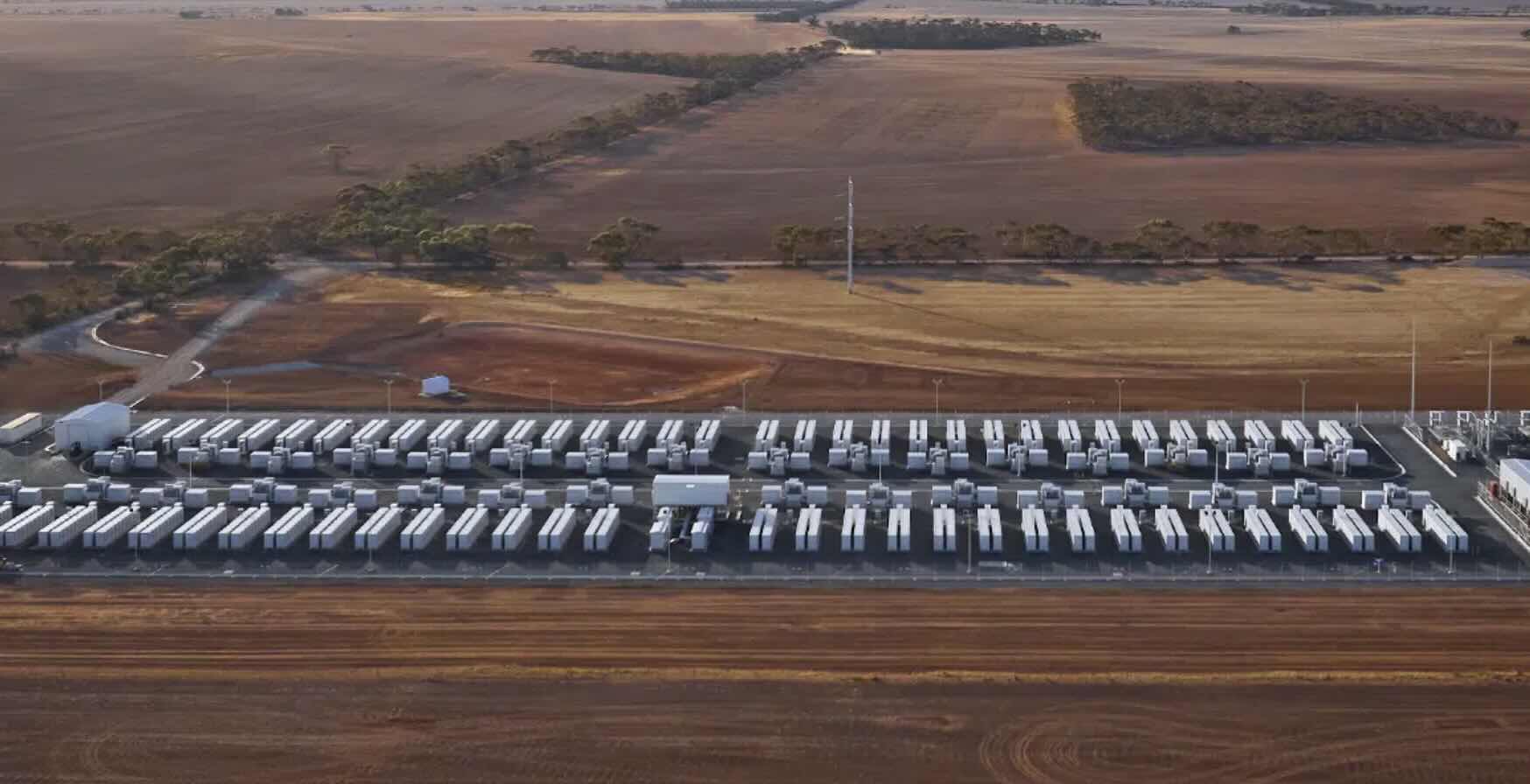
Battery storage technology has triumphed again over fossil gas generators after scooping the pool in an open tender designed to deliver firm supply at times of system stress in Australia’s most advanced renewable grid.
The so-called “firming tender” – announced by the South Australia government last October – was open to both flexible gas generators and big batteries that could demonstrate at least eight hours of storage.
The tender – officially known as the Firm Energy Reliability Mechanism – was designed specifically to ensure supply was available to the market at times of system stress as it reached and moved beyond its target of reaching 100 per cent net renewable by the end of 2027.
State energy minister Tom Koutsantonis said at the time he expected a mix of both battery and gas technologies to emerge, and ASL – the tender manager – confirms that bids were received for both technologies.
But the results of the tender announced on Friday morning show that big battery projects have scooped the pool, with a total of 517 megawatts of output capacity and 4,136 megawatt hours of storage capacity from six different projects.
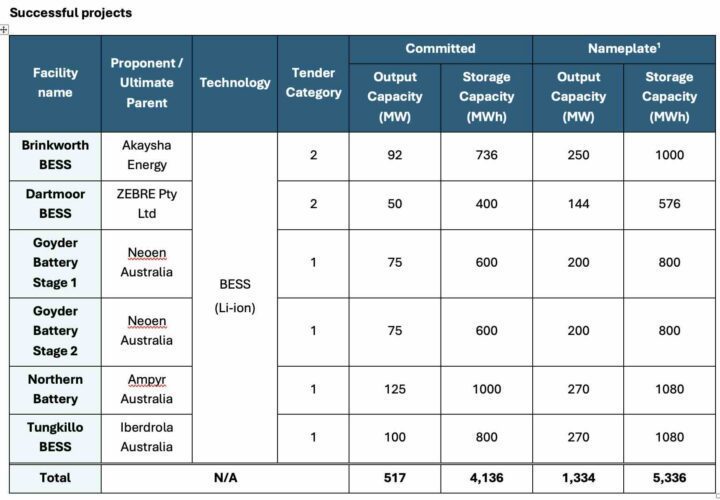
The biggest winner was Neoen Australia, a regular winner of these type of auctions, which won 15-year contracts for two stages of its proposed Goyder North battery, which already forms part of a deal to supply 100 MW of “base-load renewables” to mining giant BHP’s Olympic Dam operations.
The Goyder North contracts are for 75 MW and 600 MWh for each stage of the project, which will eventually total 400 MW and 1,600 MWh over two stages – supplying BHP and the requirements of this contract.
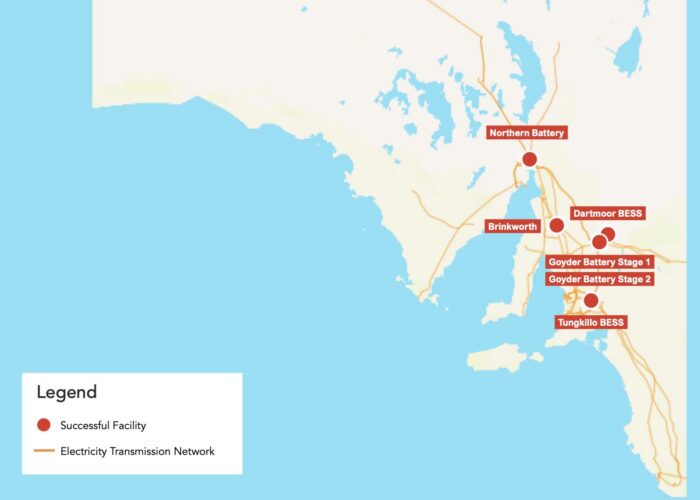
Other winners included Ampyr Australia, for the Northern battery to be built at the site of the last coal fired power station in South Australia, Iberdrola for its Tungkillo battery near Adelaide, Akaysha Energy for its Brinkworth battery and Zebre for its Dartmoor battery.
Tender manager ASL noted that all the winning projects would register with the market operator as four-hour batteries, but would be required to deliver the contracted capacity (usually much smaller than the nameplate capacity) for eight hours if called on during lack of reserve 2 and lack of reserve 3 events.
“Projects are able to use the additional capacity flexibly throughout their operation and are not required to operate as an 8 hour project outside the requirements of the FERMA,” ASL said.
It is yet another sign of the growing dominance of battery storage technology in Australia’s main grids (and off grid).
Big batteries have dominated other long duration storage tenders, particularly in NSW, were it has sidelined pumped hydro projects, and battery storage has been steadily sending gas peakers to the sidelines, particularly in the demand peaks they used to dominate.
The overall capacity awarded fell short of the original target of 700 MW for the first tender, mainly because ASL said the proponents of projects in the third band of the tender, due to be delivered by 2031, “did not demonstrate sufficient merit to be awarded in this Tender Round.” M
“The tender attracted robust competition, with successful projects performing strongly against the key assessment criteria,” ASL CEO Nevenka Codeville said in a statement.
“ASL’s evaluation prioritised projects with a clear and credible pathway to commercial operation, a meaningful contribution to system reliability, and strong value for SA electricity consumers.
“South Australia’s electricity system has already undergone a substantial transformation, with renewable generation now supplying more than 70 per cent of the state’s electricity. The projects secured through SA FERM Tender 1 will strengthen the power system by adding additional reliable, long‑duration dispatchable capacity.”
Gas projects will have more opportunities with the South Australia government expected to announce further tender rounds to boost its portfolio of firm capacity.
South Australia recently announced a contract with AGL to keep open two units at Torrens B because of delays in the completion of the Project EnergyConnect transmission link to NSW – a project that Koutsantonis is not a big fan of. The details of the contract have not been released.
Koutsantonis said in a statement that these six fast-tracked projects would take the state’s overall battery capacity to three-quarters of the state’s record peak demand, eclipsing all other state grids in Australia.
“All around the world, legacy generators are leaving the system, and that’s a reality we have been preparing for,” he said.
“We … are looking to the future with an innovative energy policy that creates certainty for both consumers and generators.
“The output this first stage tender commits to our energy system will ensure that South Australia remains at the forefront of the global energy transition, while also delivering the system resilience to protect consumers.”
The Goyder North, Northern and Tungkillo batteries are required to make their capacity available by November, 2028, with the other two batteries having a deadline of November, 2029.
ASL said in a market briefing that the best bids had clear timelines, a strong track record, and strong financial value. They had lower costs per MW of committed output capacity and storage, as well as lower revenue floors and payment caps.
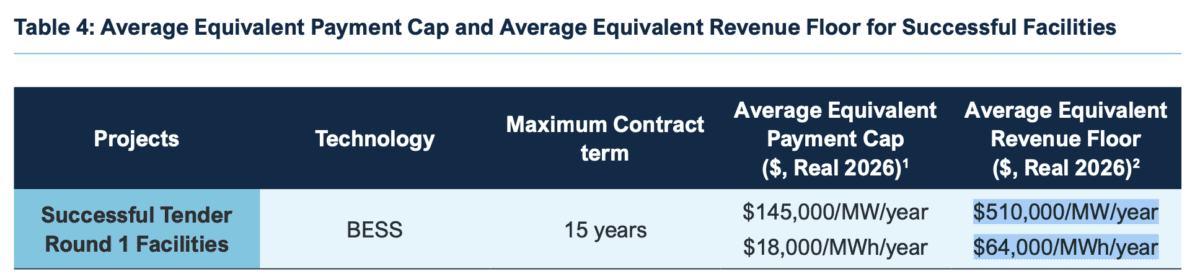
They published this table above to highlight the average average payment caps and revenue floors. As best as Renew Economy can understand it, it means if the revenue is below $510k/MW/Yr then the financial vehicle would provide a revenue top up that is capped at $145k /MW/Yr from successful facilities.
However, this does not mean that multiplying total capacity will deliver an answer on the total cost of the scheme, as some winning projects will have excluded years from the 15-year contracts, or made other variations.
If you would like to join more than 29,000 others and get the latest clean energy news delivered straight to your inbox, for free, please click here to subscribe to our free daily newsletter.