Australia’s biggest data centre proposal to date is set to cover 610 hectares of land, and will need four substations, three sheds to house its racks, and two 330 kilovolt (kV) power lines to hook into the grid and enough diesel capacity to keep the operations going for at least four days should the grid go down.
The first planning documents filed with the federal government’s EPBC process reveals that it will store 500 kilolitres (kL) of diesel on site — enough to fill 20 per cent of an Olympic sized pool — as well as 3,000 litre “day storage tanks” beside each generator.
These will provide 96 hours of backup for Iren’s 800 megawatt (MW) draw on the grid for its Bundey data centre complex, should the grid go down. The 800 MW power needs is equivalent to 550 MW of IT load.
The US-based data centre specialist Iren announced in June that it is planning to build the city-scale project near the Bundey sub-station, around 75 km north-east of Adelaide. Media reports estimate the total cost of the facility at about $10 billion.
It said then it was attracted to South Australia’s high share of renewable energy – already at 75 per cent share of wind and solar and heading towards 100 per cent net renewables next year, before the centre is built – although it will be required to contract new wind and solar to support its energy needs under new government requirements.
However, the Bundey centre, like others, will build huge capacity of diesel generators as back up for the grid. Batteries will be installed, but only with enough storage to allow time for the diesel generators to be switched on if needed. Iren says the diesel generators will be rarely used, but will be required to provide up to 96 hours of back-up if needed.
The project as a whole will need three data halls, worth around 200 MW of IT load each. Three primary substations will feed power to these and connect to a bulk substation, which will handle electricity coming in from the grid, via those 330 kV power lines.
The remainder of the site, which is currently used for growing crops and grazing stock, will house the diesel generators and fuel storage, car parks, access roads, and the buildings needed for the humans who will manage the site.
If Iren uses the largest diesel generators that are starting to be seen on hyperscale campuses — up to 4 MW each — that would mean mean the Bundey site could be storing about 1.1 million litres of enough diesel, or enough to fill nearly half of an Olympic swimming pool.
“Construction is anticipated to occur progressively over approximately six to eight years, with activities potentially proceeding concurrently across different work areas,” the EPBC referral says.
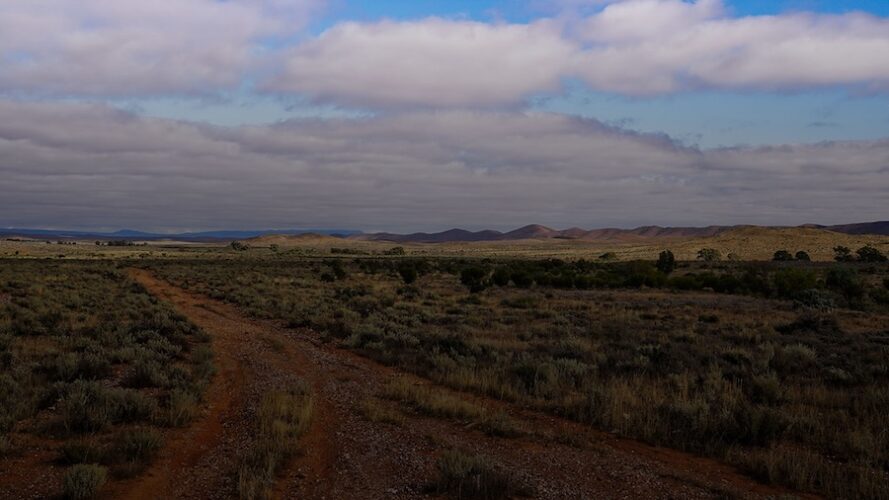
Part of the Bundey site where Iren wants to build. Image: Iren
The Bundey data centre is taking advantage of the Bundey substation, the hub that connects the Project Energy Connect transmission line from New South Wales (NSW) with the major proposed power lines linking Adelaide in the south and the swathes of energy projects planned to the north.
There are about 22 wind and solar projects either already operating in the 50km radius around Iren’s data centre site, or being planned, according to project tracker Renewmap.
This includes Neoen’s 802 MW Goyder wind development, which is already partly contracted to the likes of BHP for its Olympic Dam mine.
The water question
In often-parched South Australia the water issue could become a cause du jour given communities 100km to the north, from Burra to Peterborough, already fear the prospect of extreme shortages – particularly given last year’s drought.
SA Water has said it could supply 2.6 million litres a year to the Bundey data centre, in addition to water needed to fill tanks for the first time.
Iren told the ABC in June that it it would use “less than 1 per cent” of its on-site tank capacity a year, which the latest documents put at 33 million litres once the site reaches its full 550 MW IT load capacity.
Initially, however, it will need about 3 million litres per 50 MW load that it brings on.
Of the total 610 hectare site, which includes the corridor of land needed for power lines to connect to the grid, Iren expects to need to clear 270 hectares for the operation.
Some 100 hectares of this will be rehabilitated “to encourage natural regeneration”, the EPBC referral says.
Some 43 hectares is labelled an avoidance area, based on desktop analysis of threatened species habitats and sightings on site, and another 147 hectares will be a “retention” area used for conservation. It’s unclear if this will also be cleared land.
“The project area is in a rural area comprising a mix of land uses and vegetation types,” the EPBC referral says.
“Cleared agricultural land, currently grazed by sheep and historically cropped, occurs alongside chenopod shrubland and remnant mallee vegetation, both of which are subject to ongoing grazing pressure.
“Areas of higher ecological value vegetation are interspersed within more modified landscapes with no to low ecological value. Of the native vegetation present, some patches
have sufficient integrity and composition to meet the criteria for the Mallee bird community of the Murray Darling Depression Bioregion Threatened Ecological Community.”
The 610 hectares Iren wants to take over is a hive of activity for local bird and animal life.
Observers saw threatened bird species the southern whiteface and hooded robin, and a host of others that are important to the Murray Darling Depression Bioregion.
They found active hairy-nose wombat burrows, evidence of two species of kangaroo, and a range of reptiles.
But they also saw rabbits and foxes, and have strong suspicions that feral cats are likely to be using the area as well.
If you would like to join more than 29,000 others and get the latest clean energy news delivered straight to your inbox, for free, you ca click here to subscribe to our free daily newsletter.