
Australia’s green bank hopes to sign multiple deals to kickstart major wind farm projects over the next year, with ventures in NSW and Queensland the focus, says Paul McCartney, the new chief executive of the Clean Energy Finance Corporation.
McCartney, who was the CEFC’s chief investment officer before succeeding Ian Learmonth in the top job four weeks ago, says wars and “hyperinflation” in the costs of building new wind projects mean the CEFC will have to step back into a sector it had largely exited.
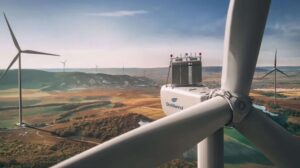
“In six to 12 months, I would hope that you would see hopefully more than one announcement where we’re actively supporting wind,” McCartney told Renew Economy in an interview on Friday. “There’s some projects in Queensland, potentially which we’re in discussions with, and projects in NSW as well.”
Origin Energy chief executive Frank Calabria this week said the economics of its proposed 1.5-gigawatt Yanco Delta wind project remained “challenging even with support from the [federal] capacity investment scheme”.
Asked whether the CEFC might intervene in that project to help, McCartney said, “look, it could”.

Wherever large-scale wind projects had challenging economics, or where power purchase agreements “maybe don’t match up”, the CEFC was prepared to enter “almost at the 11th hour to try and help that”, he said.
“That cost inflation on the supply chains and that borrowing cost expansion really has recreated a big need for us to step in and actively work out how we can help,” McCartney said, adding solutions would vary.
“Sometimes it might just be a scale-liquidity issue in the market. Other times it might be that the economics are strained, and we need to look at how we can help alleviate that,” he said.
The federal government this week touted figures from the Clean Energy Regulator showing a record 1.1 GW of new wind farms had reached a final investment decision in the September quarter.
The figures, though, masked wind’s lagging performance in NSW, one of the states most in need of new generation to fill the void that will be left once aging coal plants exit the grid. Only one wind farm has started construction in the past four years.
McCartney said part of the problem for wind farm investment stemmed from “capex blowouts” and revenue issues, but also the sector’s reduced appeal to lenders.
“There’s probably a general cooling in the sector, I think, of the commercial banks’ appetite,” he said. “We may be required also just from a liquidity and capacity angle to help get some of these projects up.”
The CEFC has not been entirely absent from the sector, however. Last year, the bank’s renewables team played a key role in breaking the so-called “wind drought”.
Prior to the CEFC’s supply of $247m in senior debt investment in December, there had been no new, large-scale wind projects in the Australia during 2025.
The funds supported three wind farms, all of which have started construction – including the Carmody’s Hill wind farm investment with Aula Energy in South Australia.
In the first eight years since the bank’s inception in 2012, the CEFC had financed 12 large-scale wind farms and more than 30 utility scale solar farms. It also provided $50 million in debt to bring the first big battery, the Hornsdale Power Reserve in South Australia, on line.
The CEFC could yet intervene to support solar farms or even more storage, if that’s what the market needed to be unblocked.
“Don’t take what I’m saying as exclusively wind,” McCartney said. “We want to creating more and more renewables but we do have a big focus on wind because of the well-known problems.”
“Solar, of course, has got its own sort of struggles today,” he said. “If you don’t have a storage element for time shifting, it’s difficult.”
McCartney said he could see why some might consider the CEFC a “Swiss Army knife” of the renewables sector given its many roles, it’s not a term he would use.
“[W]e have a highly flexible act under which we’re established across renewable energy, energy efficiency, and low-emissions technology,” he said.
An example of that versatility can be seen in the bank’s role in supporting Snowy Hydro in providing the clean energy needed to underpin the $2.5b package to extend the life of the Tomago aluminium smelter in NSW’s Hunter Valley.
“If we can support [some wind farms to] help Snowy in their venture with Tomago, fantastic,” McCartney said.
“Our best role to play there is trying trying to crowd-in and bring on the renewals at affordable prices,” he said. “[What] we saw with Tomago is potentially an opportunity there to get PPAs written to help drag the wind through and unblock things a bit and get stuff moving.”

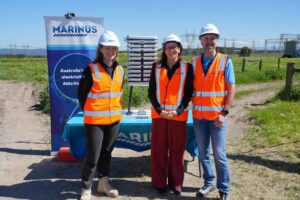
CEFC’s $3.8b support for the $5b Marinus Link was another example, with the bank preparing to support the modernisation of Hydro Tasmania’s hydro plants – some of which are about a century old.
The support would including improving water carriage systems to give turbines the capability to turn on and off as it’s needed, rather than a very long delay with non-pressurised systems”, he said.
In turn, that would help the effectiveness of Marinus Link when that transmission connection across Bass Strait opens.
“You’ve got plenty of daytime solar on the mainland,” McCartney said. The objective would be to have “Tasmania benefit from those very low price events during that time, and then having a flexible hydro scheme that helps act as a bit deeper storage”.
The CEFC would also rejig its internal divisions, post-Learmonth, to focus expertise on several key areas, including electricity, transport, and consumer energy resources and virtual power plants
Electric passenger vehicles “are going amazingly well”, McCartney said. The CEFC’s focus will be on more commercial EVs, particularly heavy transport, and charging networks.
On the home energy upgrade front, a CEFC fund is targeting households to provide them with the upfront finance to install solar panels, batteries, heatpumps and other devices to electrify their homes.
McCartney said work by the CSIRO showed households could save as much as $2500 a year.
Soaring global interest rates – fuelled in part by the artificial intelligence and data centre borrowing binge – actually reinforces CEFC’s appeal to commercial counterparts.
“AI is just soaking up a lot of capital globally, so it’s putting pressure [via a] scarcity of capital to lift the cost of capital, he said.
While the CEFC is required to operate atno cost to the Australian taxpayer, its access to lower borrowing costs and the absence of Australian Predential Regulation Authority (APRA) requirement gave the green bank more flexibility.
“So I see we’re now needed more than ever,” McCartney said.
“Everything’s getting more expensive so we really need to push forward and get it done.”
To join more than 29,000 others and get the latest clean energy news delivered straight to your inbox, for free, click here to subscribe to our free daily newsletter.