
Senior CSIRO scientists have had a candid internal discussion about the threats posed by a warming world and how to convey them to the public, including that northern Australia will become unliveable and Great Barrier Reef corals that “all turn white forever”.
Renew Economy has viewed videos from a multi-day internal CSIRO workshop, livestreamed from Adelaide, that explored how the CSIRO would reprioritise research after the latest round of deep staff cuts. CSIRO lopped as many as one in four researchers covering environment, including at least one third of its climate modellers.
Dan Metcalf, the head of the environment research unit, responded to a detailed question from one senior colleague, who noted the recent suppressed UK national security assessment on global ecosystem threats.
The colleague asked whether “the capability in this room and across CSIRO” could also be applied to the complex interplay of threats from climate change, energy use and artificial intelligence, adding he wasn’t sure the agency was “being sufficiently blunt and accurate” in its advice so far.
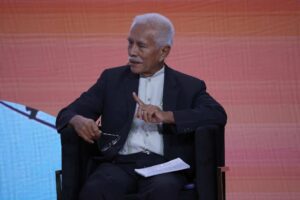
“I think you’re absolutely right,” Metcalf said. “So, given that we’re live streaming, I’m not going to name the department I was talking to, but we were being exhorted to to do work about ecosystem collapse, and about what we could do to maintain some functionality, because government and community was not ready to consider that yet”.
“And we can do the work, but I wonder … whether we should take responsibility to actually have that as an open conversation, because by the time it becomes the bleeding obvious, it’s too late,” he said.
“[I] think it is beholden to us to start looking at what would depopulation of Northern Australia look like because it was too hot and too dry, and it burned too much to feasibly maintain people there,” Metcalf said.
“What will we do when the northern parts of the Great Barrier Reef all turn white forever?” he said, adding there was “an opportunity to say this is the dystopian future that we are blindly wandering towards, and here are some of the coping mechanisms that we have available to us.
“They might not revert us to where we used to be, but what are the alternative futures that we might consider,” Metcalf said.
The candid comments among some of Australia’s most senior researchers have rarely entered the public realm in Australia, and even more rarely have they stirred public debate.
The country’s first National Climate Risk Assessment (NCRA), might have made a bigger splash in its exploration of the perils Australia faces from warming world had its release not been delayed by the Albanese government until after the May 2025 election, as some contributing scientists have said.
At the time of the NCRA release in September 2025, journalists were given little time to absorb the hundreds of pages, including in supplementary material, and a complementary National Adaptation Plan, before a media conference. Few returned to examine the overall findings in depth.
A closer reading would have come to similar conclusions as Metcalf and others within CSIRO and the wider science community, that outdoor life in northern Australia in particular may become unliveable for much of the year because of rising humidity and heat.
Many knowledge gaps were identified in the NCRA report but the Albanese government has not indicated it has any follow-up plans for future NCRAs.
Independent ACT senator David Pocock told Renew Economy that scientists “have been clear that we are facing major shifts in our climate, which are likely to spark ecosystem collapse and make parts of the country uninhabitable”.
“It’s reassuring that at least some public servants are thinking about what that means and how we’ll need to adapt as a country,” Pocock said.
“But the Albanese Government is one of the most secretive in living memory,” he said. “It’s still refusing to release the Office of National Intelligence’s climate and security risk assessment, nearly four years after receiving it. Australians deserve an open and honest conversation about the scale of what’s coming.”
“We also need to invest far more in research and adaptation, starting with permanent, indexed funding for CSIRO, which has shed hundreds of scientists, including in key capabilities such as climate modelling,” Pocock said.
Renew Economy sought comment from the Department of Climate Change, Energy, the Environment and Water, and Minister Chris Bowen’s office. The inquiry was passed on to Senator Tim Ayres and his industry department.
Asked about the internal discussions seen by Renew Economy, a CSIRO spokesperson said Australia was “particularly exposed to climate change with extreme heat, drought, bushfires and flooding posing growing risks to communities, ecosystems and the economy”.
“CSIRO’s strengthened focus on climate adaptation and resilience will ensure we continue to deliver practical science to help manage climate risk, including coincident, consecutive and compounding events,” the spokesperson said.
However, within CSIRO, scientists view the cramming together of disparate research groups into a Nature Research Area – combining “future water”, “integrated ocean stewardship”, “climate, nature and community resilience (CNCR)”, and “decarbonisation pathways” – as creating a “grab-bag” that will make focus difficult.
Within its CNCR unit, for instance, “lessons learnt” include how to bring together “different domains, methods, appoaches, and science framings, together with a diversity of exising projects…”
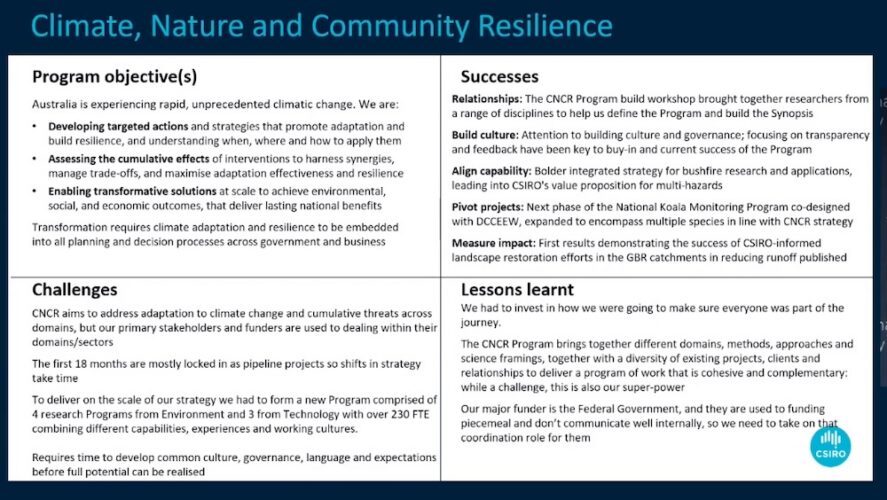
In addition, CSIRO’s major funder was “used to funding piecemeal and don’t communicate well internally, so we need to take on that coordination role for them”.
CSIRO’s spokesperson, meanwhile, described climate change and environmental protection as “a transgenerational challenge that requires a steadfast resolve to tackle”, adding that one issue was the relatively low ranking the issue had within the Australia community.
“For example, the latest Ipsos Issues Monitor for Sept 2026 places it 11th on the list of issues that Australians are most concerned about,” the spokesperson said – underscoring perhaps the need for the “open conversation” advocated by Metcalf.
That low ranking “underscores the challenge faced by researchers and policy makers in addressing the issue amidst a growing number of other acute issues that require national focus and attention”. Other nations faced the same challenges across successive governments, and their agencies and departments.
“This is the context in which Dr Metcalfe made the remarks at the CSIRO science workshop as he was responding to a hypothetical, scenario-based question,” the spokesperson said. “The remarks were a commentary on the challenge we face as a community.”
Zali Steggall, a Community Strong Australia MP, said Australia couldn’t develop an effective adaptation strategy without investing in the science that underpinned it.
“I’m deeply concerned about the state of funding for Australia’s scientific institutions and research capabilities,” Steggall said. “We need sustained investment in climate science, modelling and risk assessment so we can better understand the threats we face and maximise our capacity to adapt.”
Steggall has been pushing for a legislated National Climate Risk Assessment framework, “to ensure that assessing climate risks, planning for adaptation and reporting on progress become enduring obligations of government, rather than one-off exercises”.
“We need a National Climate Risk Commission to oversee the full co-ordinated implementation of adaptation across the country,” she said.
“The UK provides a significant example of bringing together climate science, national security expertise and long-term risk assessment together to inform government decision-making,” Steggall said.
“Australia could take a similarly coordinated approach, involving our scientific institutions, defence and national security agencies, state and local governments, and communities.”