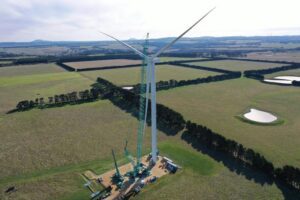
Spanish energy giant and renewable energy developer Iberdrola has lobbed its second New South Wales (NSW) plantation wind project into the federal EPBC queue, asking for environmental approval for 21 turbines to be erected in a state forest.
The Four Mile Creek project will have a capacity of 158 megawatts (MW) within the Canobolas state forest, south-west of Orange, the smallest of the five projects solicited by the state’s Forestry Corporation in 2023.
Iberdrola referred its 248 MW Mullion Creek project to the EPBC, itself 20km north of Orange, a week earlier.
Forestry Corp says its softwood plantations are good locations for wind power given they’re monocultures with little native vegetation and because the trees will be cut down eventually anyway.
“This forestry land use has resulted in a highly modified and degraded ecological condition across the majority of the site. Native vegetation is limited and fragmented, occurring mainly as small grassy forest patches and riparian remnants,” the EPBC referral says.
“Fauna habitat quality is generally low, reflecting the dominance of plantation forest, although limited higher quality habitat.”
Wind energy is not the only extra industrial use that companies would like explore in the forest.
The EPBC referral shows there are eight current mining or exploration licence applications over the same area.
Iberdrola is looking at an area of 5,911 hectares of which the 21 turbines will live in a 321 hectare ‘disturbance area’ that takes in the other infrastructure needed to build them.
These will have a blade tip height of up to 250m and a hub height of 150m above ground level, and connect via underground cables to an on-site substation.
A single federally listed Threatened Ecological Community (TECs) was found inside the almost 6,000 hectare site, a white box-yellow box Blakely’s red gum grassy woodland and grassland, albeit patches that aren’t in good health.
Surveys found evidence of seven threatened animals in the region, including the superb parrot and large-eared pied bat, but the referral says more work needs to be done to work out whether any of these live in the areas where turbines might be built.
Iberdrola bought Infigen Energy in 2020, and with it a wind, solar, battery and gas portfolio that is now sized at 2.4 gigawatts (GW). The company says it’s invested $2 billion into Australian renewables.
If you would like to join more than 29,000 others and get the latest clean energy news delivered straight to your inbox, for free, please click here to subscribe to our free daily newsletter.