Australian thermal energy storage hopeful MGA Thermal has taken the next key step to developing what is set to be Australia’s largest industrial-scale thermal storage project.
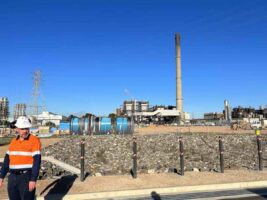
It announced this week that it has begun a Front-End Engineering and Design (FEED) study for a proposed 195 megawatt-hour (MWh) electro-thermal energy storage (ETES) to be built at global chemicals and mining company Tronox’s Kwinana pigment plant in Western Australia.
The 195 MWh ETES project will use MGA Thermal’s proprietary thermal energy storage (TES) technology which has been proven to be economically competitive with traditional fossil fuel technologies at an industrial scale, according to a pre-feasibility study carried out by MGA Thermal and Knode in 2025.
The FEED study, backed by a $2.95 million investment from the Australian Renewable Energy Agency (ARENA), is a significant milestone for the flagship thermal storage project and builds on the work carried out during the pre-feasibility study.
“Commencing the FEED study is a significant step – it’s where engineering challenges are resolved, and the pathway to FID and construction becomes real,” said Mark Croudace, CEO of MGA Thermal.
“This project is the first of several we are actively developing, and it demonstrates that MGA Thermal’s technology is ready to scale across industrial and manufacturing sectors.”

Image Credit: MGA Thermal
Construction of the project is currently expected to get underway in 2027 with support from Sydney based civil engineering company GHD, with commercial operation expected for some time in 2028.
When completed, the project will deliver approximately 20 tonnes per hour of renewable steam to Tronox’s Kwinana facility under a Heat as a Service agreement, helping Tronox to avoid 38,000 tonnes of CO2 emissions each year and boasting the potential to eliminate fossil fuel usage entirely if eventually deployed at scale.
“Industrial operators have been waiting for clean energy to make economic sense at their scale,” said Croudace.
“Price parity with fossil fuels has been the bar. We have cleared it. Now, with Knode, we’re building. While the upfront investment is significant, first movers will reap the benefits, leveraging available funding to lock in lower long-term energy costs and reduce exposure to rising fossil fuel prices.”
MGA Thermal’s TES technology uses so-called MGA Blocks using its patented Miscibility Gap Alloy (MGA) material which can store and deliver thermal energy while remaining outwardly solid.
The blocks are designed using two key materials – tiny metal alloy particles dispersed through a matrix material. The small particles melt as the blocks are heated and energy is absorbed even while the matrix material itself remains solid, keeping the molten particles in place.
This allows energy to be stored in the solid-to-liquid phase and release as the blocks cool.
ARENA has also awarded MGA Thermal a further $3.25 million in funding for five separate FEED studies regarding the deployment of its TES technology, funds that MGA Thermal says will power its active industrial projects pipeline.
If you would like to join more than 29,000 others and get the latest clean energy news delivered straight to your inbox, for free, please click here to subscribe to our free daily newsletter.