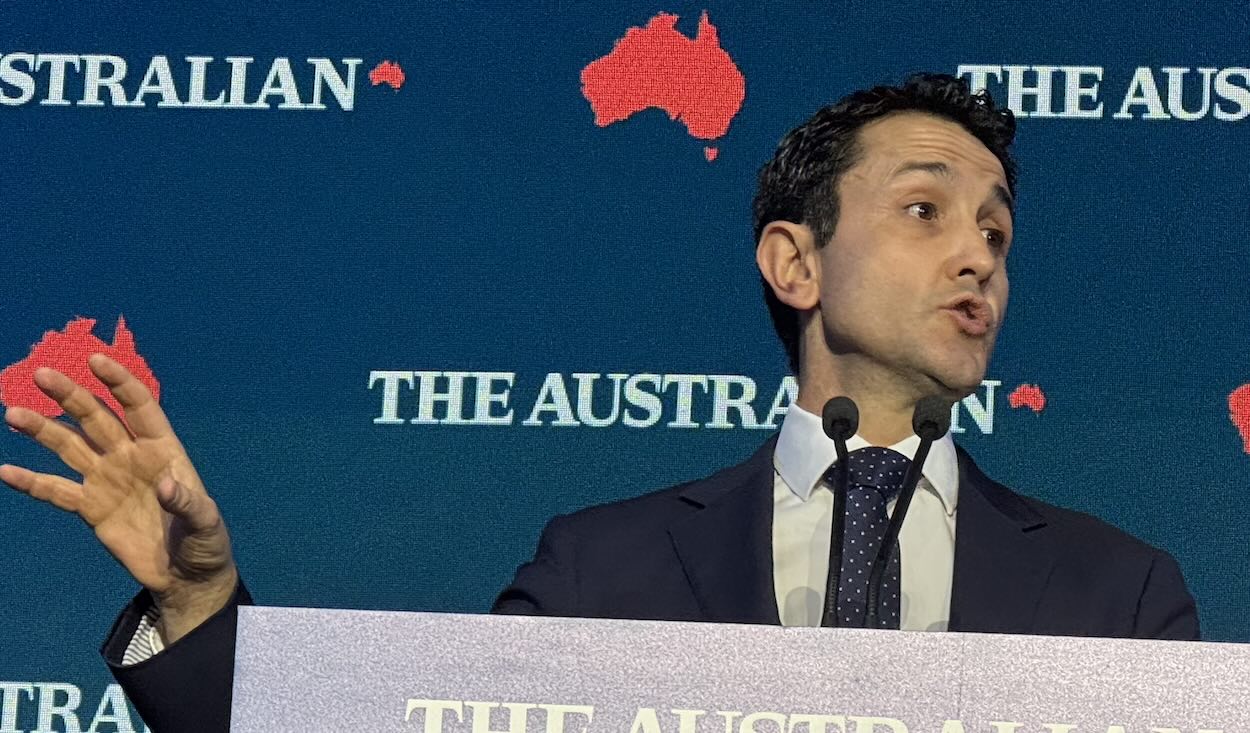
Queensland’s premier David Crisafulli has restated his state’s intent to power new data centres from coal and gas, while also rejecting key elements of the new energy and climate policies proposed by his federal Coalition counterparts.
Crisafulli told the Australian’s energy conference in Sydney on Wednesday he had secured an exemption for Queensland at last month’s national cabinet meeting to permit the state to source the extra electricity from non-renewable sources.
“I was very, very firm on making sure that we got a carve-out,” he said, adding the Albanese government had sought to have new data centres “fuelled entirely by renewable energy, [much] of which isn’t in the grid yet”.
Prime minister Anthony Albanese had granted his state an exemption to his “great credit”, Crisafulli said. Queensland’s control over much of the state’s power generation and distribution placed the state in “a very unique place’ when it came to attracting data centres.
Crisafulli’s comments contradict those of federal climate change and energy minister Chris Bowen, who declared two days after the national cabinet meeting that neither Queensland nor the Northern Territory had received any such carve-outs.
The Commonwealth has been sending mixed messages over whether it will use its approval powers to stop data centres that tap more fossil fuel energy.
Its consultation paper, released last week stoked fears about loopholes that could see the centres securing the nod without adding additional renewable generation capacity. The booming sector’s potential carbon emissions consequences have also largely been downplayed by the government.
Crisafulli, though, also indicated this state would go a separate way from certain elements of the federal Coalition’s new climate and energy policies – also announced on Wednesday – that some critics decried as “dumb and desperate”.
Prodded by an editor from The Australian whether Queensland would lift the state’s moratorium on nuclear energy – as called for in the Coalition’s new policies – Crisafulli said his policy stance hadn’t changed since prior to be elected.
“Until you get both sides of federal parliament to agree, no one’s going to invest in [nuclear energy,” he said. “To bring on a nuclear reactor of any size, it will take some time … several terms.”
“[Y]ou’ll have one side of politics say, well, if government changes again, we’ll cancel those approvals,” he said. As a result “people won’t invest in it”.
Tehan, though, later told the energy forum the Coalition wanted to lead national discussions on nuclear energy.
“My view is if we lead that national debate, then the states and territories will follow,” Tehan told the gathering, according to The Australian.
“What you’ll see from us is national leadership when it comes to nuclear, because I can tell you, the technology, the innovation, our best nuclear engineers, they’re all going to the United States or elsewhere to pursue this,” he said. “Australia is missing out.”
Crisafulli also declined to answer whether Queensland should ditch its net zero emissions policy by 2050, as the federal Coalition advocates.
There was no “identity crisis” because Queenslanders could see “our energy plan, they’re living it, and it’s working … We’re ticking all three boxes: affordable, reliable, sustainable,” he said.