London-based energy storage specialists Highview Power has unveiled plans to build the United Kingdom’s first large-scale and commercial cryogenic energy storage facility – a 50 MW/250 MWh energy storage system utilising the inherent natural properties of liquid air.
Cryogenic energy storage is based on the fact that air turns to liquid when it is cooled down to -196°C (-320˚F), allowing it to be efficiently stored in insulated, low-pressure vessels.
Conversely, exposing the liquid air to ambient temperature causes rapid re-gasification and a 700-fold expansion in volume which is subsequently used to drive a turbine and create electricity without combustion.
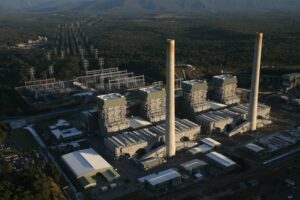
Highview Power announced on Monday plans to develop the 50 MW/250 MWh cryogenic energy storage system at a decommissioned thermal power station in the North of England.
The project will be the first such project in the UK and will not only supply energy storage but will also provide valuable grid stability services to the country’s National Grid – helping to integrate variable renewable energy generation and ensuring future energy security.
Announced at the BloombergNEF (BNEF) summit in London, the cryogenic energy storage facility will utilise Highview Power’s patented CRYOBattery which uses only benign materials with zero emissions and which has zero water impact.
The company bills its CRYOBattery as “the only freely locatable energy storage solution on the market today that delivers clean, reliable, and cost-efficient long-duration energy storage with grid synchronous inertia.”
It says the CRYOBattery can store energy for weeks at a time – instead of only hours or days – and at approximately £110/MWh for a for a 10-hour, 200 MW/2 GWh system, offering what Highview Power describes as “the lowest levelized cost of storage for large-scale applications.”
“We are excited to begin working on our first commercial UK project at scale to become the largest battery storage system in Europe and support the National Grid,” said Highview Power CEO Javier Cavada.
“This CRYOBattery plant will provide the critical services needed to help maintain a stable and reliable grid. Long-duration, giga-scale energy storage is the necessary foundation to enable baseload renewable energy and will be key to a 100% carbon free future.”
Energy storage is expected to continue to decrease in cost and increase in development and capacity over the coming decades – with Bloomberg New Energy Finance predicting energy storage insatllations will grow to 1,095 GW/2,850 GWh by 2040, requiring $662 billion in investment.