The 2.2 gigawatt Star of the South project proposed for construction off the coast of Gippsland in Victoria has officially launched its bid for environmental approval, marking a major new milestone for Australia’s fledgling offshore wind industry.
Southerly Ten on Monday published the draft Commonwealth Environmental Impact Statement (EIS) and Victorian Environment Effects Statement (EES) for the Star of the South, opening them to public review and comment until the end of June.
The call for public submissions is the first step in the federal and state government environmental assessment process that, ultimately, will play a critical role in whether or not the huge project can go ahead – informing the range of Commonwealth and Victorian government approvals that are required.
Erin Coldham, the chief development officer at Southerly Ten, says the two main reports, totalling 2,500 pages, have been several years in the making – and probably closer to 15,000 pages if you include all the separate technical reports – and the company has worked hard to set a strong precedent.
“After five years of research, consultation, and technical studies, our environmental assessments are ready for public review and comment,” Coldham says in a video message.
“Our studies cover a wide range of topics. They identify the potential effects of constructing, operating, and decommissioning the project and explain how we will protect the environment at every stage.”
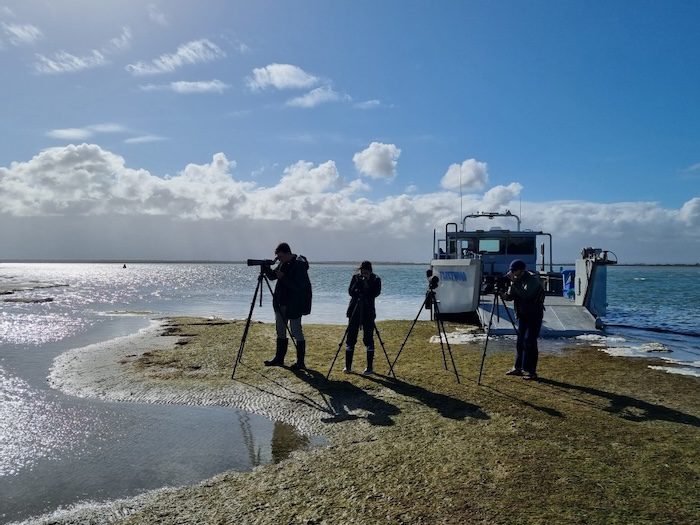
Among the studies is the largest-ever marine ecology survey program of Bass Strait, completed over three years between 2021 and 2023 involving surveys, satellite tracking and underwater monitoring to study birds, fish and other marine life.
Among the 26 technical reports made public by Southerly Ten, these include deep-dives into Benthic Ecologies, Fish and Invertebrates, Offshore Ornithology and Bats, Electromagnetic Field Exposure, Onshore Noise and Vibration and Underwater Noise Modelling.
Coldham says Southerly Ten has also tried hard to make the multitude of comprehensive reports accessible to the broader public, by breaking them into a range of more digestible summary reports, information chapters and technical chapters.
Facts and figures
As the draft EIS explains, the Star of the South proposes to install up to 147 turbines at a maximum height (from the water to the blade tip) of 350 metres, within a 586 km2 licence area, between 10 to 40 km off the Gippsland coast.
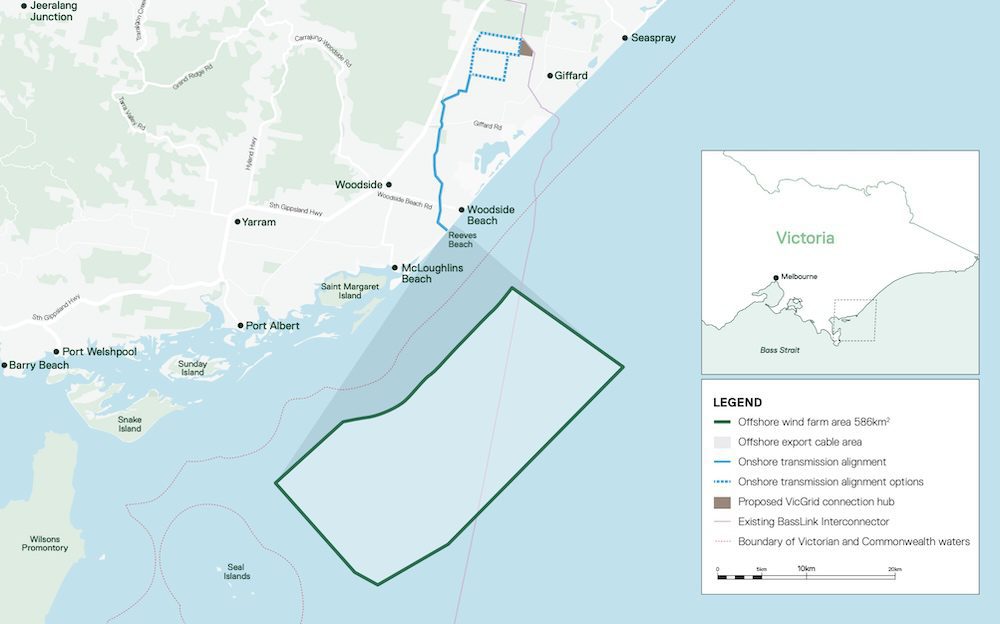
Image: Southerly Ten
Inter-array cables would connect each turbine to one of up to five substations, and would transmit electricity at a lower voltage (66 kV) and be buried in the seabed at a target depth of between 0.6 and 2 metres.
To get the wind power ashore, the project would install up to eight offshore export cables, which would transmit electricity at a higher voltage (up to 275 kV) and would be buried in the seabed at a target depth of between 1-2 metres.
Onshore cables will be installed underground within a 40 metre-wide easement, with a maximum of eight circuits to be buried 1 m deep in up to four trenches. The cable route of approximately 30 km will connect to the grid at the proposed VicGrid connection hub in Giffard.
The documents say offshore construction is expected to take up to five years. For wind turbine installation, turbine components are pre-assembled at port and then transported to site and installed using a specialised vessel.
Site preparation activities will include survey and “clearing the seabed of obstacles or hazards.” Offshore export cable installation will be done using specialist cable laying vessels, using methods including ploughing, jet trenching or mechanical trenching.
Foundations for the turbines and substations will be piled or drilled into the seabed using equipment on large vessels. The report says several turbine foundation options were assessed, with monopile foundations found to offer the best solution for the project, based on technical suitability, cost, logistics, and constructability.
Shore crossing construction – where the undersea cables are connected to the land cables – is expected to take up to two years and three months. Southerly Ten says a drilling will be used to install the shore crossings to avoid trenching in the sensitive nearshore and coastal environment.
A temporary construction compound on private land north of Reeves Beach will host the drilling and cable jointing activities and provide storage and worker facilities.
Southerly Ten says the project’s location and design have sought to minimise adverse environmental impacts, including siting turbines to avoid reef habitat on the seabed and lifting the lower tips of turbines to 35 metres to greatly reduce risk to birds.
Mammals, fish and birds
The documents say the assessment identified 18 marine mammal and turtle species that may use or migrate through the study area, while nine marine mammals and one turtle species were observed during visual aerial surveys – although most of those sightings (87%) were outside the project area.
The species include the Common Dolphin, Bottlenose Dolphin, Humpback Whale, Southern Right Whale, Dwarf Minke Whale, Bryde’s Whale, Pygmy Blue Whale, Killer Whale and a fur seal. A ‘likely’ single Leatherback Turtle was also sighted west of Wilsons Promontory.
Vocalisations from Humpback Whales, Dwarf Minke Whale, Antarctic Minke Whale, Australian Pygmy Blue Whale and New Zealand Pygmy Blue Whale
were picked up with underwater acoustic recorders, the report says.
Of the fish and invertebrate species, field surveys identified 163 species in the study area, including 29 sharks and rays, 103 bony fishes and 31 invertebrates.
Five species listed under the EPBC Act were either observed or are likely to occur in the area, including the Australian Grayling, Blue Warehou, Syngnathids, School Shark and White Shark.
Field surveys also identified 50 seabird species, of which 35 were present in the offshore wind farm area. Species of interest include albatross, petrel, prion, shearwater, gannet, tern, cormorant, gull, jaeger and skua species.
The offshore wind farm area does not fall within the main migratory routes between Tasmania and Victoria for conservation important species such as
the Orange Bellied Parrot, Swift Parrot and Tasmanian Boobook. And no evidence of bats was detected.
Big changes over time
The documents note that since the project’s inception, back in 2017, the maximum number of turbines has been reduced from 400 to 147, thanks to technological advancements.
The “air gap” – or distance between the water level and the bottom blade tip – has increased from 25 m to 35 m after modelling found that this will significantly reduce collision risks for birds.
During construction, the developer will use noise suppression and other protection measures to minimise the impact of underwater noise on marine life. For underwater noise, Star of the South proposes using “the best available sound attenuation system:” a double big bubble curtain.
“This system releases two rings of bubbles around a noisy activity, acting like a sound shield. When noise reaches the bubble walls it is scattered and reduced before it can travel further.”
On land, the project proposes to use underground cables and trenchless construction methods at the shoreline to protect the environment and reduce long-term impacts to landholders.
On the other side of the coin, the project project promises to help replace coal power generators by supplying around 20 per cent of Victoria’s electricity needs, while also injecting billions of dollars into the local Gippsland economy and creating hundreds of jobs.
“Star of the South is a critical step in ensuring Australia’s energy security in a low emissions future,” says Southerly Ten CEO Charles Rattray.
“Years of wind monitoring and a study by energy consultants Jacobs indicate that it will produce a huge supply of electricity during the dinnertime peak use time, reducing wholesale electricity prices.”
The EIS and EES documents will be on public display between May 18 and June 29. The public can make submissions on the draft EIS on the Star of the South website at starofthesouth.com.au and the EES via the Victorian Government’s Engage Victoria website at engage.vic.gov.au/SOTS.
Government decision makers will review the assessments and public submissions before deciding if the project should be approved as the first Australian offshore wind project.
“Gippsland has brilliant nature, that’s why we’ve put so much research and effort into making a careful plan to protect it. With more than 13,000 offshore wind turbines already operating in 20 countries, our industry has learned a lot about how to look after nature,” Rattray says.
“Community and landholder involvement in our projects is a huge priority – to date we’ve recorded well over 12,000 community interactions, held 88 community information sessions, and welcomed 400 people to our Gippsland office to talk about Star of the South and offshore wind.
“This has given us a good appreciation for the different perspectives of locals and allowed us to adapt our project in response.”
If you would like to join more than 29,000 others and get the latest clean energy news delivered straight to your inbox, for free, please click here to subscribe to our free daily newsletter.