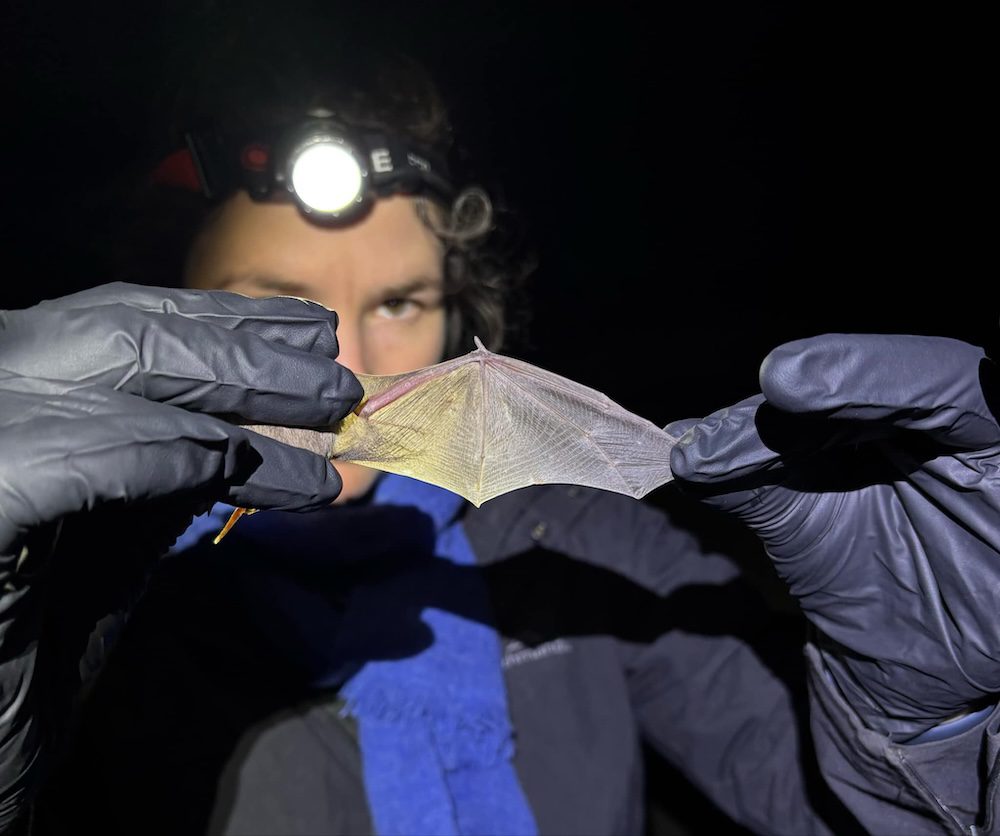

At a still-secret site in New South Wales (NSW), microbats circle around a meteorological mast during the night – are they investigating it? Are they meeting friends or picking up a mate? Is it the new dinner spot?
All of these are questions for the future, says Biosis zoologist Felicity Williams.
Right now, Williams is simply excited to get confirmation that the bats are there.
“It’s so exciting to see bats on video,” she told Renew Economy. “In the past when we’ve had call data, it’s like doing [bat identification] with a blindfold on.”
Environmental approval consultancy Biosis is working with a new piece of US software that can identify and track individual bats, to try to better predict how they move in and around wind turbines.
Two thermal cameras, devices that have long been used in the field to track birds and bats, are set up near the meteorological mast, a temporary tower set up with equipment to measure all kinds of things a wind developer would like to know about a site, including bat call detectors up to a height of 120m.
An algorithm then matches the visual data with the audio, giving a full picture about who is in the sky and how they’re moving through space.
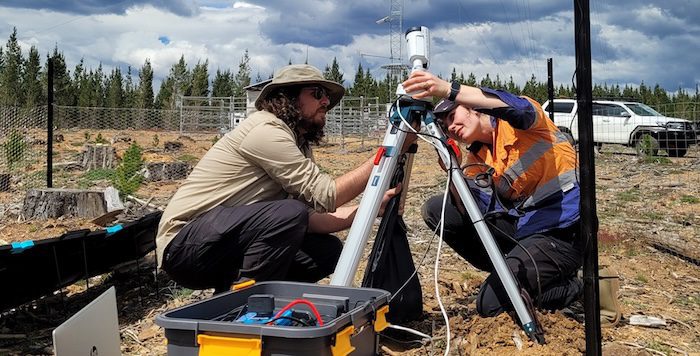
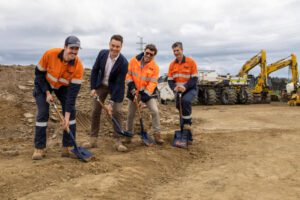
Biosis Emma Heath and Wes Hart installing thermal cameras. Image: Biosis.
The next trick will be to find out what the bats are doing up there and why – whether it’s social, foraging, depending on wind speeds or temperature, or something else – because this could radically change the bat-related curtailment measures environmental regulators are considering for wind farms.
“We know that those blanket curtailment approaches are really impacting project viability, so we’re hoping to get some data to help our clients find a better solution,” says Williams.
“What we’d like to get out of it is, first of all, more data driven and site specific collision risk for bats and, moving forward into the operational phase and doing this monitoring at operational turbines, to see if our predictions hold [or if] bats do something completely different around turbines… and generating power not at the expense of bats.”
Williams is using the tech at three NSW sites, with the first set up on Halloween last year – “very auspicious for bats”, she says.
The US company that owns the software, Wildlife Imaging Systems (WIS), is keen to understand more about the height data.
“We normally work with farms where the turbines have already been built and our aim is to help stop fatalities, so
we’re particularly interested in the outcome of the Biosis research, because the findings around estimated flight
height before the turbines go in, will help inform collision risk and design of farms everywhere,” WIS CEO Brogan Morton said in a statement.
Underestimates equal excess deaths
The difficulties of identifying tiny avian creatures such as microbats, and species that are rare because they’re endangered, is not only undermining good wind farm environmental, planning but also causing conservative precautionary curtailment levels.
Bats do get hit by turbine blades.
Three unnamed wind farms in Victoria recorded eight, 11 and 37 deaths each of endangered southern bent-wing bats in 2024, a rate that put estimated total deaths of that critically species at more than 1300 since those wind farms began operating, according to a Victoria government report on pre- and post-construction bird and bat surveys.
Not only were pre-construction surveys not done at a height adequate for predicting collision risk for this species — the worst wind farm in that study said the impact was “likely to be minimal” — but the sites with the lowest pre-survey bat identification had the highest number of deaths.
That report, part of a series of studies to provide the evidence on wind turbines and wildlife protection, found pre-construction surveys aren’t good at identifying endangered or threatened birds and bats in the area.
“The relationship between pre-construction survey results and assessed risk was often unclear, with almost all assessments stating that risk was ‘low’ or ‘minimal’,” it said.
Williams is seeing environmental regulators begin to try to solve this problem with conservative blanket curtailment requirements, where turbines must shut down for specific periods of time during the day when birds and bats are expected to be in the air.
“It’s more about in the absence of data they are precautionary,” she says.
This kind of curtailment is now standard in parts of Europe, wrote ecologist Emma Bennett in an article in Austral Ecology in 2024.
She led a study in 2018-19 at Cape Nelson North wind farm in southwest Victoria, that showed turbine curtailment reduced overall bird and bat deaths by 54 per cent.
Getting better data before a wind farm is built, and then having a better understanding of what bats are doing when they’re out and about, would have benefits across the board.
From guess work to facts
Williams says the data they’re getting from the new software includes actual information on things that, in the past, they’ve only been able to hypothesise about.
“The really exciting piece to me is having some kind of data about the height species are flying,” she says.
“In the past we’ve used proxies, like wing morphology and expected foraging behaviour… without having any real number around that like how many flights are they doing above canopy and how many at canopy.
“It’s really nice to have some actual numbers around flight heights.”
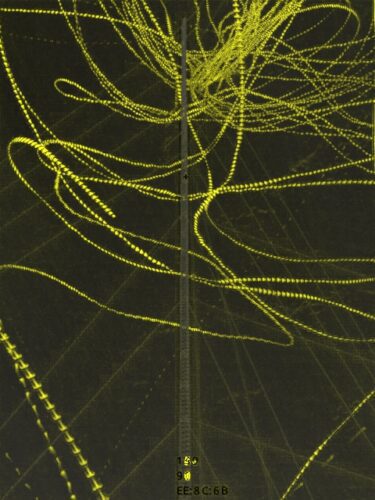
Biosis 3D Stereo Thermal Imagery of Bat Trail Flight Height Sample 2026. Image: Biosis
The current tech available means ecologists can measure thermal imagery, and listen for bat calls, but cannot match them up. If a bat isn’t making any noise, they can’t figure out the species from a thermal image.
At the first NSW site, they’ve identified individual bats circling the meteorological mast “as if they’re investigating this new structure in their environment”, Williams says.
“In the past from call data you get a whole lot of calls but you don’t know if it’s one bat or lots of different bats.”
Williams can now start looking at why bats are more active on some nights and less so on others, which she hopes will allow regulators to fine tune their curtailment requirements.
“We know from collision data that bats are getting hit by turbines but we don’t really know why,” she says.
“This is the next step, because if we know they’re coming in to investigate a met. mast and then a turbine… we know they’re spending time in the zone of risk and possibly getting hit from that.
“The idea is that if we get this data pre-construction about how much time bats are spending when they’re at risk we can start to look at things like wind speed and temperature to figure out the times that bats are present and start to look at options to switch off turbines when the bats are most at risk.”
If you would like to join more than 29,000 others and get the latest clean energy news delivered straight to your inbox, for free, please click here to subscribe to our free daily newsletter.