Data centres may be allowed to operate for years before new renewable generation capacity is added to the grid, although some may have to offer to power down during an “emergency”, says Anna Collyer, chair of the Australian Energy Market Commission.
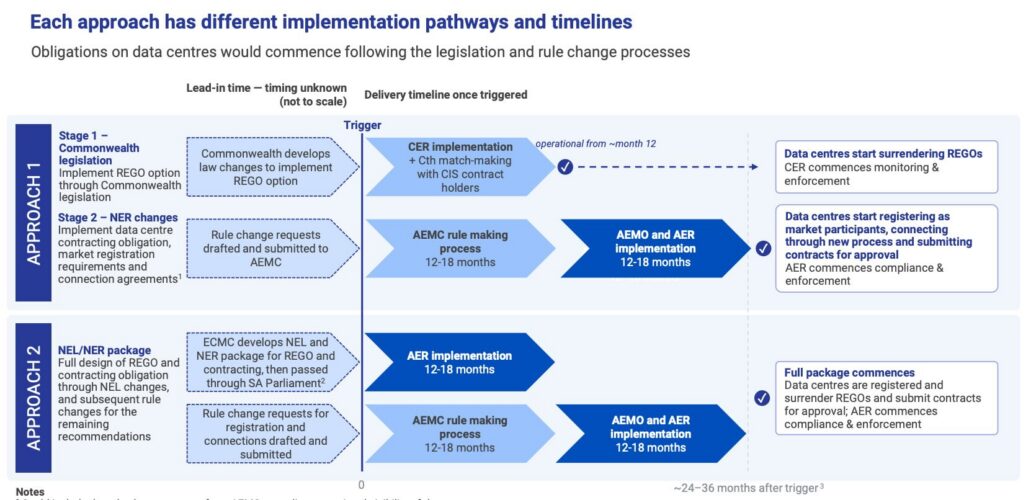
In an interview with Renew Economy, Collyer elaborated on one of the rule maker’s recommendations on data centre regulations that “[a]s a temporary arrangement, in the initial year(s)” of the policy, data centres may be able to meet their obligations through purchasing renewable energy guarantees of origin (REGOs) from existing generators”.
Some energy analysts, such as those from Green Energy Markets, have demanded data centres be required to surrender a REGO certificate from a new project for every megawatt-hour of electricity they consume.
Collyer said use of so-called generic REGOs “would be very much a transitional measure” as it’s typically faster to build a data centre than it is to build a new power station. Such advice, though, was “only something that we put up for consideration”.

Commonwealth legislation would determine the length of any “temporary” provision, while the AEMC would seek to have a complementary rule change entered into the National Electricity Rules on firming requirements.
“The firming and the renewable obligations obviously need to work together,” Collyer said.
The AEMC also suggested data centres would be required to “catch up” if necessary, with operators required to deliver REGOs based on new projects.
It was also possible some states could demand additional obligations, she said.
“If jurisdictions want to have tougher measures, particularly for the larger data centres, then they may well do that,” Collyer said.
Should new renewable projects fail to come on line as fast as anticipated, it may be that data centres “become the first load that’s interruptible”, Collyer said. “You don’t want to end up in a situation where something’s been promised but then not ultimately delivered.”
Supporting this transitions was a separate proposal from the Australian Energy Market Operator (AEMO) to require greater visibility on how large the real – rather than prospective – data centre demand would be. A further network rule change request would help regulators get a handle on the size and location of data centre connections.
“AEMO has found that, over reporting for a 12-month period, a lot of those connection requests then disappear because the data centre works out they don’t need it anymore [as] they’ve picked a particular site, and/or they actually ramp up their own needs quite slowly.” Collyer said. “So they don’t have the ‘big bang” that it potentially looks like on paper.”

Data centres, for instance, might be asked to be given “prudential requirements” when they’re seeking a connection request to give “a little bit of a financial incentive” to tailor their submissions to fall more in line with their final power needs, she said.
Collyer, who last week visited a data centre to look at their operations, said they “all tend to bring pretty comprehensive backup supply, but they don’t want to use it very often”.
They can reduce demand on the grid, if needed, “almost in an emergency situation”, and rely on their own back-up supply to help stabilise the grid, she said.
“That’s why we’re trying to keep flexibility in how they meet their obligations, so that we can take advantage of the different ways of operating that they might be able to provide,” Collyer said.
Fossil fuels, meanwhile, might struggle to be viable sources for powering new data centres.
“While the rules around firming will be technology neutral, because they’ll need to work together with the Commonwealth’s renewable obligations, you would think that a smart business model would be to try and use the same power source to meet both sets of obligations,” she said.
“Because if you were using fossil [fuels], like a new gas [plant], for example, to meet your firming obligations … you still have to meet REGO obligations,” Collyer said.
“So we would have thought, for example, that a solar-battery hybrid was probably something that you could meet both sets of obligations from the one source of power, which would be make logical and business sense,” she said.
“[It would] also mean that we were meeting the decarbonisation objectives as well as meeting the firming objectives.”
“So that’s the way that we see the two parallel sets of obligations working together to deliver the overall emissions outcomes as much as the power supply outcomes,” she said.
While it was up to both the government and AEMC to determine how those obligations worked together, the Commonwealth “could override us … if they wanted to do something tougher,” she said.
To join more than 29,000 others and get the latest clean energy news delivered straight to your inbox, for free, click here to subscribe to our free daily newsletter.