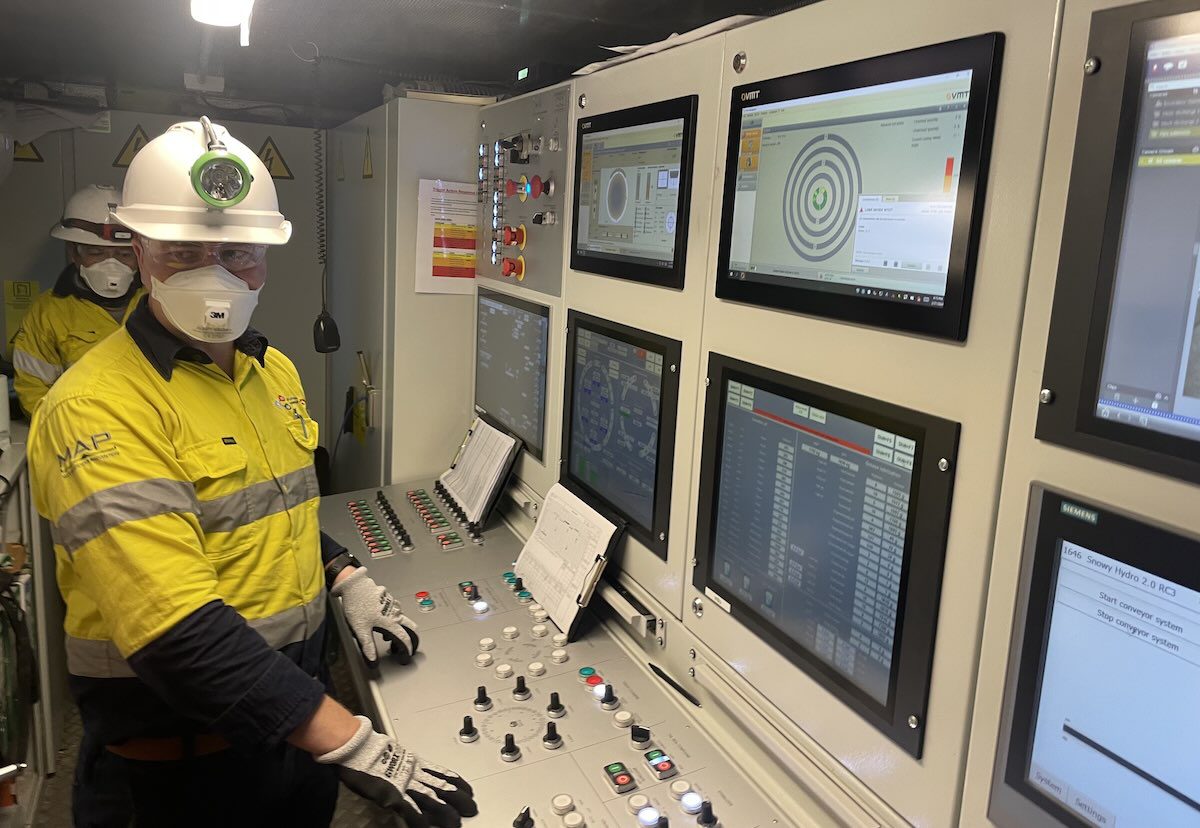
The admission last month by Snowy Hydro that its giant 2.0 pumped hydro project would be further delayed and even more over-budget will prompt a revision of Australian Energy Market Operator’s annual electricity opportunities, the agency has confirmed.
As flagged by Renew Economy in a separate article on Snowy 2.0, AEMO was working to update its Electricity Statement of Opportunities report following Snowy Hydro’s predicted 10-month delay in the now $22.2-$25 billion project to October 2029.
The sole reference to the project in terms of its impact on so-called reliability gaps in the grid based on “relevant” Retailer Reliability Obligations, was to note its 2.2 gigawatts/350 GW-hours of capacity would come on line in NSW “from December 2028.”
Renew Economy understands staff are updating the forecasts, with results likely to be made public in early December.
The existing ESOO did not estimate any “unserved energy” beyond the reliability standard in the National Electricity Market before 2032-33.
Without action, the gap might result in dreaded “blackouts” that fiscal year in NSW, South Australia and Victoria.

An AEMO spokesperson noted ESOO revisions were hardly unusual, with such updates recorded in five of the past six years.
The spokesperson listed them in reverse chronological order as:
2025 ESOO Update – delayed retirement of three units at the Torrens Island B Power Station (SA) and the earlier potential closure of the Gladstone Power Station (Qld) from 2035 to 31 March 2029.
2023 ESOO Update – extensions of the Interim Reliability Measure (IRM) from 30 June 2025 to 30 June 2028.
2022 ESOO Update – early closure for Torrens Island, one-year delay for Snowy 2.0, Osborne Power Station extension, etc.
2021 ESOO Update – Eraring Power Station closure brought forward from 2032 to 2025-26 and Bayswater Power Station.
2020 ESOO Update– Yallourn retirement brought forward to mid-2028 from 2032.
Murdoch tabloids on Monday raised the spectre of “millions of households [facing] rolling blackouts due to the latest Snowy 2.0” unless authorities “scrap a deal to shut the nation’s largest coal-fired power station”.
As things stand, Origin Energy, owner of the Eraring power station in the lower Hunter region of NSW, remains committed to its own timetable to close the plant in April 2029, as reported last month by Renew Economy after Origin’s annual general meeting.
Speculation, though, has been mounting that the Minns Labor government will seek some arrangement to keep at least two of the plant’s four 720-megawatt capacity units operational beyond mid-2029.
In the run-up to the March 2023 elections, which propelled Labor back into power after 12 years in opposition, soon-to-be premier Chris Minns vowed to review plans to shut Eraring as early as August 2025. The subsequent assessment resulted in the plant’s extension of as much as 44 months.
One issue is that unplanned outages of aging coal plants can prompt spikes in wholesale power prices, as has been seen this spring in NSW and elsewhere in the NEM. In other words, having coal units notionally available is not always matched by performance if equipment fails.
As the Bureau of Meteorology has noted, Australia’s temperatures have risen more than a degree Celsius over the past century, with the frequency of extreme heat events increasing even faster.
To the extent heatwaves arrive earlier in the spring and later in the autumns, operators of fossil fuel plants also have shorter “shoulder” seasons to conduct maintenance. The additional air-conditioning use can push up electricity demand – and wholesale prices.
AEMO told Renew Economy that “large-scale, long-duration storage projects like Snowy 2.0 will play an important role in the NEM, helping balance supply and demand and maintain reliability during extended periods of low wind and solar output”.
Both its 2025 and 2026 ESOOs applied a standard six-month buffer to developer-advised commissioning dates for all committed projects, including Snowy 2.0. This margin reflected recent trends in project delivery delays.
“For the 2026 ESOO, AEMO applied this adjustment to Snowy Hydro’s advised commissioning dates for each of Snowy 2.0’s six units,” the spokesperson said.
Hence, two of the six were modelled as available from December 2028, rather than winter 2028, with the remaining four units modelled as becoming available from June 2029, rather than December 2028.