For years, dairy farmer Peter Mulheron had a steady procession of solar salespeople turning up at his farm in Swan Marsh in south-west Victoria.

It wasn’t that he was opposed to renewable energy. Mulheron, a fourth-generation dairy farmer who runs around 240 cows with his wife Trish and son James, wanted to cut his exposure to rising electricity prices and an unreliable rural grid.
The problem was that conventional rooftop solar didn’t really fit the way his farm used electricity.
“We use a lot of power in the dark, so early morning and late evening, so solar panels just never added up for us,” Mulheron told the Renewables in Agriculture conference that is being held in Orange, NSW, this week.
At one point, he signed up for a solar system, before an electrician friend sat him down at the kitchen table and convinced him that what he had been sold did not match the farm’s actual energy use.
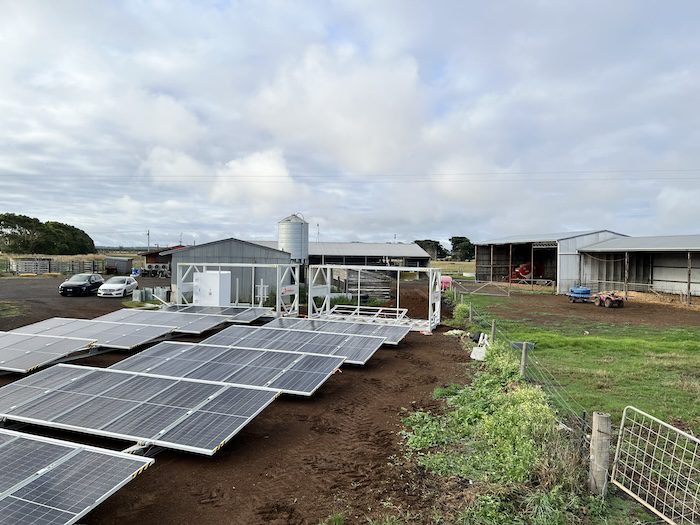
It was an important lesson, which eventually helped shape the solar system that was installed on Mulheron’s farm in March this year: 105kW of solar combined with 241kWh of battery storage, packed into a portable system that can be folded into shipping containers and taken somewhere else.
But it was the battery that changed things for Mulheron: “For us, the game changer on a dairy farm is batteries, or you’re wasting your time.”
Cows don’t take a day off
The challenge for dairy farms is their electricity demand is both substantial, and tied to the cows rather than the sun.
“The cows have a very demanding electricity schedule. They don’t take any days off, so it’s every day of the year, twice a day, and we need to have power there so we can do our job,” Mulheron says.
Dairies also need water heated to around 90°C for cleaning and food safety, and when the Mulherons eventually measured their farm’s electricity consumption in detail they found hot water accounted for more than half its energy use.
A reliable power supply is also a major issue for dairy farms. Bushfires, winter storms and other emergencies can knock out electricity on the Mulheron’s farm for six to eight hours or longer. With up to 9,000 litres of milk sitting in storage, that can cost up to $10,000 in lost milk along with having to dispose of the spoilt milk.
From two solar panels to a microgrid
The solution for the Mulherons arrived accidentally. Mulheron’s son was studying electrical engineering at the University of Melbourne when he took an internship with PHNXX which was developing portable solar and battery systems initially aimed at the mining industry.
The company needed somewhere to test a prototype.
“Matt came home and said, ‘Dad, I’ve got a good idea. We’ll set up the pilot program here on the farm.’ So, as you do, you always do what your kids want you to do.”
The first prototype was tiny: two solar panels, a small wind turbine and a battery powering a spotlight. From there PHNXX installed 32.5kW of solar and 128kWh of battery storage, initially concentrating on the dairy’s large hot-water load.
The system remained on site for several months gathering real-world data on when the Mulherons consumed electricity and how much solar energy could actually be produced.
Mulheron says the results exceeded their expectations: “It gave us confidence to think that what we were looking at was possible.”
The pilot delivered around $13,400 in savings and provided the data needed to design a system around the farm’s actual loads rather than theoretical ones.
“We had confidence because we had the numbers to back us up, so it wasn’t a door-to-door salesman that was coming and selling us his story and not the real story that we needed.”
Solar that behaves like farm machinery
The Mulheron’s have now installed a microgrid system that was specifically designed for their usage: 105kW of solar with 241kWh of battery storage which provides around 90 per cent of the farm’s grid consumption. PHNXX estimates it could reduce annual energy costs by more than $22,000.
But rather than permanently fixing hundreds of solar panels to sheds or installing them in a conventional ground-mounted array, the system arrived in shipping containers.
The batteries and inverters remain inside the containers and the solar array is pulled out on rails concertina-style. Mulheron says it takes roughly four hours to deploy.
Portability ended up being almost as important to the family as the energy savings. Mulheron says he and Trish are conscious they have a limited number of years left in dairying, while the longer-term future of the farm isn’t certain.
Spending heavily on permanent energy infrastructure was hard for the Mulherons to justify, especially since many dairy farmers in his area have already stopped operating.
“The flexibility of this system certainly attracted our attention.”
Measure first, buy second
Mulheron’s advice to other farmers before they install renewable energy systems is to measure their actual electricity demand.
“You need to understand your own farm usage,” Mulheron says. “You need to measure the resources so you’re familiar with what your climate will actually produce.”
And putting the whole system in a couple of shipping containers also dealt with another problem facing the farming industry: nobody can be completely certain what a farm will look like in decades to come.
If you would like to join more than 29,000 others and get the latest clean energy news delivered straight to your inbox, for free, please click here to subscribe to our free daily newsletter.