One of the big surprises about the latest tender for long-duration firm capacity in Australia’s most advanced renewable energy grid was the fact that none of the six battery project winners were long-duration set-ups, at least at face value.
South Australia leads the country, and arguably the world, with a 75 per cent share of wind and solar in a grid that sits at the end of a long skinny network, and has a target of reaching 100 per cent “net” renewables by the end of 2027.
Its main challenge, given its ageing fleet of flexible gas capacity (built to back up its now shuttered coal generators), is to ensure it has enough “firm capacity” to fill the gaps when the system is in stress.
So late last year the state government put out a tender for new projects that can provide that capacity for a minimum of eight hours.
It was fully expected that gas would fill some of that capacity, given it was one of the only tenders in Australia that didn’t specifically exclude the fossil fuel. But the winners announced last week ended up being six big battery projects, all with a nominal capacity of four hours and with a combined capacity of 1,334 MW and 5,336 MWh.
What’s going on? What is “long duration” about four-hour batteries?
As the tender manager ASL describes it, the four hour batteries can operate for eight-hour periods simply by dialling down the rate of their output. So, instead of sending out 300 MW for a four hour period, for instance, it might choose to send out 150 MW over eight hours, when called upon by the terms of the tender contract.
One of the winning bidders, who declined to be named, confirmed to Renew Economy that this is exactly their thinking, noting that the returns per megawatt hour of storage tend to decline as more is added, so a four-hour configuration is generally more profitable, but the set-up can be changed with a push of a button.
“We thought we were being very clever, but it turned out that everyone else was thinking along the same lines,” the bidder said.
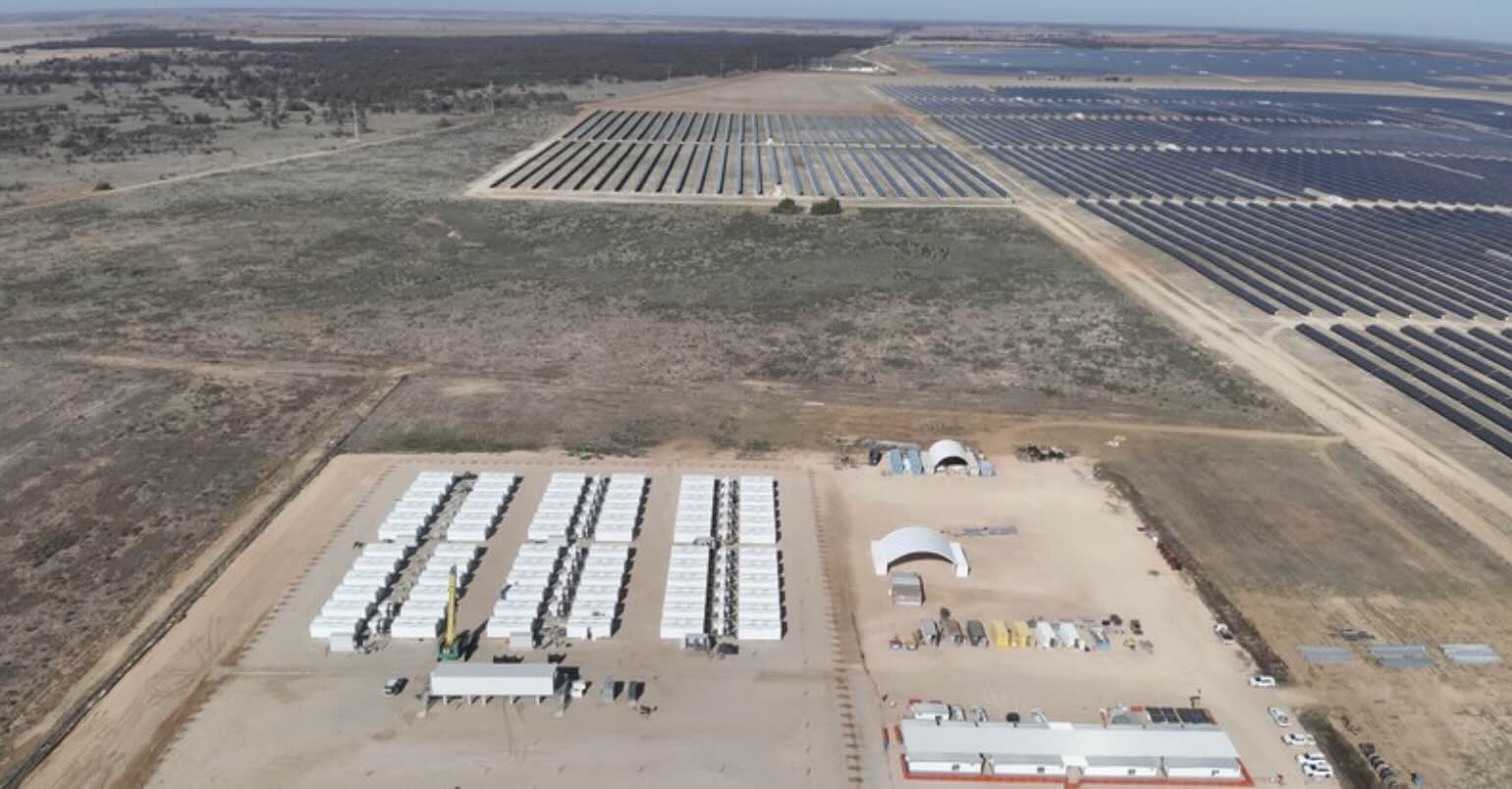
The blurring of the lines between four hour batteries and eight hour batteries is further highlighted by the revelations that RWE’s newly commissioned 50 MW, 400 MWh Limondale facility near Balranald in NSW, the first eight-hour battery on the grid, is allowed to charge at twice the rate of its discharge.
There’s a good reason for this. The surging levels of rooftop and utility scale solar are pushing wholesale prices into negative territory most days, but not necessarily for long periods.
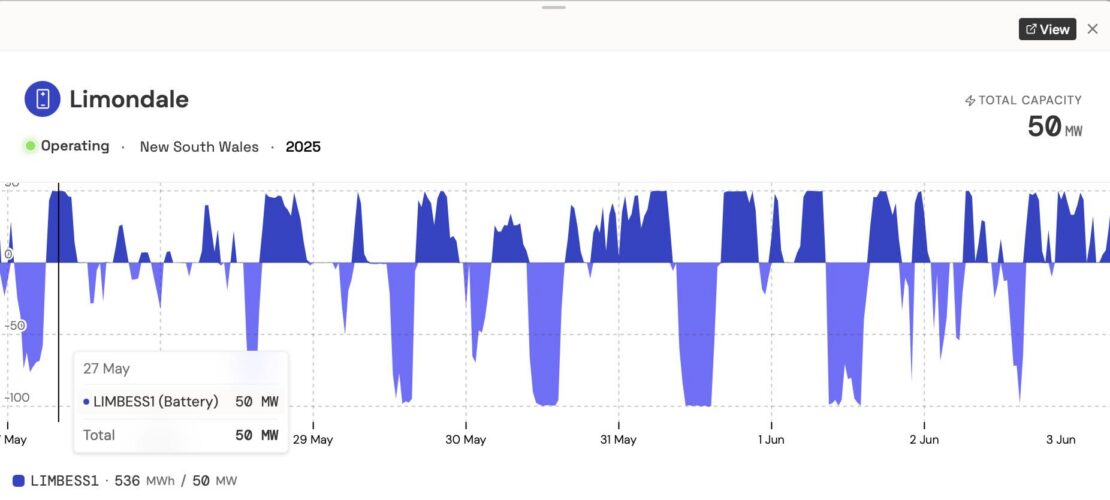
As the graph above illustrates, Limondale’s charging (below the line in lighter colour) happens at around twice the rate of its discharging, which is drawn out over longer time periods, depending on market prices.
The best time to charge a battery is at low or negative prices and that usually happens in the middle of the day. Limiting Limondale to a 50 MW charging rate might have forced its charging activities into higher price periods, eroding the potential value of its energy arbitrage, which is a key part of battery revenues and profits.
On the flip side, batteries may also want to discharge more quickly to tap into the hours when prices are high.
Which is another reason why the batteries that won the South Australia are supersized beyond the dimensions required of the firming contract.
They are free to play the market at other times – or meet other contractual obligations. And, if they do get advice that they need to be available in the event of a Lack of Reserve situation, they are also able to charge up quickly.
Indeed, some of these batteries will be busy doing other things for most of the time. Neoen Australia’s Goyder battery, which will initially consist of two 200 MW, 800 MWh facilities built side by side in the shade of a new wind farm, will be helping provide a constant 100 MW supply to BHP’s massive and energy hungry Olympic Dam mine.
But the facilities have plenty of excess capacity to reconfigure its output to meet the latest tender requirements. They will each have to provide 75 MW and 600 MWh of capacity when called upon.
Akaysha Energy’s Brinkworth battery is similar. It will be built as a 250MW / 1,000MWh project, that will mostly focus on the “merchant” market – buying at the lows in the middle of the day and selling into the evening and other demand peaks.
As part of its “firming contract”, it will make available 92MW over 8 hours, equating to 736 MWh if South Australia forecasts a Lack of Reserve (LOR) capacity event.
As the company itself explains, this means that Brinkworth will operate as an 8 hour BESS when long duration storage is needed the most, and operate as something different at all other times.
If you would like to join more than 29,000 others and get the latest clean energy news delivered straight to your inbox, for free, please click here to subscribe to our free daily newsletter.