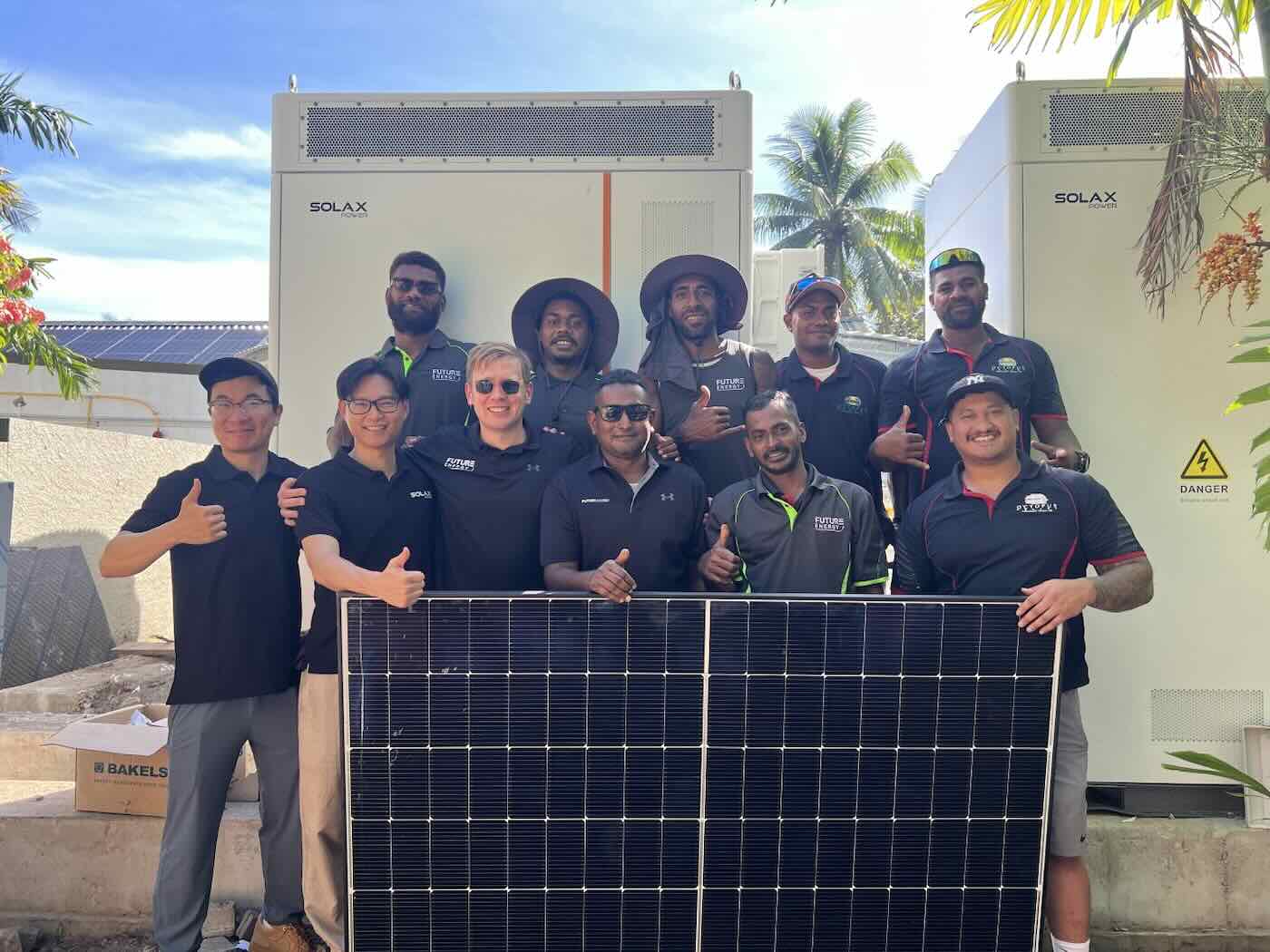
When I was sent to the Yasawa Islands in Fiji to commission a 1.6 megawatt-hour off-grid solar battery installation across three remote island resorts, I thought I had a good handle on what the job required.
Commission the system. Some maintenance training. Come home.
What I didn’t fully appreciate until I was standing on a remote Fijian island with five local electricians and a tight schedule was that one of the most challenging parts of this project had nothing to do with the hardware.
The system performed. That was never in question. The question was whether the local sparkies left behind to run it would be able to keep it running – six months later or even a year later when something unexpected happened and we weren’t there.
That’s a very different problem to solve. And you can’t solve it by shipping a manual.
The five electricians we worked with on the Yasawa project had no prior solar experience. None. Which makes sense, considering Paradise Cove, Blue Lagoon and Octopus Resort were previously 100% reliant on diesel generators. There was no prior need for solar expertise.
But they were also starting from a completely different baseline to what you’d encounter on a commercial installation in Melbourne or Brisbane. The knowledge we take for granted in the Australian market – safety protocols, system integration, fault identification – wasn’t there yet.
That meant rethinking how we transferred knowledge entirely. Detailed technical explanation didn’t land. But a step-by-step demonstration did. And they learnt quickly. We worked alongside them, with every site visit becoming a training session and any faults becoming a teaching moment.
One of those faults sticks with me. During installation, a door on one of the cabinets was scratched during transit (there were no cranes on the island so the locals had to transport cabinets by hand, forklift or tractor).
A small oversight, but in a coastal tropical environment – with salt water, extreme humidity and tropical deluges – small oversights can compound. That small scratch would soon rust and corrode the cabinet entirely.
We’ll provide the specialty paint to reseal the cabinet. But more importantly, we showed the local team what to look for, what to fix, and how to fix it themselves.
That’s the point. We weren’t just commissioning a system, we were building the local capacity to maintain one.
By the time the Yasawa project was fully operational, those five electricians could run and maintain a 1.6 MWh battery storage system independently.
Long-term capability built in from day one and, with it, a genuine reduction in reliance on expensive external support. That’s no small thing in a part of the world where flying in a specialist technician is expensive, slow and not always possible.
The measure of a successful remote deployment isn’t commissioning day. It’s what happens when something goes wrong at 7:30PM on a Thursday, when resort guests are dining in the dark, and the nearest qualified technician is thousands of kilometres away.
Getting the knowledge transfer right is critical to ensuring the system becomes genuinely self-sufficient. Get it wrong and you’ve just created a new kind of dependency – swapping diesel for a different resource you can’t produce locally.
But what does this mean for local projects in Australia? Of course, we have our own version of this challenge.
Remote communities, off-grid installations, rural hospitals, island infrastructure – environments where the tyranny of distance makes ongoing external support impractical and expensive.
The Yasawa project demonstrates the inherent value of going beyond just commissioning the project and instead undergoing a genuine process of capacity building for the local workforce.
The technology is already proven – that’s the easy part. The hard part is making sure the people on the ground trust it, understand it and can keep it running long after installation is complete.
You can’t ship that in a container. You must take the time to build it in person.
Danny Fang is a senior field application engineer at SolaX Power Australia.