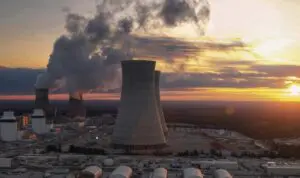
How to fill the 1.45 gigawatt (GW) gap created by the closure of the Yallourn brown coal power station in 2028 is being furiously debated by politicians, as new numbers show just how ready for retirement the aged plant is.
Despite $400 million worth of maintenance work, Yallourn’s operating capacity has stayed around just 60 per cent of its rated capacity since 2022, an analysis by Nexa Advisory has found.
“Since 2020, total downtime across the four units has averaged more than 8,000 unit-hours a year – equivalent to each unit being unavailable for more than 12 weeks annually,” says the report Delay is putting Victoria’s energy security at risk.
“This is a material gap between nominal and dependable capacity. Unplanned performance is particularly important for reliability.”
Furthermore, the aged brown coal can’t dance, as some of the younger plants in Australia can, around solar and wind peaks and troughs.
The current Labor government backs EnergyAustralia’s plans to close the 50 year old power station, and even One Nation’s local branch has admitted it’s probably too far gone to keep alive.
But given the very slow build out of new generation in the state, the 2028 closure date is also causing some consternation: what, as one speaker at a recent conference in Gippsland asked, will fill the gap?
The Victorian Coalition are promising to fill it with gas.
Delayed transmission equals higher bills
The Nexa Advisory modelling shows a gas-led future for Victoria, one where new transmission projects such as the VNI West and Western Renewables Link are just delayed as opposed to cancelled, would require up to 1.1 GW of extra gas power stations and 118 petajoules (PJ) of gas between 2027 and 2035.
That’s compared to 90 PJ in an “orderly” transition.
“Between 2027 and 2031, the average Victorian wholesale price could increase from $62.29/ MWh to $85.20/MWh under a disorderly transition – a difference of $22.91/MWh (37 per cent) on average across this period,” the report says.
“Gas-fired generation has an important but limited role in firming the system.
“It can support reliability during peaks, renewable droughts, and unexpected outages, but it is not a low-cost or readily available substitute for Yallourn’s routine energy production.
“Southern gas supply is tightening and the Australian Energy Market Operator (AEMO) forecasts peak-day shortfall risks from winter 2029, leaving less readily available gas when it is most needed.”
Adding to the difficulty are the market operator’s expectations of tightening gas markets, and manufacturer reports of gas turbine delivery timelines of two to four years.
Simply delaying the two major transmission lines would see Victorian households paying an extra $100 a year between 2027 and 2031, and small businesses up to an extra $1000 a year.
If the Coalition wins the Victorian state election in November and carries out its promise to cancel the VNI West project, the Nexa report envisions even higher household bills.
“Permanent cancellation would compound the impact of delays modelled in this report,” it says.
“If VNI West or Western Renewables Link were cancelled without equivalent replacement, the associated renewable hosting capacity and, in the case of VNI West, additional access to generation and storage in New South Wales would not be delivered.
“This would increase reliability risks and place continued upward pressure on electricity costs.”
Waiting for construction to start
And while the construction and completion of actual wind and solar projects has been slow going in the state, the opportunity to fill the Yallourn-sized gap is there.
There are currently more than 7 GW of solar, 1 GW of wind and 4 GW of large-scale batteries with state of federal approvals in hand, Nexa’s analysis found.
Delays to the Western Renewables Link and the VNI West interstate line defer up to 2 GW of wind and 0.6 GW of solar between 2027 and 2035, Nexa’s modelling found.
The Western Renewables Link was supposed to be finished in 2025 and is now scheduled for 2029, and VNI West was 2027-28 and is now slated for late 2030.
On top of that is a pipeline of about 16 GW of solar and wind and 5 GW of large-scale battery storage. While this isn’t committed capacity, it indicates that Victoria does have generation possibilities available to more than meet the challenge, the report says.
“A geographically and technologically diverse pipeline reduces concentration risk,” it says.
But accessing these means speeding up transmission projects — making the organisations building them more accountable and letting private investors in on the action.
“Victoria’s energy security risk is now a delivery risk,” the report says.
“Yallourn will close in 2028; its operating record does not support extension as a dependable fallback, and new gas-fired generation is neither cheap nor quickly available.
“The state must therefore deliver replacement renewable generation, storage, transmission and firming capacity
on time.
The answer is to stay the course and double down on the transition pipeline.”
To join more than 29,000 others and get the latest clean energy news delivered straight to your inbox, for free, click here to subscribe to our free daily newsletter.