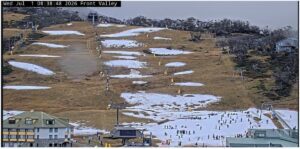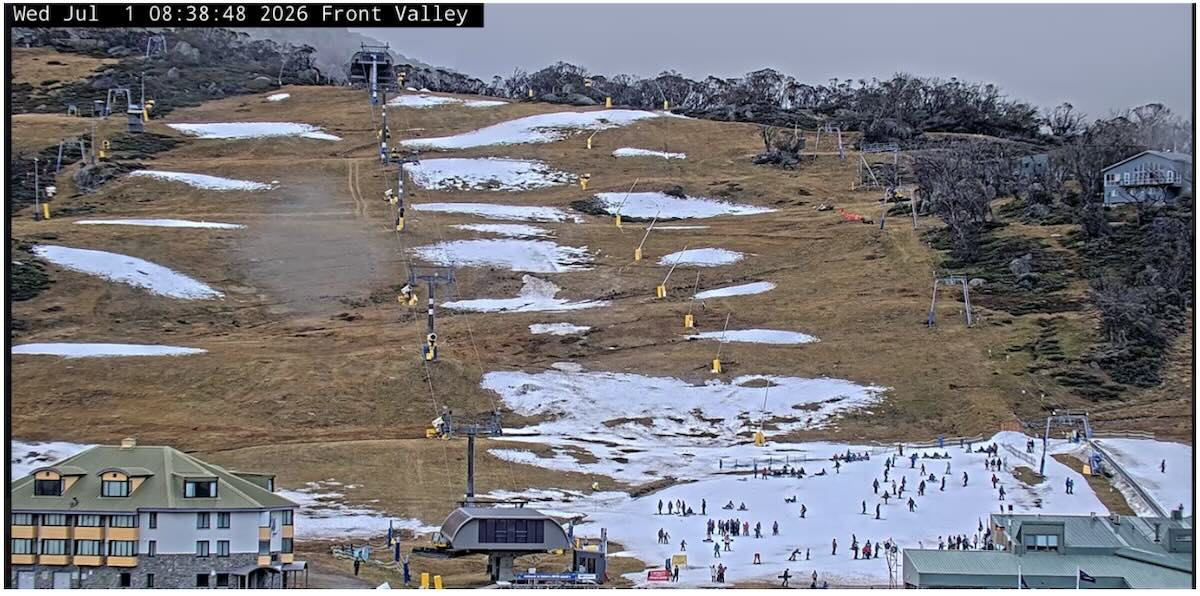
Thin white strips of snow scar the mostly brown slopes of Front Valley in Kosciuszko National Park. Spraying those 16–18 white strips likely consumed several megawatt-hours of electricity – in the order of 4–7 MWh – for that one Front Valley slope, as mostly fossil‑fuelled snow cannons dumped roughly a few tonnes of CO2 into the atmosphere (my calculations).
This is the new “winter” in a warming climate: a fossil-powered illusion of snow, sprayed over fragile alpine ecosystems inside Kosciuszko National Park.
The long-running Three Mile Dam record shows that average peak snow depth in the Australian Alps has already fallen by around 40 centimetres since the 1950s, with shorter seasons and fewer cold days.
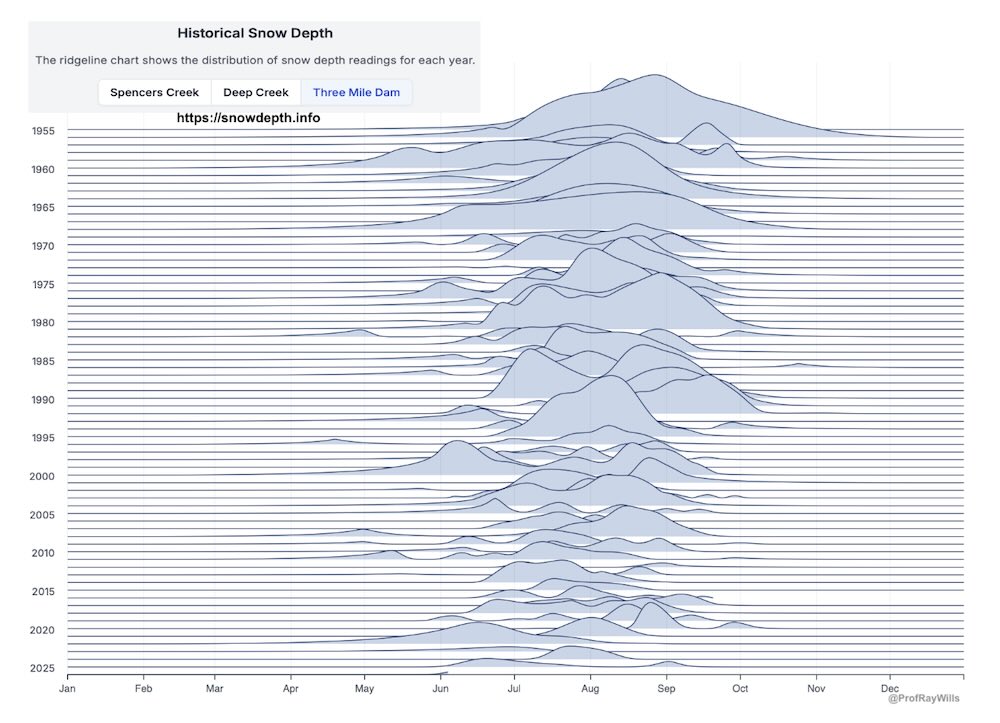
Three Mile Dam ridgeline chart of 70 years of declining snow depth snowdepth.info
A bare snow stake on 1 July 2026 is entirely consistent with the long-term trend rather than a one-off anomaly.
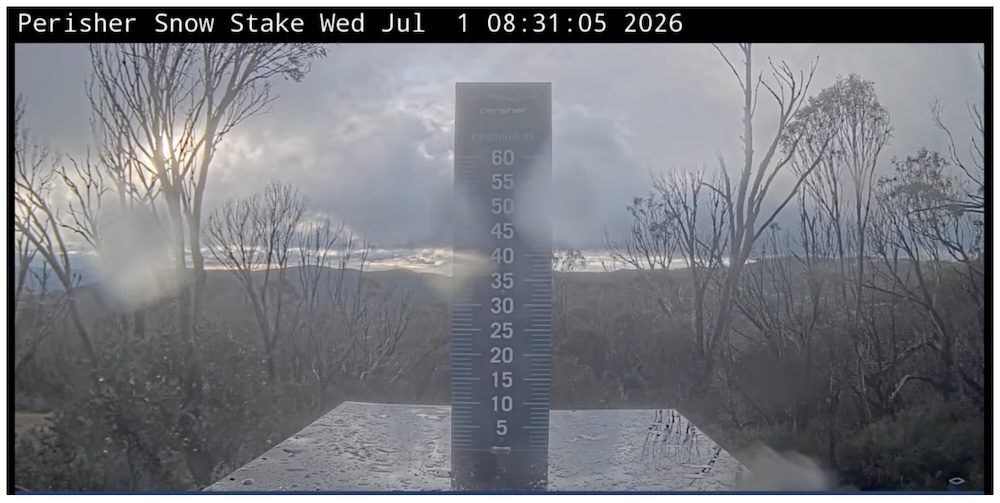
Perisher Snow Stake 1 July 2026
Kosciuszko is public land, protected for its natural and cultural values, yet resort operations are increasingly locked into high-energy, high-emissions snowmaking, just to stay marginally viable.
These are private operators, but their choices about energy‑intensive snowmaking are authorised by public agencies on public land.
That may be commercially rational, but it is not compatible with the park’s role in climate mitigation, or with Australia’s stated climate targets. National parks are supposed to be front-line responses to climate change, not showcases for energy-intensive recreations that deepen the problem.
Alpine policy documents already recognise that climate change is a key threatening process, and that tourism and resort activities add cumulative pressure to stressed alpine flora and fauna.
NSW’s own environmental management system framework for the Kosciuszko Alpine Region requires resorts to adopt formal EMS plans, yet these frameworks still stop short of setting binding limits on greenhouse emissions from operations such as large-scale snowmaking.
If resort operators wish to continue on public land, their licences, planning approvals and EMS obligations should be explicitly aligned with national-park climate-mitigation objectives: enforceable emissions caps on resort operations, clear timelines to run lifts and snowmaking on verifiable renewable electricity, and strict limits on expanding high‑energy activities like artificial snow.
Anything less means we are using protected areas to subsidise the appearance of winter, while accelerating the loss of the very climate and ecosystems those parks were created to defend.
A park that trades real winters for thin, fossil-powered ribbons of snow is not adapting to climate change; it is advertising our failure to take climate protection on public land seriously.