The clock is ticking on a critical gas network reform process. Submissions on the AEMC’s GRC0082 Directions Paper close on April 30, and across the sector, from consumer advocates to network companies, the same uncomfortable truth is emerging: the rule maker has gone about as far as it can go.
What makes the Directions Paper remarkable is not the suite of reforms it proposes, which include accelerated depreciation, tariff design, tighter rules on capital spending, and a mandatory 20-year planning outlook. Sensible and overdue. What’s remarkable is how candidly the AEMC has laid out the things it cannot do.
Establishing a decommissioning framework? Out of scope. Authorising gas networks to offer “non-pipeline alternatives” like funding a customer’s switch to a heat pump, or supplying LPG to the last households on a dying main? Beyond the commission’s legal reach. Coordinating gas retirement with electricity network upgrades? Not its job.
The AEMC’s Directions paper puts it plainly: there will be a role for governments in supporting consumers and planning for potential network decommissioning. The Directions Paper calls for “clearer jurisdictional policy signals.” In the restrained language of an independent rule maker, that is about as close as you get to a flare gun.
The question for the submissions now flooding in is whether anyone will pick up the signal and point it squarely at the body that holds the power to act: the Energy and Climate Change Ministerial Council (ECMC).
What the rules can’t fix
The GRC0082 process is doing necessary work. Without it, gas networks would continue investing in long duration infrastructure destined for redundancy, and consumers would carry the full weight of stranded assets. The AEMC deserves credit for moving.
But economic rule changes cannot solve what is fundamentally an engineering and coordination problem, and the scale of that engineering problem is larger than most people realise.
AEMO’s own 2026 Gas Statement of Opportunities projects, under its Step Change scenario, that around 80 per cent of distribution-connected residential and commercial gas demand will leave the network over the next 20 years. That’s a drop from 166 to 35 PJ / year. Survey work done by Energy Consumers Australia found that about one in three homeowner households on mains gas say they will probably cancel their supply within a decade.
That energy has to go somewhere. And where it’s going is onto electricity distribution networks that were never designed to carry it.
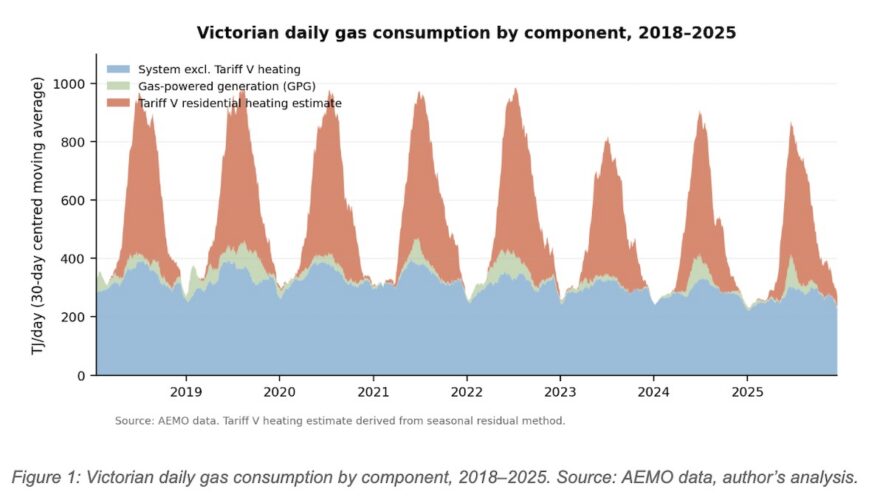
Figure 1: Victorian daily gas consumption by component, 2018–2025. Source: AEMO data, author’s analysis.
Figure 1 shows where the problem lies. Residential heating (the red band) dominates Victorian gas demand in winter, reaching around 580 terajoules per day at peak. In summer it drops to near zero.
Heat pumps are far more efficient than the ducted gas systems they replace, delivering three to four units of heat for every unit of electricity, compared to the 60–80 per cent seasonal efficiency of gas ducting.
But even after accounting for that gain, replacing the peak winter heating load with electricity would require the equivalent of roughly two million home batteries (at 15 kWh each), fully discharged, every day of a cold winter stretch. And the next day, you’d need to fill them all again.
Victoria’s electricity grid was built on the assumption that gas would carry this winter heating peak. Around two million households rely on gas for space heating, which has historically kept the electricity system summer-peaking. The mass uptake of heat pumps (each drawing between 2 and 5 kilowatts) is inverting that profile.
Because heat pump demand is driven by the weather rather than by individual habits, the load is highly coincident: hundreds of households on the same low-voltage feeder all drawing hard at the same time, on the same cold evening. The aggregate demand can exceed the thermal ratings of street-level transformers, or depress voltage at the end of long feeders below statutory limits before any thermal rating is breached.
And here is a point that deserves more attention: the consumer energy resources (CER) that usually help manage distribution stress offer limited relief for this specific problem.
Rooftop solar output is at its lowest precisely when heating demand peaks: cold winter evenings and overcast days. Residential batteries, typically sized for daily solar cycling, are not designed to offset sustained heating loads across long winter nights. Distribution transformers will bear the full brunt of heat pump demand without much help from CER during the critical winter peak. The usual playbook doesn’t apply.
The clustering problem
This risk doesn’t arrive gradually or uniformly. The AEMC’s own CEPA modelling identifies a “switching point,” the gas tariff level at which consumers begin substituting electricity for gas.
As the customer base shrinks, per-unit tariffs rise to cover fixed network costs, pushing more customers out. Once tariffs enter the switching-point range, defection accelerates sharply, and it clusters geographically, driven by community campaigns, contractor availability, and word of mouth.
For customers who remain on gas only for cooking, it’s already cheaper to switch to LPG and disconnect from the ~$300 / year in fixed gas network charges even if induction cooking doesn’t appeal.
The current Middle East energy crisis is adding external pressure to this dynamic. With global LNG prices surging and the government weighing new powers to secure domestic gas supply for winter, the tariff increases that trigger the switching point may arrive sooner than any domestic modelling assumed.
The result is sudden, localised surges in electricity demand that no amount of historical load data can predict. Compounding the problem, commercial and light-industrial gas users (bakeries, laundries, small manufacturers) are frequently embedded within residential zones, sharing the same low-voltage feeders.
When those businesses electrify alongside surrounding households, the concentrated commercial load stacks on top of the diffuse residential heat pump load on infrastructure already under stress.
Here’s the critical mismatch: upgrading distribution network capacity takes three to five years from planning to commissioning. Localised gas defection can tip much faster. If the electricity grid isn’t reinforced ahead of the wave, the result is either reliability failures or, perversely, households trapped on an increasingly expensive gas network because the local grid can’t accept them.
And no one is joining the dots. In Victoria, gas distribution is split across three operators while electricity distribution is split across five, with service territories that don’t align. An electricity distributor using its own historical data will entirely miss the non-linear demand surges driven by gas tariff increases set by a separate, unrelated company. No depreciation schedule addresses this.
The zombie network is already forming
The limits of an economic framework become starkest when you look at what happens physically as customers leave.
Under current settings, permanently disconnecting from the gas network is not cheap. Victoria has capped the upfront abolishment fee at $220, with the remaining cost socialised across all gas customers, but in other jurisdictions households have been quoted $1,000 or more.
Even at the lower end, the incentive is clear: most households will simply cancel the retail contract and leave the physical connection in the ground, creating a dormant service line that remains live and pressurised but is no longer monitored, inspected, or billed.
This is not hypothetical. In the ACT, where electrification is accelerating but abolishment fees remain high, over 11 per cent of residential connections have been dormant for over a year. These ageing assets degrade silently, creating a growing safety liability borne by the shrinking pool of remaining customers.
Without a coordinated, zone-by-zone plan for retirement, Australia risks creating what some in the sector have called a “zombie network”: a sprawling web of unmonitored pipe that nobody fully owns responsibility for. The AEMC can adjust price signals. It cannot write a physical decommissioning plan.
The ministers already have form
Here is what makes the case for ECMC action not just logical, but practically achievable: the ministerial council has already established the precedent.
Following the 2022 energy crisis, the ECMC created a Reliability and Supply Adequacy framework for the East Coast Gas System, granting AEMO expanded powers to monitor and manage supply shortfalls as a last resort.
The ECMC is currently consulting on extending these functions to include a “Last Resort Investment Support Tool” that would step in where the market fails to deliver the investment needed to address structural gaps.
The principle is already in play. If energy ministers are willing to intervene when there isn’t enough gas to meet demand, the same logic should apply when there isn’t enough demand to sustain the network. Supply adequacy and managed decline are mirror images of the same structural problem. The ECMC doesn’t need a new philosophy. It needs to apply its existing one symmetrically.
Three things that can only happen at the ministerial level
The April 30 submissions will generate plenty of useful technical feedback on the AEMC’s proposed rules. But the most important message stakeholders could send is this: the reforms that matter most are beyond the AEMC’s gift.
Amend the National Gas Law to unlock non-pipeline alternatives. The AEMC has been explicit: it cannot authorise networks to offer services not delivered through a pipeline. Only an NGL amendment can allow a network to fund a customer’s electrification or supply LPG to the last few homes on a retiring main, choosing the lowest-cost solution rather than being legally forced to maintain stranded pipe. This single legislative change would transform the economics of managed decline.
Mandate integrated load-transfer planning. Electricity distributors are currently flying blind on the gas transition. AEMO is the only institution that holds both the gas demand trajectories and the electricity demand forecasts. It is already committed to producing an inaugural Distribution System Opportunity Outlook, a document that could, if properly scoped, map the gas-to-electric load transfer at postcode level, identifying the feeders and zone substations most at risk from heat pump clustering. This is where the winter heating surge will hit, and it’s where augmentation investment needs to be sequenced years in advance. A ministerial direction to scope the DSOO for cross-system load transfer would give every distributor, and every state government, the evidence base they currently lack.
Establish a framework for coordinated network retirement. Whether the vehicle is a dedicated authority, an expanded AEMO mandate, or some other structure, the essential requirement is clear: someone must be responsible for sequencing gas decommissioning with electricity augmentation, street by street and zone by zone, informed by data that shows where the electricity grid can absorb new load and where it can’t.
The Solstice Energy shutdown gave us a glimpse of what uncoordinated retreat looks like: 1,150 households and 34 businesses in ten regional Victorian towns scrambling for alternatives, many pushed onto LPG rather than supported to electrify. Victoria alone has two million gas-connected homes.
The window for orderly retreat is narrowing
The death spiral’s arithmetic is unforgiving. Every household that leaves pushes costs onto those who remain, disproportionately renters who can’t control their appliances, apartment dwellers navigating strata decisions, and low-income households without the capital to switch.
An orderly transition remains achievable. But it requires the body with legislative authority, the ECMC, to act on what the AEMC has now said publicly: the rules alone are not enough.
The rule maker has laid out the problem with unusual candour, and invited submissions by April 30. The most useful submission anyone could write might be the one that says: this is no longer a question for the AEMC. It’s a question for energy ministers.
John Godfrey is an energy policy analyst focusing on Victoria’s gas transition