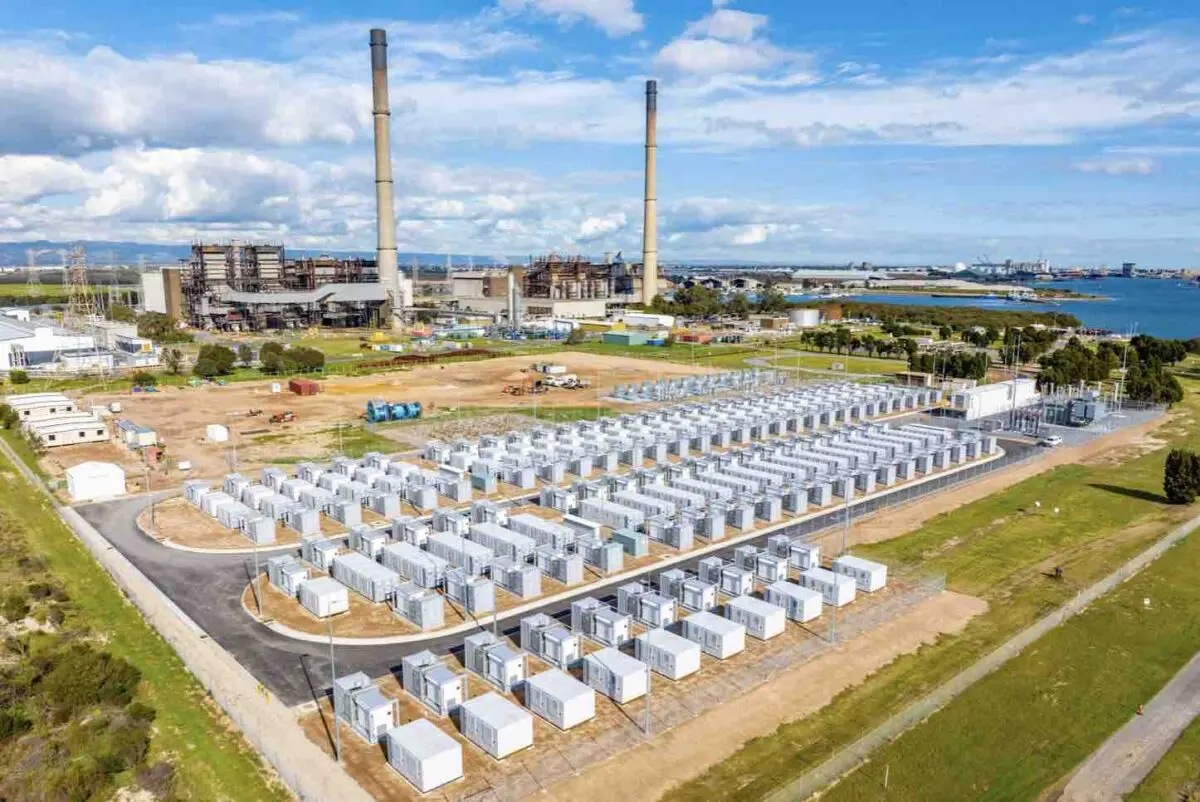
South Australia’s push to lower electricity bills through a high share of renewables continues to be thwarted by its ongoing dependence on high priced diesel and gas generators – even if it is for just a few hours every couple of months.
The surge in prices over just a few trading periods – when the spot price of electricity can hit more than $20,000 a megawatt hour – is having a huge impact on the average price of electricity, an important factor in setting retail electricity prices.
It’s happened twice already this year in South Australia, the country’s most advanced renewable state – it has an average 75 per cent share of wind and solar and a goal of 100 per cent net renewables by the end of 2027 – once in summer due to hot weather, and again in June in a cold snap.
The January event, over the Australia Day holiday period, occurred in a heatwave and amid record demand levels as households turned to their aircons.
The demand spike was so severe the state’s growing fleet of big batteries quickly exhausted themselves, allowing gas and diesel generators to seize control of the market at set prices at eye-watering levels of up to more than $20,000/ MWh.
The impact of that wild trading pushed the average wholesale electricity price in South Australia to $143/MWh over the March quarter, well above the $81/MWh it would have been without those spikes, according to a report by the Australian Energy Regulator.
In June, it happened again.
This time it was a cold spell, combined with low wind generation and heavy network restrictions that prevented lower priced imports from neighbouring states being sent to South Australia, leaving the state once again at the mercy of the gas and diesel generator owners.
And they didn’t miss. Big batteries have been pushing diesel and gas out of the market because of their greater flexibility and cheaper offerings, but on June 26 demand was so great that the state’s existing fleet of batteries – mostly with two hours or less of storage – quickly ran out of charge.
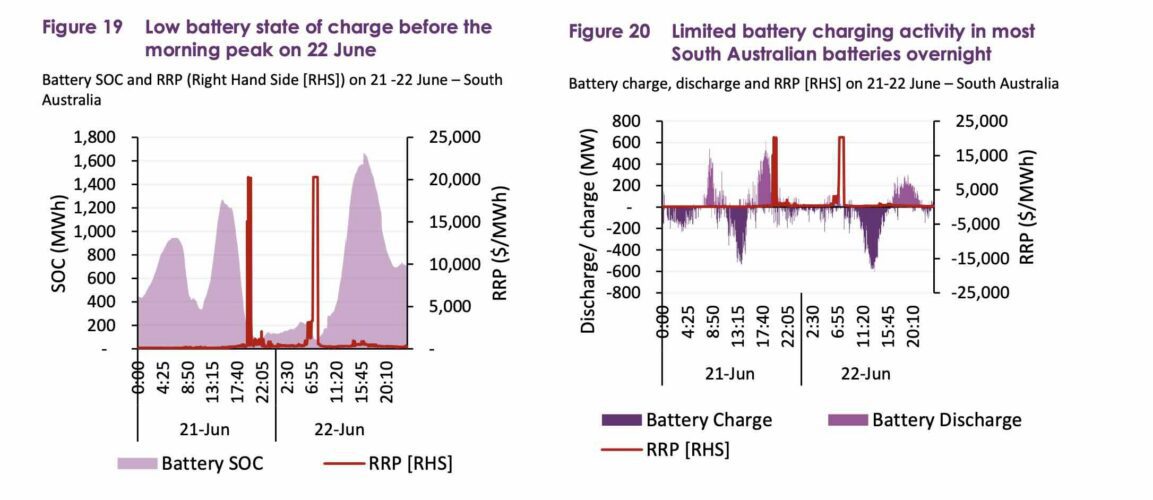
The batteries had kept the price limited to around $300/MWh, but once they left the scene the gas and diesel generators commanded a king’s ransom and quickly pushed prices up to more than $10,000/MWh over four intervals.
It got worse. Because wholesale prices remained high during the evening and overnight, batteries chose not to charge and the gas and diesel generators had an even bigger feast at breakfast time the following morning as demand surged again, this time pushing prices to the market cap of $20,300/MWh for 22 consecutive trading intervals on June 27.
According to the Australian Energy Market Operator, it added $13/MWh to the average wholesale price of electricity over the June quarter in South Australia. Its average price still fell 38 per cent below the previous quarter, but would have been much greater without price spies in Junes wholesale electricity prices.
It’s a sensitive issue in South Australia, which is aiming to reach 100 per cent “net” renewables by the end of next year but has struggled to deliver lower power bills to consumers – largely because it has historically had high consumer prices because of the large network charges.
High wholesale prices in the state – due to its big historic dependence on gas – have also affected bills, and the efforts to keep wholesale prices in South Australia below those of coal-dominated NSW and Queensland is being hindered by these intense price spikes.
In the latest quarter, prices fell heavily in all states except Tasmania.
Such price spikes have always occurred in the electricity market, and it was often recognised that the bulk of generator profits came from the surge in spot prices, often in the evening peaks.
But the intensity of the price spikes has increased because wholesale prices generally have fallen through the rest of the day and peaking gas and diesel generators have been more of less invited to bid at these levels because of a decision by market regulators to lift the price of the market cap.
Ostensibly this is to provide a market signal to keep those generators in the system, in the absence of a “capacity” market that would simply pay them for being there.
Because of their rising fuel costs, the rising cost of new equipment and the fact that they are used more sparingly as the share of renewables grows, the market price has already been jacked up from $16,000/MWh to $20,300/MWh and is now at $23,200/MWh.
South Australia has been seeking to shield itself from these sort of price spikes by holding a series of auction for “firm power” to ensure there is enough capacity to meet such events.
The first auction was one by six big battery projects that – although sized at four hours of storage – will be contracted to deliver smaller amounts over eight hours to help cover such events.
Their presents in the market will reduce the opportunity for a price feeding frenzy by other generators in the market.
But the state is also keen to find a way for new gas generators to also access the “firming” mechanism, mostly to deal with longer wind droughts and other supply issues, if they can design a program that enables them to compete with battery storage.
To join more than 29,000 others and get the latest clean energy news delivered straight to your inbox, for free, click here to subscribe to our free daily newsletter.