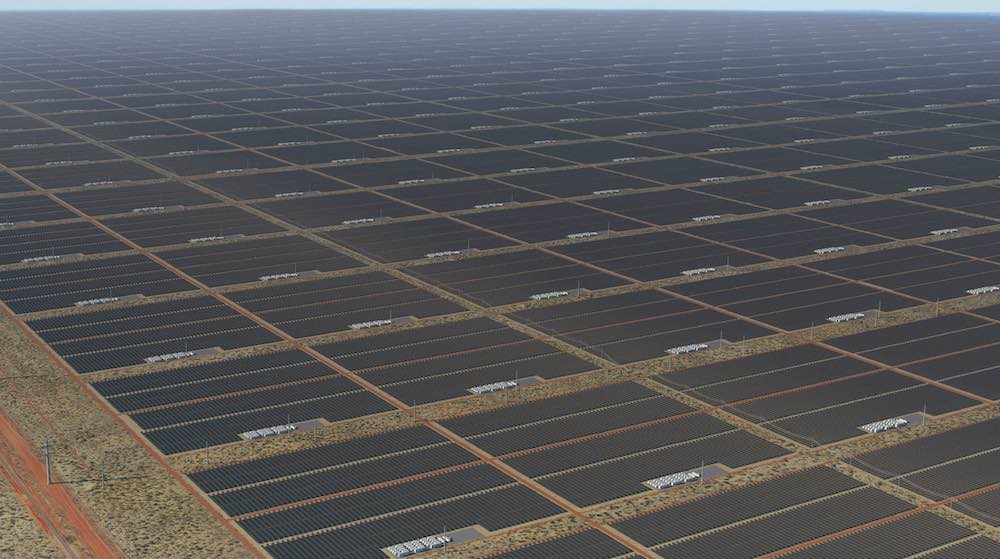
SunCable, the developer of what could be the world’s biggest renewable energy project in the Northern Territory, says efforts to raise fresh capital are “progressing well” and gathering “strong interest from multiple investors,” and insists that plans to pipe solar power overseas are still on the table.
The potential $35 billion project is on the hunt for patient capital and like-minded collaborators since securing environmental approval for its first stages, which include up to 10 gigawatts (GW) of solar and up to 35 gigawatt-hours (GWh) of battery storage.
But reports continue to surface in mainstream business media suggesting the titanic project has hit an iceberg and is starting to sink.
The Australian newspaper on Wednesday reported that SunCable’s majority shareholder, the Mike Cannon-Brookes owned investment outfit Grok Ventures, is offering to sell up to half of its stake in the project, and scaling back stage-two plans to export solar to Singapore via undersea cable.
“The scale and scope of the ambitious green project has so far failed to attract outside interest,” the Oz report says.
“SunCable has instead pivoted to opening talks over selling a substantial stake in the company behind the development, amid pressure for Mr Cannon-Brookes’ private Grok vehicle – which owns about 90 per cent of SunCable – to proceed with a final investment decision in 2027.”
Certainly, the hunt for capital is not easy for renewable energy developers across the board at the moment, as new data from BNEF has illustrated – but Sun Cable has denied claims that its own efforts have reached make-or-break stage.
“The capital raise is going well, and we have had strong interest from multiple investors,” a spokesperson for the company said in an emailed statement to Renew Economy on Wednesday.
“We are well progressed with several parties, including investors who will bring capital and the capabilities to accelerate the development of the project.
The Murdoch media report also claims that SunCable is shifting its focus from the building the sub-sea cable to building data centres in the remote Northern Territory to use the energy generated in the Barkly region, which would also be piped 800 km to Darwin.
But SunCable says that incorporating the potentially huge power demands of data has been part of its plan for some time, as the first stage of a project that could eventually pipe low cost solar to its south-east Asian neighbours.
“Data Centres have always been considered as a prospective part of the customer mix in Australia and Singapore. Data centres require renewable energy at scale, which SunCable is able to provide,” the statement says.
“There is no change to our plans, which include renewable energy supply to Australia and establishing cross border electricity trade into the region.”
SunCable points to the June renewal of the Australia-Asia Power Link’s Major Project Status by the federal government and state and federal environmental approvals, secured last year.
“These approvals support the supply of gigawatt-scale renewable energy to industrial customers in Australia, and to facilitate cross border electricity trade within our region,” the spokesperson said.
“The heart of this project is the world class solar resource,” the SunCable statement adds.
“Our market engagement demonstrates confidence in this resource, and its ability to provide large scale, low-cost firmed renewable electricity to energy-intensive industry, such as AI data centres and green fuels and minerals processing, as well as launching a cross-border electricity trade with Southeast Asia.”
All of that said, the pressure is bound to be mounting. Last year, former SunCable managing director Cameron Garnsworthy told Renew Economy the plan was to reach a financial investment decision (FID) in 2027, and financial close (meaning debt and other investors locked in) in 2028.