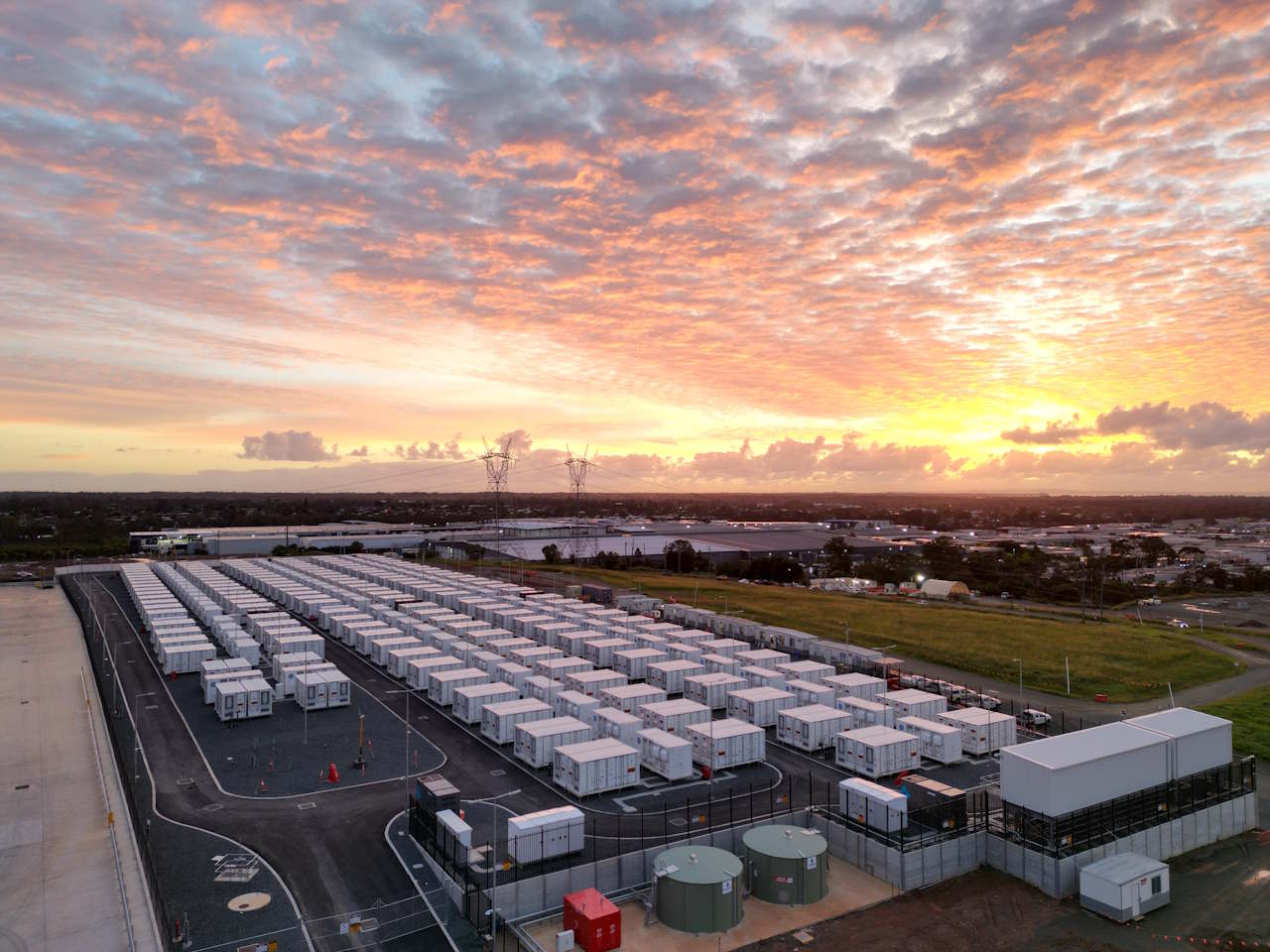
The second stage of the Supernode battery energy storage system (BESS), has commenced operations this week, bringing the total nameplate capacity to 520 megawatts (MW) and 1,858 megawatt-hours (MWh), making it the biggest in the main grid at the moment.
The Supernode project is being developed by global investment giant Quinbrook and actually refers to two separate projects – the Supernode BESS which will eventually boast 760 MW/3096 MWh of storage, as well as the adjacent Supernode Data Centre (Supernode DC).
The battery project could be expanded further, to 1GW and 5,000 MWh, depending on future demand, which would make it the biggest battery in Australia.
The first two stages are now operating under a long-term tolling agreement with energy giant Origin Energy. The third and final stage, which has been contracted by Stanwell Corp under a 15-year off-take agreement, also reached financial close this week on a $469 million debt financing package.
“Achieving commercial operations for Stage 2 means we’ve successfully delivered both Origin contracted stages on schedule, an outcome we’re incredibly proud of given the complexity of commissioning utility-scale battery storage projects in Australia,” said Tim Horneman, managing director and regional leader for Australia at Quinbrook.
“With Stage 3 now fully financed, we’ve reached another important milestone in Supernode’s continuing development.
“The ongoing support of our banking partners also reflects confidence in the Supernode project, our delivery track record and the long-term outlook for battery storage in Australia.”
Both Supernode projects are located either at or adjacent to the South Pine switchyard, the central node of the Queensland electricity transmission network through which flows 80 per cent of the state’s total electricity on a daily basis.
James Allan, a Quinbrook senior director, says Supernode’s unique location at the heart of Queensland’s transmission network makes it ideally placed to support the state’s transitioning power system.
“The site also has capacity for a further 520 MW of expansion, which could include battery storage, data centres or a combination of both. Opportunities to develop infrastructure at this scale, in such a strategically connected location, are exceptionally rare.”
To join more than 29,000 others and get the latest clean energy news delivered straight to your inbox, for free, click here to subscribe to our free daily newsletter.