Victoria’s Latrobe Valley, home to the state’s remaining coal-fired power plants, is rapidly becoming a hub for battery storage, with one project last week starting the commissioning process and another unveiling plans for a much bigger second stage project alongside a battery it currently building.
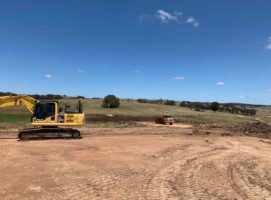
Australian renewable energy generator and retailer Flow Power last week marked a construction milestone at its Bennetts Creek Battery project, located opposite Morwell Terminal Station in eastern Victoria, adjacent to the old Hazelwood open-cut coal mine.
The Bennetts Creek Battery, which reached financial close late last year, is a 100-megawatt (MW) battery energy storage system (BESS) with 233-megawatt-hours (MWh) of storage, or a little over two hours, and is expected to begin operations in mid-2028.
Once operational, the battery will help support the integration of existing renewable energy generation into the state grid during peak times and help place downward pressure on wholesale electricity prices.
Following an on-site ceremony, a community day was held at the nearby Churchill Public Hall where Flow Power announced its plans to expand the big battery with an second big battery.
The proposed Bennetts Creek Stage 2 would add a second storage facility alongside the existing Bennetts Creek Battery, but with capacity of up to 300 MW and 1,200 MWh – or four hours of energy storage.
The project is only in its early planning phase, with Flow Power undertaking initial environmental, noise, and cultural heritage investigations, and an application for development approval being prepared for the state government.
Flow Power is also seeking community input as part of the normal consultation process.
Both stages of the Bennetts Creek Battery will also seek to deliver ongoing community benefits such as electricity discount offers for neighbours, local residents, and commercial and industrial businesses.
“We want the Bennetts Creek BESS to deliver benefits that are felt locally as well as across the energy system,” said Byron Serjeantson, Flow Power chief operating officer.
“That means continuing to invest in practical community initiatives, supporting local organisations, offering discounted electricity plans to local homes and businesses, and creating long-term shared value opportunities for the region.”
Meanwhile, a four-hour big battery that has been built to help replace EnergyAustralia’s Yallourn coal power plant, which closes in 2028, has quietly joined the energy market operator’s management system, as it starts working its way through the grid commissioning process towards full operation.
Global Power Energy advisor Geoff Eldridge last week noted that the Wooreen Battery Energy Storage System had entered AEMO’s Market Management System (MMS) on Tuesday September 15, “marking the start of another significant battery commissioning sequence in Victoria.”
The 350 MW, 1,400 MWh WESS is being developed in partnership with Banpu Energy Australia at Hazelwood North in the Latrobe Valley, adjacent to EnergyAustralia’s existing Jeeralang gas power station.
EnergyAustralia , one of Australia’s three biggest privately owned utilities, broke ground on the $700,000 million project in February of 2025, hailing it as “the biggest single investment” the company has ever made.
“At 350 MW with four hours of storage, Wooreen is a substantial addition to Victoria’s battery fleet,” Eldridge said on LinkedIn. “Its location is also notable.
“The project sits within the Latrobe Valley, close to the long-established centre of Victoria’s electricity supply and near existing transmission infrastructure around Hazelwood, Morwell and Loy Yang.
“The GPE NEMLog Geomap highlights that context particularly well. Looking east from Melbourne, Wooreen forms part of a growing cluster of new storage and network infrastructure across Gippsland and the Latrobe Valley.
“As always, MMS registration is not the same as full commercial operation. But it is a useful operational milestone, showing that the unit has now appeared in AEMO’s market systems and can progress through testing and commissioning.”