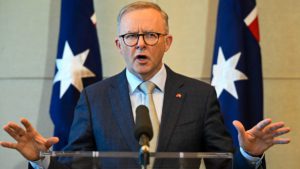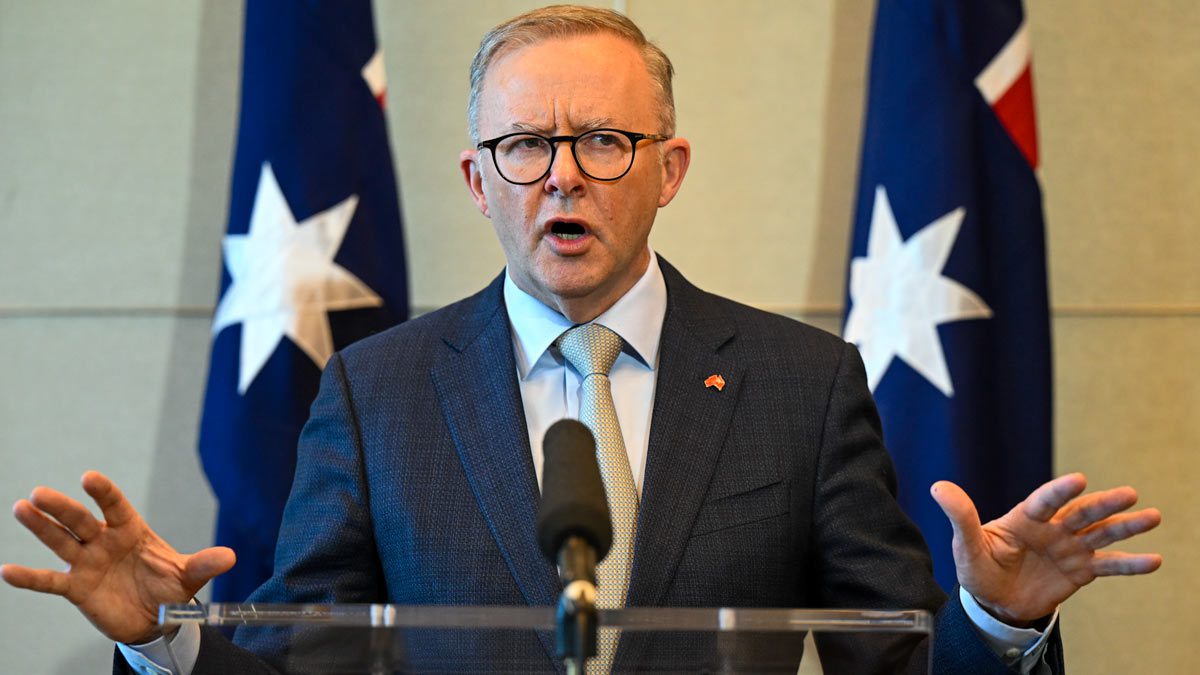
The federal government has ditched its stated determination to require new data centres to prioritise renewables as their energy source, with Prime Minister Anthony Albanese saying national cabinet had agreed on a “flexible” approach allowing states to choose their own energy mix.
The leaders of Queensland and the Northern Territory, who had declared their intention to pursue coal and gas to power new data centre projects prior to Wednesday’s meeting in Sydney, declared satisfaction with the outcome.
“The Commonwealth will work with state and territory governments to develop consistent mandatory standards for data centre energy, water and land-use, and support skills and training opportunities,” a communique of the meeting stated.
“These standards will ensure consistency and clarity for investors, while protecting Australia’s economy, strengthen our sovereignty and secure benefits in line with our national interests,” it said, adding that “Commonwealth legislation will be designed to complement, not duplicate, state and territory planning and approval processes”.
In comments to the media at the meeting’s conclusion, Prime Minister Anthony Albanese said national cabinet had reached “a common position” over how data centres would be powered.
Queensland premier David Crisafulli told the media conference, “[it] was a productive meeting and done in good spirits, and what we are signing now is proof of that”.
“In the state of Queensland, we have a really big point of difference in that we own distribution, transmission [and] generation, and that enables us to control the energy mix, and we have done that well, and our energy plan shows that,” he said.
Queensland’s treasurer David Janetzki reinforced his state’s backing of the outcome, telling ABC’s RN Breakfast on Thursday that Albanese had shown a “good streak of pragmatism” at the meeting.
“We’re very supportive of a renewable sector and we do believe there’ll be an opportunity for the renewables to feed into data centres, and we won’t be ruling out one energy form over another,” Janetzki said.
Albanese’s accommodation of coal and gas as the energy sources for data centres in Queensland and the NT was in contrast to the federal government’s rhetoric in the past six weeks, following the PM’s landmark AI speech.
At the time, Albanese stressed his government would “create a legal obligation for the next generation of large-scale data centres to underwrite new power supply”. Various ministers, including climate change and energy minister Chris Bowen have lately echoed such comments.
Differences between the states were “accommodated in the way that we normally do, in a flexible way, and that will enable us to move forward”, Albanese said at the conclusion of Wednesday’s meeting. He expected draft legislation would be ready by the end of the year with an aim for it to be passed in the federal parliament early in 2027.
“I’m very confident that we will move forward with every single jurisdiction,” he said.
While the federal government did not want “eight different systems operating around the country” when it came to attracting data centre investment, the leaders “recognised all states aren’t exactly the same”, he said.
NT chief minister Finocchiaro did not have an opportunity to add her response before the media conference ended. However, in a subsequent media release, she thanked the PM and state and territory counterparts “for recognising that the Territory needs a different approach”.
“When it comes to issues like data security, data sovereignty, water usage, and location of data centres we need a nationally consistent approach because all Australians know this is important,” Finocchiaro said.
“Today’s deal recognises the Beetaloo Basin will be online within days, we are not part of the National Electricity Market and we have a Territory-owned generation, transmission, and distribution system,” she said, in comment similar to Crisafulli’s.
“We are proud of the large uptake of renewables in the Territory, and they will continue to be an important part of our energy mix.”
For its part, NSW has lately issued its own guidelines, including a requirement for new wind energy projects to supply at least 40% of the electricity for new data centres.
NSW, along with Victoria, account for the bulk of new data centres seeking connection to the power grid in Australia.
South Australia premier Peter Malinauskas sought to temper criticism of the Commonwealth’s retreat, telling ABC’s 7.30 program on Wednesday, “the way we’re going to see these data centres roll out in an Australian context will be powered by renewables because that is where the generation can come from”.
“That’s where the very large scale of energy is able to be procured at relatively quick speed, which is going to be very important if we realise this opportunity,” Malinauskas said.
“[I]n South Australia, we are all for gas-fired generation where it backs up renewables. But even if you want to order today a new gas-fired generator, you’re looking at a lead time of at least five to six years before that generator will arrive on our shores just through the global demand for that product,” he said.
Environment Centre NT said it was appalled the Albanese government “appears to have
caved in to the gas lobby and will allow AI data centres in the Northern Territory to be
powered by fracked gas from the Beetaloo Basin”.
“The Northern Territory government wants to use fracked gas to make the NT the ‘data
centre capital of the globe’, powered by fracked gas from the Beetaloo Basin,” the environmental group said in a statement.
“Fracking the Beetaloo will detonate a climate bomb, generating more than a billion
tonnes of climate pollution and increasing Australia’s emissions by up to 20%,” it said.
“If frackers get their way, thousands of wells will be drilled through our underground
reservoirs, which supply 90% of the Territory’s water needs.”
Wednesday’s national cabinet meeting was the first since June, with the most recent in-person gathering held last December, the ABC stated.
To join more than 29,000 others and get the latest clean energy news delivered straight to your inbox, for free, click here to subscribe to our free daily newsletter.