It is now well established that the combination of new renewables and the huge growth of grid and household batteries has contributed to a significant fall in wholesale electricity prices in Australia’s main grid over the past year.
What is less understood is the impact that it is having on profit margins, particularly for big batteries. They have helped flatten the solar duck curve, but they have also squashed the arbitrage between low prices (when they charge) and high prices (when they dispatch) by nearly 80 per cent.
And that means they are crimping their own profit margins and effectively eating each other’s lunch, and dinner. And some of them are starting to say “ouch”.
A new report from leading analysts BloombergNEF says the average intraday arbitrage in Australia’s main grid, the National Electricity Market, was $103 per megawatt-hour (MWh) in the June quarter, a 79 per cent fall from the same period a year ago.
It blames a milder winter, lower evening demand and increased battery discharge during evening price peaks, which has moderated wholesale prices at times when they are usually a lot higher. A lot of big batteries have joined the grid in that time and, of course, there has also been the impact of the successful home battery rebates.
Those falling prices have had an impact on all generator types – wind, solar, coal and gas (apart from those project with fixed price agreements), and also diminished the market price signal for new projects.
The growing competition among big batteries has been particularly fierce, and BNEF estimates that the actual arbitrage returns have fallen 84 per cent from $362/MWh to just $60/MWh.
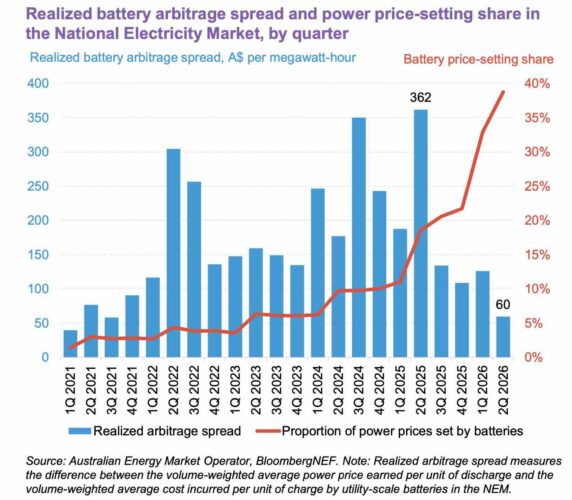
“The decline could signal greater revenue cannibalisation as more capacity is commissioned,” BNEF notes in its report, noting that batteries are now the dominant player in the market, setting the price on 39 per cent of trading intervals.
“More batteries are targeting the same low-priced charging and high-priced discharging windows,” BNEF writes.
“As batteries increasingly set prices in these periods, greater competition – including through bidding behavior – can push charging prices higher and discharge prices lower, further compressing the realized arbitrage spread.”
Big batteries, of course, can earn revenues away from the wholesale markets. They can secure capacity contracts (in Western Australia), and get paid for supplying grid services such as system strength and boosting grid reliability by acting as giant “shock absorbers” to the grid.
Many big batteries are not part of a broader portfolio managed by big generation companies, so their focus – and value – may be less on individual performance, but how they can use their flexibility to maximise the performance of other assets in their fleet.

When big batteries first came to the market, such as the original Tesla big battery at Hornsdale, one of the more lucrative parts were frequency and ancillary services, which had been the province of cartel-type behaviour from the incumbent fossil fuel generators.
The intervention of the big batteries was initially lucrative, but the scale of competition has reduced that pool. BNEF estimates that the FCAS market in the June quarter was just $9.2 million, compared to the more than $130 million in 2021. Batteries are now the dominant players.
Batteries are taking a larger share of evening demand, increasingly displacing gas generators during their most profitable hours.
BloombergNEF estimates that the Mannum battery in South Australia performed the best in terms of revenue per megawatt hour of storage capacity in the wholesale electricity market, earning around $72/MWh/day. The Tailem Bend battery, also in South Australia, performed best in the FCAS market.
To join more than 29,000 others and get the latest clean energy news delivered straight to your inbox, for free, click here to subscribe to our free daily newsletter.