It’s not news to say that Australians are even more in love with their energy home upgrades than ever before, but uncertainty about what other people think of the energy transition is creating doubt.
These contrasting data points are from the latest Clean Energy Solutions Index, a survey of more than 3,000 people across the country.
While support for rooftop solar and home batteries is stronger than ever and accompanied by a sharp lift in love for electric vehicles, general sentiment towards the energy transition lifted by just 1 per cent to a score of 61 out of 100.
The woman behind the study believes a minimum of 70 is what’s needed to create the community and political will to build what’s needed to replace coal.
“I hope we’re at 70 within the next five years, and if we’re not at a 70 deep support score in the next five years, I feel very hard to kind of put that genie back in the bottle,” 89 Degrees East research director Rebecca Huntley said at the Australian Clean Energy Summit in Sydney today.
“Deep support requires consistency. It requires lived experience and benefit, and really building the trust from the community up and the top down.
“We are so behind the eight-ball in building that trust… we will progress slowly in the right direction unless we address this.”
The Index’s score is made up of views on a tech being good for Australia, personal support, views on whether it’s supported by the community, and willingness to talk positively about it.
Outrage machine is winning
The continued popularity of rooftop solar in the Index comes after a quarterly study by SEC Newgate in February showed support for the perennially popular technology falling — a sign the “outrage machine” is winning, according to market analyst Ed Coper at the time.
Huntley says the data shows that over and over, Australians generally support green energy but anxiety about what other think — fed by vocal minorities and conservative media — is making them more pessimistic about the energy transition and less likely to publicly advocate for it.
“We are also getting lots and lots of anxiety about how large-scale renewable energy infrastructure is rolling out across the country,” she said.
“There’s increasing anxiety in the cities that it’s not being accepted in the country.
“Those people living in the cities think we need to go faster. But when asked about whether the country feels the same way they do, they say no. There’s more resistance. So we have a kind of a push and pull impact having being felt across the community in terms of sentiment.”
“That perception gap in terms of whether people think that their personal support is something that is shared by the broader community, and again in the cities a sense that there is much less support in the country.
“Closing these gaps, nailing the financial case for renewable energy, nailing the engagement at a local level is absolutely critical to make sure that when I front up next year with this data that we are seeing more than just one score increase in the deep support for renewable energy transition in this country.”
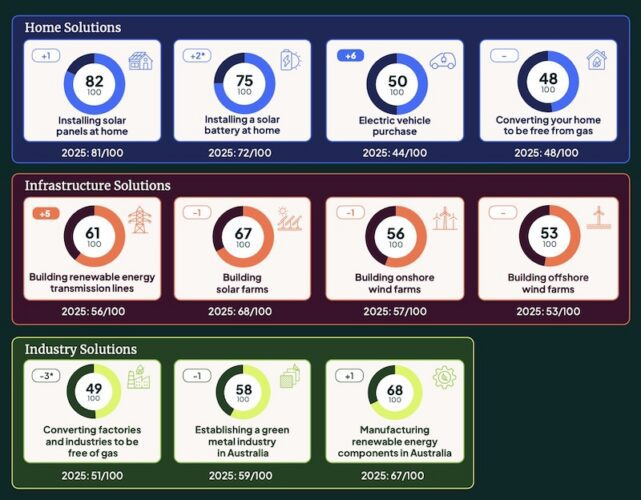
The Index found that concerns about farming land, marine areas and wildlife are the single most consistent barrier to people supporting infrastructure.
These appeared at the top of the opposition list for every technology.
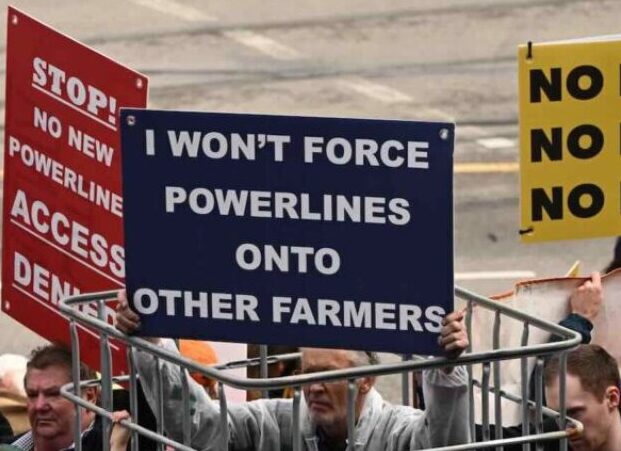
Loss of farming land is the leading concern for those who oppose solar farms and transmission lines, while impact on wildlife and nature leads opposition to onshore wind.
Offshore wind swaps land for ocean, but the same theme applies, the survey found, with opponents citing concerns about impacts on marine wildlife.
Support for solar and wind project slipped slightly, although support for transmission lines rose by five points.
And while the latest survey shows overall private support for transmission infrastructure strengthening significantly, Australians are still unwilling to speak positively about it in public.
Despite the financial case for gas free homes stacking up and regulators lining up to manage down non-essential gas use, Australians are turning away from gas free homes, citing their love of cooking with gas.
If you would like to join more than 29,000 others and get the latest clean energy news delivered straight to your inbox, for free, you can click here to subscribe to our free daily newsletter.