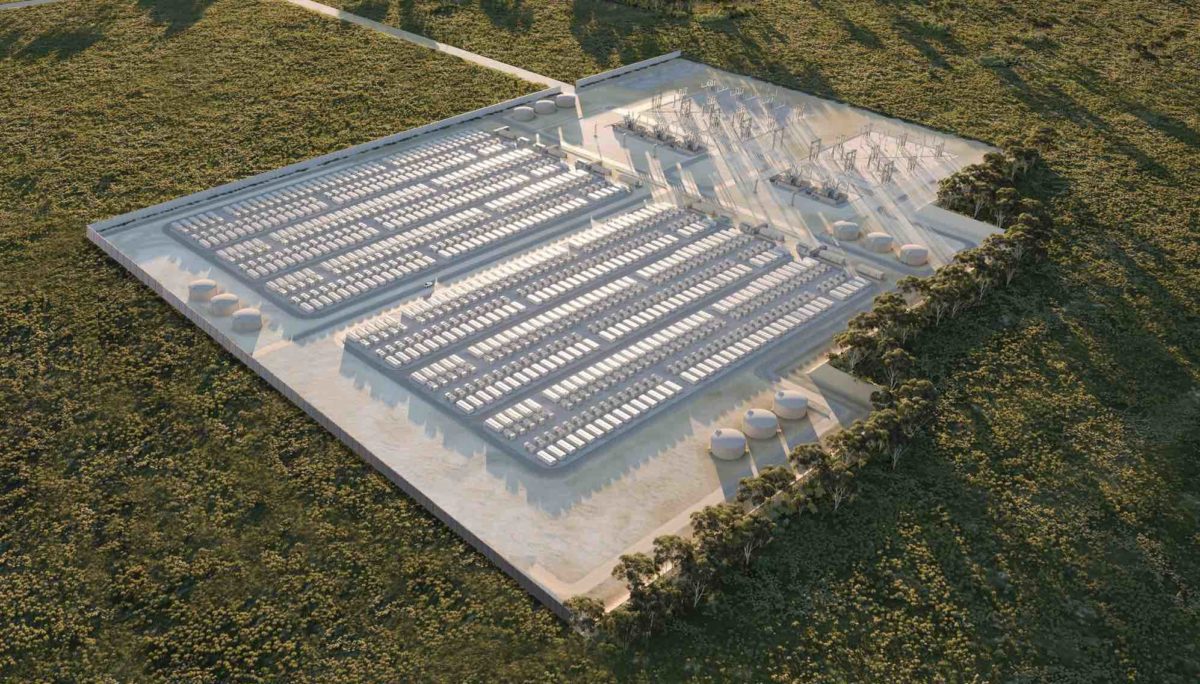
The head of the newly created Energy Security Corp in NSW, says the first priority for the state-owned “green bank” is to ensure that enough big battery and hybrid projects reach financial close over the next few years to shore up reliability as ageing coal generators exit the system.
Paul Peters, the chief executive of the ESC, says NSW will need 10,400 megawatts (MW) and 55,000 megawatt hours (MWh) of storage to be operational by 2030. About one quarter of that is in construction or operation, and a further quarter will come from household batteries installed over the next four to five years.
But he says the remaining 55,00 MWh, or 22,000 MWh, of utility scale storage must reach financial close in the next two to three years, and that will be the top priority for the ESC, which has been armed with $1 billion of seed funding.
“Only two of the twelve battery projects currently in construction or in operation exceed two hours of storage,” Peters told the Australian Clean Energy Summit in Sydney on Tuesday.
“That’s not long enough. This is why our immediate priority is to invest to bring forward the final investment decisions or commercial operation date of large scale storage (or hybrid) projects, and extending their duration to four hours and longer.”
NSW is conducting a series of auctions and tenders that have already agreed contracts with multiple battery storage projects, including three 8-hour batteries, one pumped hydro project and a landmark advanced compressed air storage project in Broken Hill.
Peters says the role of ESC will be to fill any funding gaps – up to $150 million for any one project – to ensure that they are built on time.
“Time and scale is of the essence,” he said.
“For example, where a project has a long-term energy service agreement (LTESA), (CISA) or firming award but has not yet reached financial close, we will explore if funding is required and where ESC investment can help bring the project forward.”
Near term priorities include the major load centres of Sydney, Newcastle and Wollongong, where the NSW state government announced this week it is seeking around 500 MW of firming capacity that must be built by 2027/28 to help fill the gap of the closure of the country’s biggest coal-fired generator, Eraring.
But Peters says the ESC will not be investing in projects using technology that is still “embryonic or untested,” or with companies that lack financial capacity, or projects that are still years away from “even being possible.”
Other priorities include investing in network upgrades that can increase hosting and transfer capacity in the short term and projects that support system strength, and over the longer term supporting deeper storage projects such as pumped hydro that will be needed in the early 2030s as more coal fired generators exit the system.
The ESC will also invest in consumer energy resources platforms that allow household systems such as rooftop solar and home batteries to be scaled up and orchestrated so they support the broader system – not just individual consumers.
The ESC approach is similar to the recently created State Electricity Corporation in Victoria, which has emerged as a co-investor to key battery storage and hybrid projects, and is also emerging as a retailer, initially to government departments but eventually to the broader community.
The SEC has already made two significant investments, with a small equity stake in the giant Melbourne Renewable Energy Hub battery near Melbourne, and the purchase of the Horsham solar project which has been transformed into a solar hybrid project with the addition of a big battery.
In each case, SEC chairman Simon Corbell said, it meant that the projects could be built more quickly, and help fill the gap to be created by the closure of one of Victoria’s last coal generators, Yallourn, in 2028.
“We’ve got about two gigawatts of LDS (long duration storage) projects in our development pipeline that we’re partnering with the private sector on,” Corbell said.
“It’s early stage. Obviously, we need to investigate what’s viable and what isn’t, but we’re having a view to, how do we make sure in Victoria, as particularly as we approach the Loy Yang closure (in the early 2030s) , that we’ve got that longer duration storage available.”
Corbell said the SEC is looking at pumped hydro, but – unlike the ESC in NSW – is open to less mature technologies.
“There’s a range of other technology types that are just not yet fully commercial. And so I think there is a role for government entity to invest in kind as well, which are sufficiently mature, but perhaps not fully mature,” Corbell said.
“I guess if I have a (more) nuanced position on it. So there are other types of storage technologies storing different types of gasses, and there are alternative battery technologies, which, we haven’t seen developed commercially in Australia today, but which could be potentially part of the mix from our perspective.”