Global wind and solar technologies continued to achieve massive declines in cost last year, but observers warn the full impacts of the current supply chain and commodity crunch have yet to be fully felt across energy markets.
In a new report, the International Renewable Energy Agency (IRENA) estimates that wind and solar technologies achieved double-digit cost reductions in 2021, but warned supply chain pressures and a surge in commodity prices could dent this progress in 2022.
Last year, the global cost of onshore wind energy fell by 15 per cent, offshore wind projects fell by 13 per cent, and the cost of solar PV dropped by 13 per cent, the IRENA report says.
IRENA says around two-thirds of renewable energy additions last year had lower costs than the globally cheapest coal-fired power stations, providing further evidence that wind and solar continue to beat fossil fuels on cost.
“Renewables are by far the cheapest form of power today,” director general of IRENA, Francesco La Camera, said.
“2022 is a stark example of just how economically viable new renewable power generation has become.”
“Renewable power frees economies from volatile fossil fuel prices and imports, curbs energy costs and enhances market resilience – even more so if today’s energy crunch continues.”
IRENA estimated that the more than 250GW of new renewable energy projects commissioned in 2021 helped avoid US$55 billion (A$82 billion) in additional fossil fuel energy costs as a result of the coal, gas and oil price spikes observed in 2022.
IRENA found that renewables were particularly competitive in European countries, where there was the largest gap in price between wind and solar technologies and those of fossil fuels.
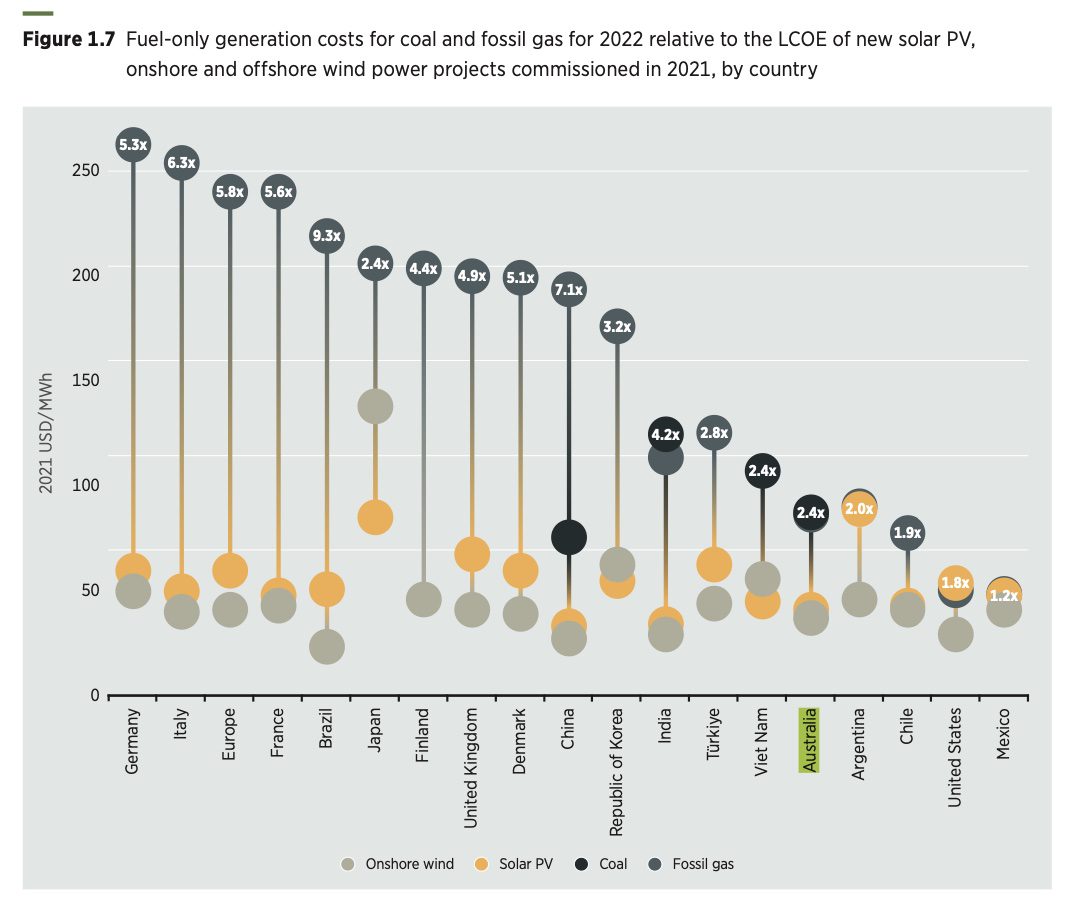
While Australia has comparatively cheaper access to coal and gas supplies – at least, before the recent price spike – IRENA found that Australia ranked as the third most competitive market for utility-scale solar, behind China and India, with some of the lowest levelised solar energy costs, and achieved a massive 21 per cent year-on-year decline in costs in 2021.
IRENA estimated the average levelised cost of utility scale solar fell to US$42 per MWh in Australia (A$62/MWh) – making it one of the cheapest sources of new power generation anywhere in the world.
La Camera said that while governments may be looking to ramp up additional coal and gas supplies to manage the current global energy crisis, long-term energy system planning had to focus on the growth of cleaner energy sources.
“While a temporary crisis response might be necessary in the current situation, excuses to soften climate goals will not hold mid-to-long-term. Today’s situation is a devastating reminder that renewables and energy saving are the future,” La Camera said.
“With the COP27 in Egypt and COP28 in the UAE ahead, renewables provide governments with affordable energy to align with net zero and turn their climate promises into concrete action with real benefits for people on the ground,” he added.
IRENA finds that while supply constraints and higher commodity prices may flow through to higher renewable energy technology costs – the extremely high prices of fossil fuels will “profoundly deteriorate” the competitiveness of fossil fuels compared to wind and solar.
“As to supply chains, IRENA’s data suggests that not all materials cost increases have been passed through into equipment prices and project costs yet,” IRENA says.
“If material costs remain elevated, the price pressures in 2022 will be more pronounced. Increases might however be dwarfed by the overall gains of cost-competitive renewables in comparison to higher fossil fuel prices.”