Victoria’s government-owned electricity generator and retailer is turning its focus to deep energy storage, including non-lithium battery technologies with up to 12 hours duration, following up on the “standout” success of its first ever investment, a very big battery in Melbourne’s west.
State Electricity Commission (SEC) chief Chris Miller this week presented an update on the progress of the newly rebooted public utility, including towards its target of underwriting 4.5 gigawatts (GW) of new renewable energy generation and storage by 2035.
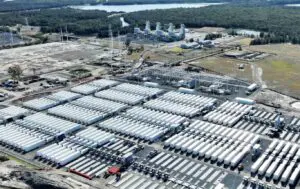
Its first move towards that target was a 2023 co-investment with GreenPoint Energy (formerly Equis) in the Melbourne Renewable Energy Hub (MREH), a 600 megawatt (MW) battery made up of Tesla Megapacks and offering between two and four hours of storage duration.
In an address to the Australian Energy Week 2026 conference in Melbourne, Miller touched on the significant contribution the MREH has made to Victoria’s electricity mix since it powered up last year, just in time for the summer.
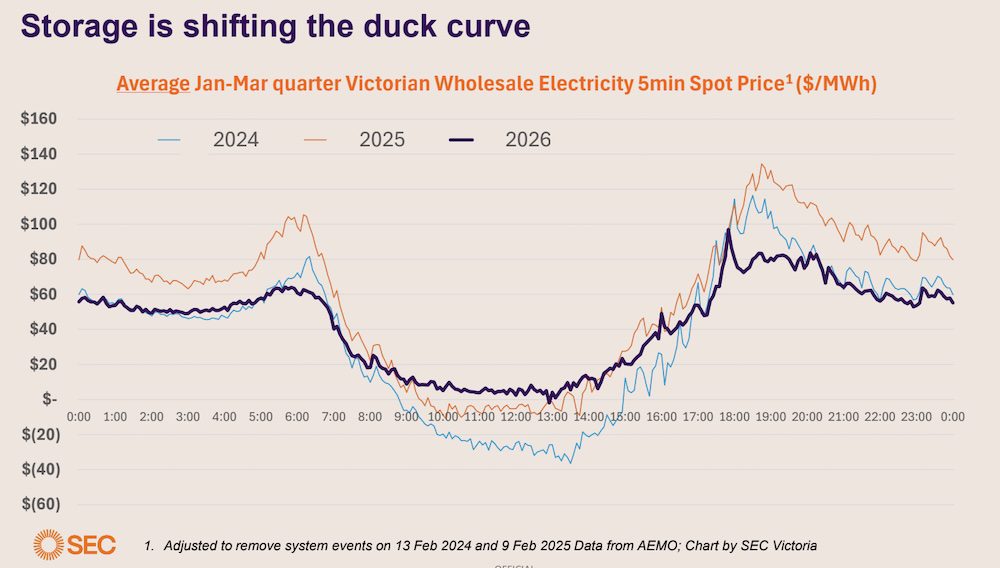
With the aid of some slides, Miller illustrated how the state-backed battery is helping to flatten the solar duck curve, compress wholesale electricity prices in the morning and evening peaks, and stopping daytime prices from “scooting” into negative territory.
“I don’t think it’s controversial to say that this is largely due to the uptake of home batteries and the increased capacity and availability of utility-scale batteries in Victoria, including our own,” he told the conference on Wednesday.
“This slide [see below] … is a great proof point of the role of shorter duration batteries, two to four hours, and shows how they can provide that really important intraday shaping or intraday firming capability.
“The next challenge we see is seasonal balancing and providing backup during those extended periods of low solar and low wind.”
Miller says medium to long duration storage – between four and 12 hours – has now become a key area of strategic focus for the SEC, particularly in light of the 2028 retirement of the Yallourn coal plant.
“I’ve talked about our role, plugging in gaps, taking a long-term and systemic view of the market,” Miller told the conference on Wednesday.
“What we’re seeing at the moment in that zero emissions, long-duration space is there’s not a lot of development activity, so the concern we have is we’re not going to have a pipeline of projects … ready to get to [final investment decision] for the period that we know we’re going to need it.
“I’d say here that there are clearly different technology options available to the market, different economics, different strengths.
“So to that end, we are … progressing some interesting development partnership opportunities with [original equipment manufacturers] of zero emissions firming technologies,” Miller said.
“We’ll have a bit more to say about that later, but we’re progressing well into a joint development partnership with at least one OEM.”
A “standout investment”
Miller, who was formally appointed as the CEO of the SEC in August 2024, played a key role in securing its $245 million equity position in the Melbourne Renewable Energy Hub – and is clearly proud of this investment.
Miller says that while the market was seeing strong investment in one-hour and two-hour batteries in 2023, it wasn’t yet delivering batteries at the four-hour mark, and so the SEC felt the need to give it a “bit of a push and a nudge.”
“Melbourne Renewable Energy Hub was our first investment, and it was a standout investment, to be honest,” Miller told Renew Economy’s Solar Insiders podcast, recorded on the sidelines of the AEW 2026 conference on Wednesday.
“It was a large-scale battery located in a strategic part of the high voltage transmission network that we knew would simultaneously strengthen that part of the grid and unlock capacity for more renewables to be developed, particularly in the west of Victoria, and it is having a measurable impact on wholesale prices, particularly over the summer period.
“My trading guys have tracked the average wholesale prices over the Victorian summer through from 2023-24 to the current summer, 2025-26 and what we’re seeing is a market decline in the average wholesale prices, and even more importantly, a flattening of that duck curve, which is, we think, largely attributable to the role of utility-scale and home batteries.
“And that’s flowing directly through into forward markets as well, which is flowing directly through into consumer bills, and I think … that AEMO [the Australian Energy Market Operator] is losing far less sleep, now, about reliability issues in the summer because of the important role that batteries are playing.”
At the conference, Miller went into some more detail about why the timing and the location of MREH – as well as its unique design – has been such a success.
“This particular asset is right in the heart of Victoria’s high voltage network. If you can draw a map of Victoria, you’d see it’s right at the apex of the high voltage lines, and we knew that the hub would … actually make an important contribution to strengthening the grid, relieving system stress, reducing curtailment risk for existing assets, and improving dispatch flexibility.
“And because it’s located where it is, it’s actually next to, or adjacent to, three [renewable energy zones] in Victoria, and what it does is unlock capacity for more renewables to build out those REZs,” he said.
Miller says that the MREH has three units, each of them with a capacity of 200 MW but with differing storage durations.
“The SEC is a co-invester in all three, but actually holds dispatch rights for the third module, which is actually the deepest module – it’s got four hours of duration.
“Over last summer [this module] completed 77 charge and discharge cycles and shifted more than 61,000 megawatt-hours from the middle of the day into peak demand periods, and that’s enough stored energy discharged on average to power around 55,000 homes per day.
“Summer pricing trends across 2023-24, 2024-25 and 2025-26 … [show] quite clearly [that] … the most recent summer … [is] considerably flatter in its pricing shape than the previous two summers,” he adds.
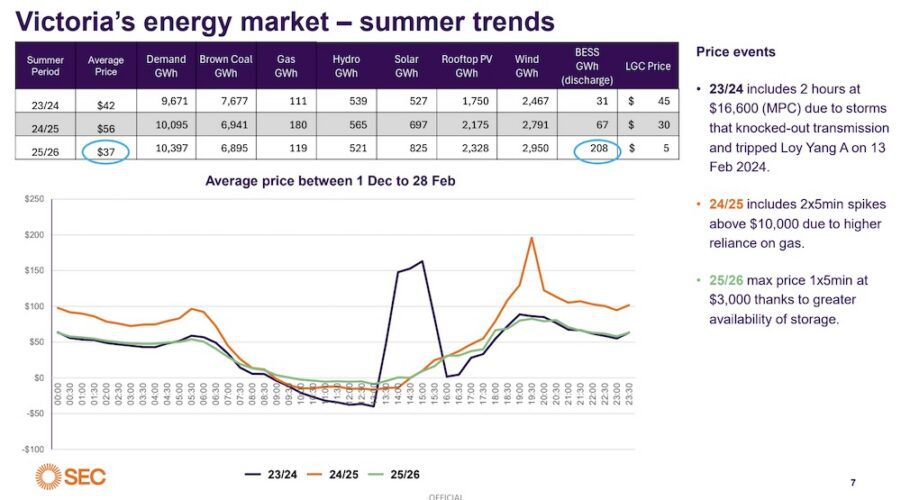
“The average price at $37 per megawatt-hour is the lowest average price in the last three summer periods, and you’ll see …on the supply side, a big uptick in the contribution of BESS, and … a downturn in the contribution of gas over summer. So utilities-scale batteries are … playing a role and performing the services that gas have historically provided during those peak periods.”
From wind turbines to induction cooktops and electric hot water
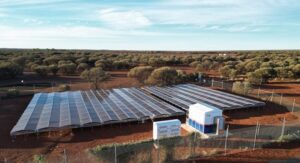
Beyond the MREH, the SEC is currently co-developing the Renewable Energy Park in Horsham, which is being built in two stages, starting with a 119 MW solar farm and then adding a 100 MW, two-hour battery energy storage system (BESS).
And the SEC is also working with OSMI Australia on the Delburn Wind Farm, a 205 MW project that, once complete with be Victoria’s first 100% publicly owned, utility-scale wind farm, south of the Latrobe Valley in Gippsland.
Miller says more onshore wind is also on the utility’s investment horizon.
“In terms of our longer term focus now at SEC… we’re looking at what the system needs to support a smooth, reliable transition, and what that is telling us right now is that there is a need to support more [onshore] wind to come into the system,” Miller told Renew Economy.
“It’s no secret that wind is challenging at the moment, but as a government-owned company that takes a long-term view of the market – and risk and the role of our capital – we want to support more wind to come in, so that is a particular area of focus for our investment team at the moment.”
On the consumer front, the SEC is working to help drive the state’s push to get gas out of homes and businesses with a new website called Easy Electric that guides consumers through the process of electrifying, from appliance to finance to installer.
“What we’re trying to do with the [Easy Electric] platform is lower some of the barriers that exist for consumers that are wanting to electrify,” Miller tells this week’s Solar Insiders podcast.
“So we had actually conducted a number of pilots and research exercises over the preceding 18 months to understand what was stopping consumers, what was holding them back, and those pilots told us there were really four things that were holding people back.
“There is low awareness of electrification and the benefits that can bring. There is a perception that it’s very complex and time consuming to change appliances from gas to electric. There’s low low trust in the system; consumers struggle to know who to trust in the energy market. And then finally, there’s the issue of costs.
“We took all of those insights into account in designing our Easy Electric platform, and very simply, what it’s trying to do is bring together, in one place, all the information, support, and services that a household might need to determine how to go electric; where to start, the savings they might enjoy by switching their appliances, and … the rebates that are available through the various government schemes.
“It’ll give them a view or an estimate of upfront costs, and if they’re willing to take the next step and execute, then it will connect them through to an SEC endorsed installer who can then go and install those appliances.”
If you would like to join more than 29,000 others and get the latest clean energy news delivered straight to your inbox, for free, please click here to subscribe to our free daily newsletter.