Australia’s energy companies are stepping up modernisation of plant to shore up cybersecurity, but also because they anticipate using more of it for longer, as wait times for large new equipment lengthen, according to Aaron Trueman, local head of ABB’s energy industries division.
A new synchronous condenser, for instance, can take as much as five years “from date of order to the date you get it,” with more time required to install balance-of-plant, Trueman told Renew Economy in an interview. Delivery of new gas turbines can take as long as eight years.
One response to delivery delays – and a slower than expected build-out of new generation capacity – has been for companies to seek to modernise existing assets. Trueman cited as an example the redeployment of gas turbines in remote mine sites in the Pilbara that may be decades old to other parts of Australia.
“You don’t necessarily have to buy new to increase your capacity,” he said. “You can actually shift existing assets and change your energy mix in order to meet the demand.”
The issue of how many of the expensive synchronous condensers the grid needs as coal plants exit is a contentious one.
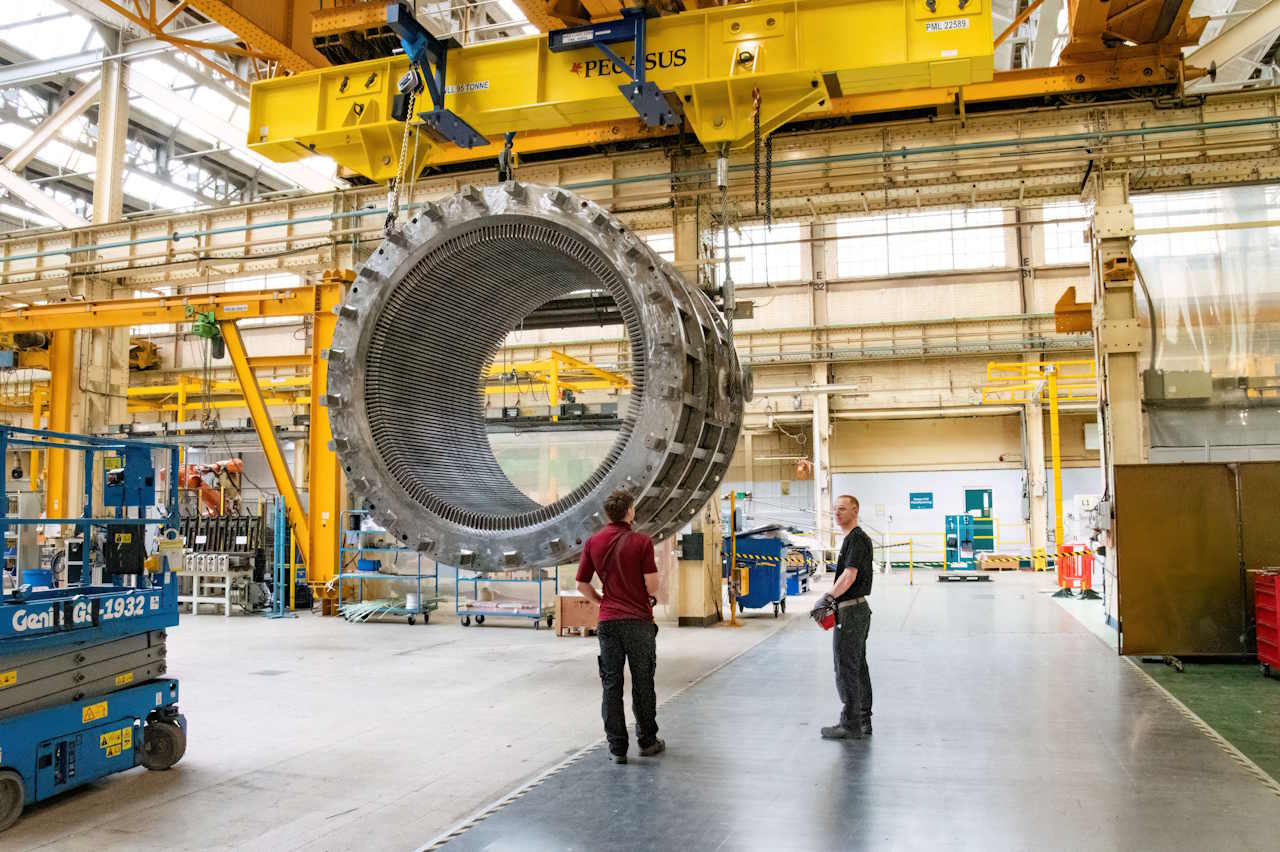
ABB this week held a roundtable of energy leaders to discuss energy resilience, with digitalisation of existing plant among the main topics of interest. The motors’ spinning shafts can provide the grid with voltage stability and other services that may not be available for other sources, such as grid-forming inverters attached to big batteries.
The Australian Energy Market Operator has two editions of its Transition Plan for System Security, with a third iteration expected before the end of the year.
In its 2025 edition, AEMO noted, for instance, that Transgrid has working on system strength requirements since 2021 to enable the planned retirement of Origin Energy’s Eraring Power Station. (Origin’s chief executive Frank Calabria said on Wednesday the company is sticking with its April 2029 closure date for the plant.)
“The decommitment of Eraring before these synchronous condensers are operational would result in the activation of Transgrid system security contracts (where available),” AEMO’s 2025 TPSS report states.
“If security contracts are unavailable, operational intervention may be required by AEMO up to 30% of the time, at significant cost to consumers, to avoid potential consequences of greater severity,” it said.
“Furthermore, without these synchronous condensers the NSW power system could face periods where there may not be enough large synchronous units available for AEMO to direct online for system strength, creating a plausible risk of last-resort operational actions.”
ABB’s recent work in Australia includes completing the control system modernisation at Engie’s Pelican Point Power Station in South Australia.
That project included upgrading ageing controllers to strengthen cyber security, improving real-time monitoring and extending the asset’s life, the company said.
Such improvements could “move the needle” on the efficiency of operating existing plant, perhaps lifting performance by a few percentage points, Trueman said.
While the Coalition at a federal and state level were talking up a plan to “sweat” fossil-fuel assets, the process was already happening.
“It doesn’t matter whether it’s a government change or not, we just haven’t built enough [and] there’s not enough in the pipeline,” Trueman said.
“[N]o one spends, you know, millions of dollars on modernising an asset when it’s only going to be there for two years,” he said. “They’re saying, ‘Hey, this is going to be another 10 years before we have to think about the next life-extension.”