Melbourne-based developer Mint Renewables is pitching a very large solar and battery complex with what could be a very high level of difficulty: there are 116 houses, not including the landowner hosts, within 4km of the project.
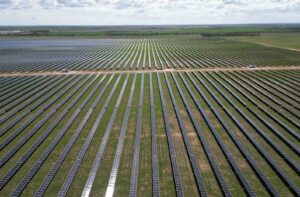
The Magpie Hill solar project, a 375 megawatts (MW) and a 375 MW, eight-hour battery, is seeking federal environmental approval to sit just north of Canberra.
Mint has signed with two landowners to use 59 different lots over 735 hectares, the scoping documents show, and the start of operations is pencilled in for 2030.
Since announcing the start of community consultation in February, the project has attracted some criticism.
Nina Dillon, the Mayor of Goulburn Mulwaree Council, expressed her dismay over the project in August on Facebook, bringing up issues around fire risks and calling it an eyesore.
Major industrial projects are not unknown in the valley and wider area, however.
Iberdrola’s 48 MW Woodlawn and 148 MW Capital wind farms are less than 2km away, as are the planned expansions of both, the scoping documents say.
Quarries dot the area, and plans are afoot for other solar and wind projects within a 30 km radius.
Mint is hoping to tap Transgrid’s 330 kilovolt (kV) transmission line that runs past the site.
It’s also still pondering how to configure the battery, be it an AC or DC connection.
“In an AC‑coupled configuration… This arrangement allows both systems to use the same substation and grid‑connection infrastructure, which can reduce costs by avoiding duplication of major electrical equipment,” the scoping documents say.
“In a DC‑coupled configuration, the BESS units are spread across the Solar/BESS Area rather than grouped in one location.
“Each BESS unit is installed close to the PV panels and shares the same power‑conditioning equipment that the PV panels use. BESS in a DC-coupled configuration can be charged directly from the PV panels without converting the energy to AC first. This reduces energy losses and allows the BESS to capture energy more efficiently.
“DC coupling can also reduce costs by allowing the PV panels and BESS to share more electrical equipment, rather than requiring separate sets for each system.”
Planning processes mould developments into their final shape, but the Magpie Hill project has already undergone some changes.
The planning documents show that a 100m exclusion buffer has been added around the Mulwaree river, about 15 hectares in the northeast corner has been carved off after a critically endangered ecological community was found, 30m buffers were added around black gums, and the battery moved north away from residences.
Two threatened birds were seen on site, the flame robin and scarlet robin, and a little whip snake according to the EPBC referral.
But as many as 75 federally protected species are known to be in the area, including the golden sun moth.
To join more than 29,000 others and get the latest clean energy news delivered straight to your inbox, for free, click here to subscribe to our free daily newsletter.