Transmission company Transgrid has presented a $1.19 billion bill for the installation of 10 giant spinning machines – known as synchronous condensers – that were fast-tracked to help protect the “heartbeat” of the country’s biggest state grid.
Transgrid says the total cost for the 10 syncons – to be supplied by US energy giant GE Vernova – is more than double original estimates made four years ago (before the company went to market), and just above the top of end of its most recent regulatory filings last year.
The company has filed the latest estimate for approval by the Australian Energy Regulator, having been granted an unusual exemption last year by the NSW state government to go ahead with the purchase without getting prior regulatory pricing approval.
Transgrid says the increased costs reflect the “continued escalation of supply constraints for this equipment” as power systems worldwide transition away from coal to renewable energy.
Indeed, it was the fear of future price hikes and delivery delays that prompted the NSW government to grant special dispensation. Transgrid says the will would have been significantly higher without the fast-track, which it says shaved two years off the delivery schedule.
The syncons – machines that spin but do not burn fuel – are considered essential to replicate and replace the so-called “system strength” services that have traditionally been provided by coal and other synchronous generators, and allow the grid to reach periods of 100 per cent “instantaneous” renewables.
As coal plants retire, the syncons – along with grid-forming inverters that are now commonplace in utility-scale battery projects – will provide that system strength, also described as the “heartbeat” of the grid.
Battery technology developers argue that grid forming inverters can provide the whole suite of the necessary system strength services, and at a fraction of the cost of the syncons, because – like coal generators – it is part of what they do.
But the country’s big transmission companies – who are responsible for maintaining system strength – and the Australian Energy Market Operator are yet to be convinced that grid forming inverters are ready, and want to conduct more trials to ensure that the full suite can be delivered.
So Transgrid, like others, is currently seeking a mix of syncons and battery inverters, and dozens of syncons are being planned for grids around the country, at a cost of several billion dollars. Hitachi recently won a contract for four such spinning machines in Queensland.
Transgrid is also in the process of negotiating contracts with the owners of nine short listed grid-forming battery projects to provide up to 2GW of system strength services to the NSW.
Transgrid’s head of network Jason Krstanoski says that the company is targeting 5GW of stabilising services from third-party owned batteries to complement syncons by 2033.
“Our System Strength Plan is designed to keep the ‘heartbeat’ of the grid strong at the lowest possible cost for consumers,” Krstanoski said in a statement.
“Our mix of cost-effective solutions will help avoid the need to increasingly rely on costly stop-gap measures to provide system strength.”
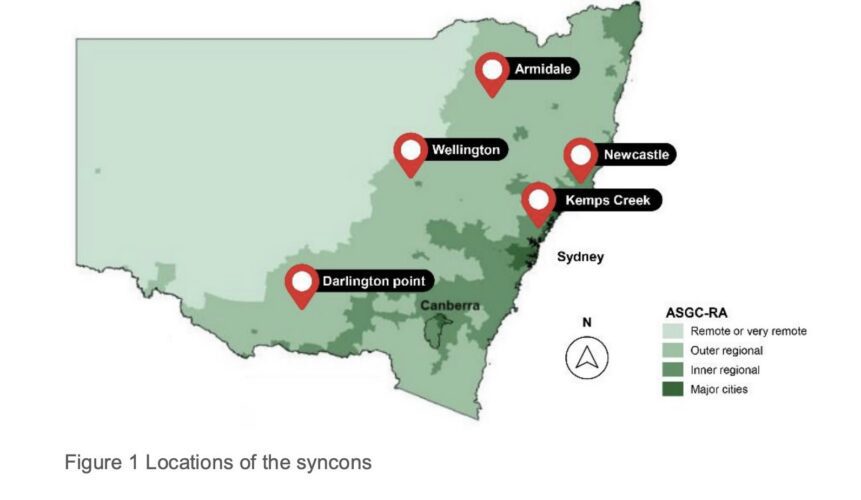
The 10 syncons will be installed across 5 sites: Newcastle, Kemps Creek, Armidale, Wellington and Darlington Point.
Transrid wants to recover $400 million over the five years to 2031 to offset the cost, and argues that the bill impact will be about $5.47 per year for residential households and $12.21 per year for small businesses over the Regulatory Period, in nominal dollars.
If you would like to join more than 29,000 others and get the latest clean energy news delivered straight to your inbox, for free, please click here to subscribe to our free daily newsletter.