It is always hard to digest the release of Ember’s annual ‘Global Electricity Review’ (GER) report. This year’s edition highlights the continued rise of renewable energy, paired with an unexpected rise in demand.
While emissions rose, that rate of growth has been slowing globally, and Ember projects all new demand will soon be met by clean energy.
Importantly, the report contains a variety of nuggets that are relevant to the election debate in Australia – particularly as a timely update on the hotly debated mix of energy technologies featuring in press releases and social media, and in the lead-up to a debate between Chris Bowen and Ted O’Brien.
Globally, gas-fired power generation – a centrepiece of the Coalition’s energy policy – has seen a five year decline in its share of total generation (due to rising overall demand, the absolute amount of gas is going up).
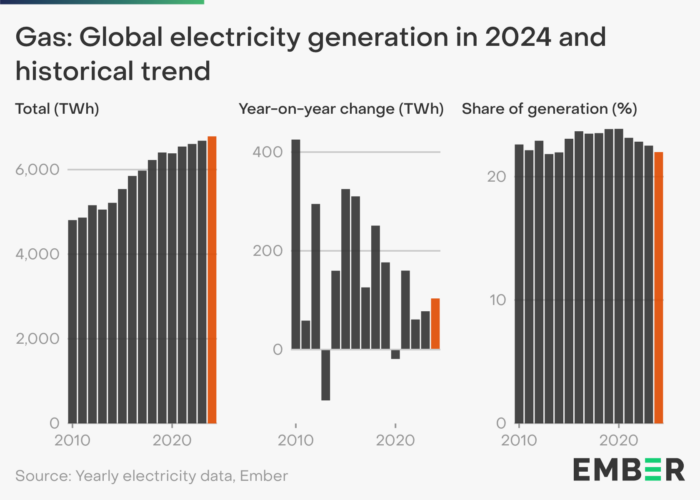
Ember’s report shows that most of the gas growth comes from regions with lower wind and solar growth, such as the US, Brazil and Korea.
“Gas generation fell in the UK (-14 TWh), Spain (-12 TWh) and France (-11 TWh) as wind and solar generation continued to expand. Across the EU, gas generation was down by 26 TWh, falling for the fifth year in a row”. Europe is stark example of how high wind and solar growth leads to far less gas, rather than needed more gas:

The global nuclear industry has also seen a rise in absolute power generation as well – but like gas, its share of total global power generation is decreasing every year. Importantly, you can see how wind, solar and hydro have been steadily rising for a long time now – but nuclear has fluctuated around a steady state:
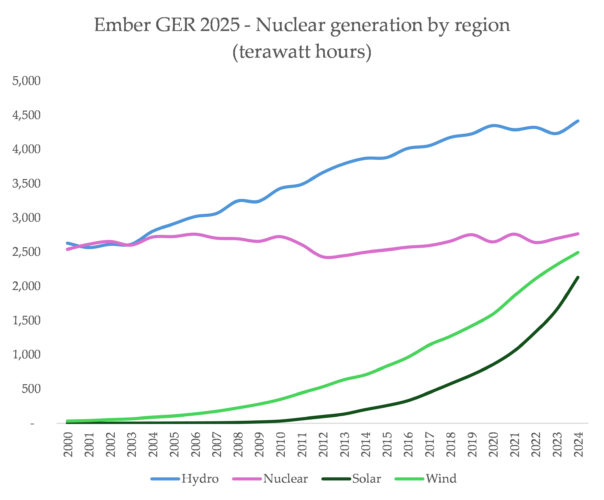
There has been some growth in nuclear power over the past decade – largely concentrated in Asia. But there has also been a decline in nuclear power in other regions, like Europe.
The net result is that nuclear power has contributed very little to any new push to displace fossil fuels, as it maintains its global levels. The graphic below shows the change in generation each year from a 2000 base year.

The simple realities of the energy transition escape the Coalition – and resultingly, they’re proposing a blatantly destructive pathway for the near future and taking that to the election.
But there are deeper lessens in the GER, too. Ember’s report explores various components of growing global power demand – AI, crypto mining, fossil-fuel-intensified heatwaves and electrification.
These things create an effect where you can have significant rising new clean power output but either stagnant or rising greenhouse gas emissions, too.
“Australia’s joint share of wind and solar (29%) is almost double the global average (15%), though it remains below peers like the United Kingdom (36%) and Spain (43%)”, Ember wrote.
But they also pointed out that “Australia relied on fossil fuels for 65% of its electricity in 2024, with 46% coming from coal … Australia’s emissions per capita were three times the global average and the second-highest in the G20. Fossil generation increased by 1.5% in 2024 after six consecutive years of decline, due to an unusual combination of increased demand and lower-than-average wind and hydro output due to weather conditions”.
Per capita, Australia has the second highest level of coal consumption in the world, for 2024.
It is stark – roughly half of new clean generation in Australia has gone towards cutting down on fossil fuels, but the other half has been tasked with meeting rising power demand:

The Ember GER also shows that there has been a global deceleration of wind power growth, consistently for four straight years now. That is also a trend that is reflected in Australia:

These are wobbles in what is overall a positive picture for clean power in Australia and around the world. But it definitely feels, geopolitically, like the right time to be paying close attention to wobbles.
Australia saw its lowest amount of added wind since 2017, and its lowest added solar since 2018. To be solidly and sustainably on track to 82% clean power by 2030, this should have been pre-empted and avoided.
Yes – the Coalition’s policies are verging on absurd. But Labor should be going to this election ready to explain how they’re going to rise to this moment. Buried in the data are enough signs that we should, at the very least, demand an answer.