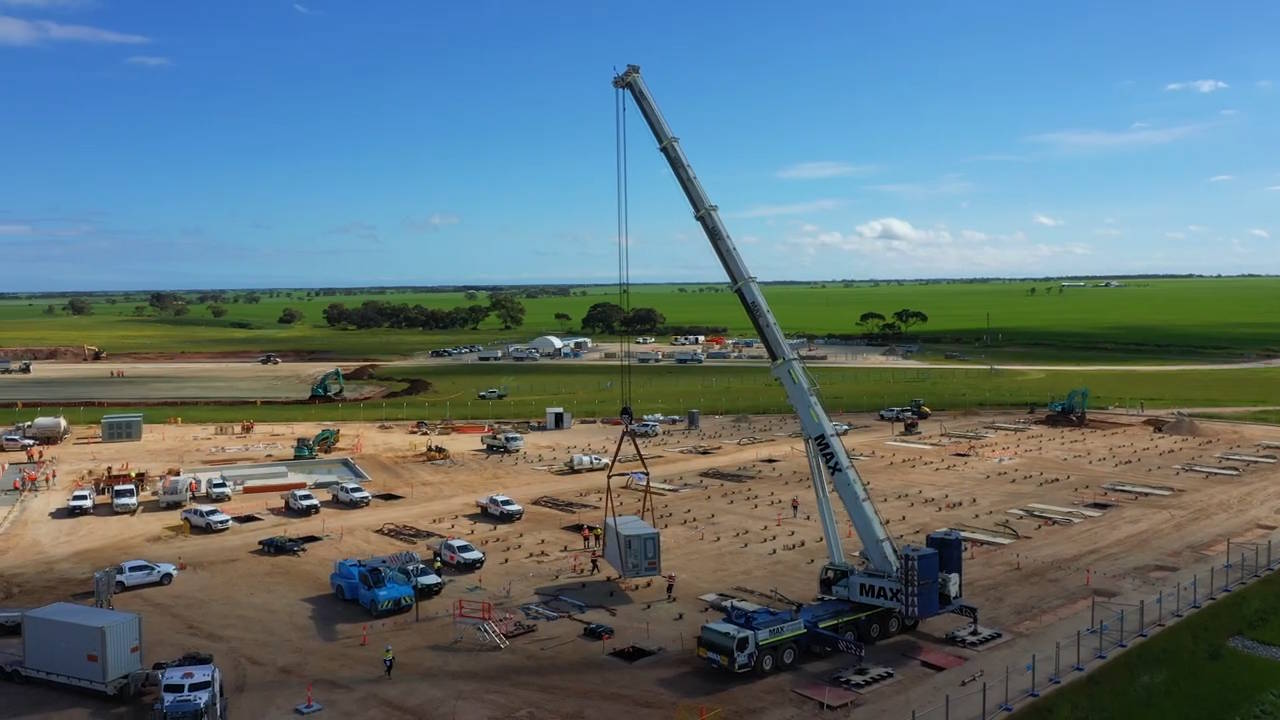
Construction on the mammoth four-hour 250-megawatt (MW) Reeves Plains Battery project in South Australia – which will be the biggest storage project in the state when completed – has reached another significant milestone with the arrival of the first battery units.
Alinta Energy, which is developing the Reeves Plains battery energy storage system (BESS), announced on Wednesday that the first 48 of 194 battery units had begun arriving on site over the past week, with the remaining units and inverters due to be delivered in coming month.
The battery units and inverters are being supplied by battery manufacturer CATL and inverter supplier Power Electronics. West Australian construction group GenusPlus is delivering the project as EPC contractor.
“The arrival of the first battery units and inverters is a significant moment for the project and brings us one step closer to delivering a 250MW battery with up to four hours of storage for South Australia,” said Ken Woolley, executive director generation and development at Alinta Energy.
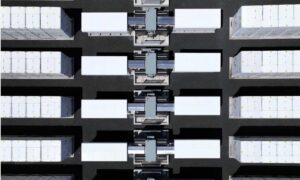
“The sheer scale of the project is impressive. Once installed, the battery and inverter units will span an area that’s three times the size of the Adelaide Oval.
Initial works on the 250 MW/1,000 megawatt-hours (MWh) project got underway in mid-2025 ahead of official construction starting earlier this year.
A second stage is already in the feasibility phase ahead of a final investment decision expected to be taken later this year. If approved, the second stage would double the project’s capacity, creating a 500 MW/2,000 MWh battery behemoth.
Once complete, even the first stage on its own will be the largest battery in South Australia, marking the state’s first giga-scale battery project, despite having the highest share of renewables at an average 75 per cent wind and solar over the last 12 months, and a target of 100 per cent net renewables to be reached by the end of next year.
However, it still falls short in terms of size compared to other behemoths around the country, such as the two bigger projects in Collie, Western Australia, and the recently completed Waratah Super Battery, a two-hour 850 MW/1,680 MWh project that has been contracted to play a key role as a kind of giant “shock absorber” to the grid.
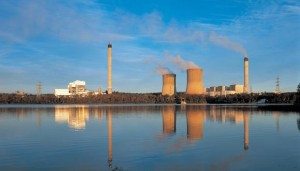
Even bigger batteries are in various stages of construction, such as the 700 MW/3,180 MWh Eraring battery, in New South Wales, that is being built over four stages adjacent to the Australia’s largest coal generator, the 2.88 GW Eraring power station, which is expected to shutter in late 2027 but could keep one or two units open through to early 2029.
Eraring will be in competition for the title of Australia’s biggest battery with the 780 MW/3,073 MWh Supernode BESS in Queensland.
The second stage of the Supernode BESS commenced operations earlier this year at the same time that financial close was reached for the third stage. However, there are plans currently in the works to add an additional fourth stage which would increase capacity by 250 MW/2,000 MWh.
If you would like to join more than 29,000 others and get the latest clean energy news delivered straight to your inbox, for free, you can click here to subscribe to our free daily newsletter.