The federal government’s green bank will underwrite a contentious Tasmania transmission project considered crucial to the connection of the huge Marinus Link subsea interconnector, in a move it says will deliver the major grid upgrade at “significantly lower cost to consumers.”
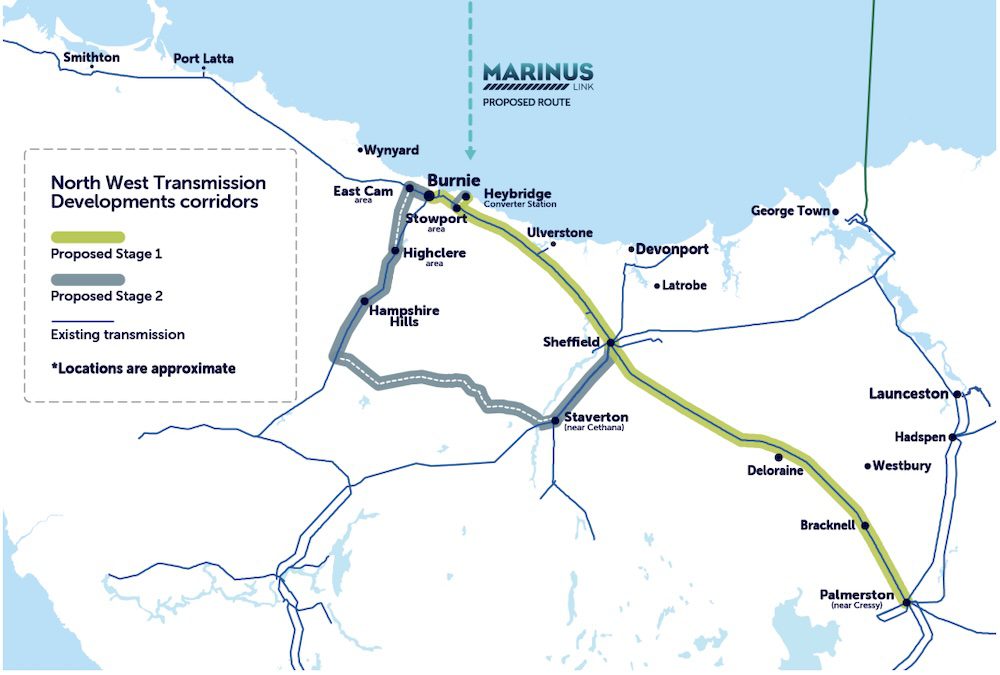
The Clean Energy Finance Corporation said on Friday that it has committed $1.2 billion from the Rewiring the Nation Fund to help TasNetworks deliver stage one of the North West Transmission Developments (NWTD) project – covering almost all of the around $1.3 billion cost of the project.
The NWTD has been a contentious part of Marinus Link – itself the subject of significant opposition in Tasmania – for its impact on the surrounding community and remnant forests in the Heybridge and Cam River Valley.
Stage one of the project runs from Palmerston (near Cressy) to Burnie/Heybridge – where the Marinus Link subsea cable makes landfall on the Tasmanian coast – and involves upgrading up to 130 km of transmission lines and substations.
The project’s state approval in March was slammed by the Bob Brown Foundation for “[upsetting] farmers and completely [dismissing] impacts on public and low-income housing residents, while sacrificing wildlife rich forest without a second thought.”
But the news of the low-cost, long-term finance from the CEFC will at least take some heat out of the economic criticisms of the project, which in essence argue that it will push up the cost of electricity for Tasmanians with little tangible benefit in return.
According to the CEFC, the federal green loan combined with TasNetworks’ lower-returning equity, is forecast to reduce network charges paid by consumers for the project by around 55 per cent over the life of the project, compared with standard regulatory settings.
“This equates to an estimated $315 million in benefits to Tasmanian electricity consumers in the first five years of operation,” the green bank says.
“Linking Tasmania’s hydro resources with mainland demand helps move renewable energy where it’s needed most, boosting grid reliability and supporting the clean energy transition, and contributes to strengthening system resilience and supports reliable supply across the national market,” says CEFC chief Ian Learmonth.
TasNetworks chair, Roger Gill, says the CEFC finance is fundamental to delivering the project in a way that wouldn’t have been possible through commercial financing, alone.
“Their investment provides a prudent funding structure that supports long-term network investment in the state while protecting customers from increased cost pressures,” Gill said.
The CEFC commitment to the TasNetworks project follows the record multi-billion dollar commitment of up to $3.8 billion in concessional finance to support the delivery of Marinus Link – the green bank’s biggest investment, yet, which brought the 750 $5 billion, 750 megawatt (MW) first stage of the project to financial close.
If you would like to join more than 29,000 others and get the latest clean energy news delivered straight to your inbox, for free, please click here to subscribe to our free daily newsletter.